Showing posts with label running. Show all posts

Thursday, 26 August 2021

The Facts About Fat Burning and Running

Fitness 


Sorry, but there’s no workout “zone” that will magically melt your fat stores.

 Runners World


Photo by Unsplash on Unsplash

If you’re reading this while sitting down, congratulations—you’re primarily burning fat. However, if you get up and start moving around your home, you won’t burn as much fat. And if you felt really active and broke into a sprint outside, you’ll be burning almost no fat.

While everything we just said is true, it doesn’t mean all you have to do is sit tight and watch your fat stores melt away. The common presentation of how to exercise to lose fat—presented in admittedly exaggerated form above—is misleading.

There’s no special “fat-burning zone” that’s key to getting lean. Here’s what you need to know about burning fat through exercise.


What Fuels Your Running?

Look at wall charts or cardio equipment in the gym, or listen to many personal trainers, and you’ll encounter the fat-burning zone. The standard advice for getting in this zone is to work out at about 60 percent of your maximum heart rate.

That level of exertion is relatively low-intensity. Runners can usually talk in complete sentences at this effort, which is an easy pace like you might run the day before a race or the day after a hard interval workout. Working in this zone, it’s said, will burn more fat, and therefore result in greater long-term weight loss, than doing the same exercise at higher intensities.

On the surface, there’s some substance to part of this claim, according to decades of research. At all times, your body fuels itself primarily by burning a mix of fat and glycogen (the stored form of carbohydrate in your muscles). The less active you are at a given moment, the greater the percentage of that fuel mix comes from fat. At rest, fat constitutes as much as 85 percent of calories burned. That figure shifts to about 70 percent at an easy walking pace. If you transition to a moderate-effort run, the mix becomes about 50 percent fat and 50 percent carbohydrate, and moves increasingly toward carbohydrate the faster you go.

One reason your body goes through this shift is because your brain runs almost entirely on carbohydrates, and it wants to preserve its limited carbohydrate stores. Although burning fat requires a lot more oxygen than does burning carbohydrate, there’s plenty of oxygen available when you’re at rest or working at a low intensity. As you start exercising harder, however, your body needs fuel more quickly, and turns more to carbohydrates.

This change in the fuel-burned ratio is why you might hit “The Wall” when trying to run a marathon as fast as possible, but you might not during an ultramarathon. A marathon run at faster than your normal training pace can use up all of the glycogen stored in your muscles. When that happens—usually in the final 10K—your muscles turn to fat to fuel your stubborn insistence on reaching the finish line. But burning fat requires a lot more oxygen than burning carbohydrate, so to meet that demand for more oxygen, you have to slow considerably, usually by a minute per mile or more.

In contrast, if you’ve ever run an ultramarathon, it was likely at a much lower intensity, probably slower than your normal easy pace. The percentage of each mile that’s fueled by fat is higher than at the faster pace of racing a marathon. So even though you might be running longer in an ultra, you’re less likely to have that sensation of having to suddenly slow significantly because of depleted glycogen stores. Even the leanest runners have enough body fat to fuel hundreds of miles at a leisurely pace.


There’s Burning Fat, and There’s Losing Weight

So, it’s true that at some workout intensities you’re burning a higher percentage of fat than at other intensities. But running a certain pace so that you burn a higher percentage of fat doesn’t magically melt fat away. And even if it did, the difference in total fat burned in running three miles slowly and doing the same distance faster is perhaps a couple dozen calories. That’s negligible in the grand scheme of things, given that burning a pound of fat entails burning about 3,500 calories.

More important, as Asker Jeukendrup, Ph.D., a leading sport nutrition researcher, puts it, fat burning and weight loss aren’t synonymous. Weight control is a matter of calories in and calories out. Burn more calories than you consume, and you’ll eventually lose weight. Do the opposite, and you’ll eventually gain weight. “If you burn more fat, but you eat more calories than the calories you burn in total, you will not lose weight,” Jeukendrup has written.

Because total calories burned is what matters, perhaps you can see another flaw with the “fat-burning zone” line of thinking: You could spend an hour walking three miles; of the roughly 300 calories you’d burn, a higher percentage would be from fat than if you ran three miles. But in that hour, you might run six miles, burning about twice as many calories.

Photo by Staff

If you want to get all geeky, the math in the following example (and in the graphic) argues against the fat-burning zone.

Walk three miles in an hour, and of the roughly 300 calories you’ll burn, about 210 of them (70 percent) will be fueled by fat. Run 10-minute miles for that hour, and of the roughly 600 calories you’ll burn, about 300 (50 percent) of them will be fueled by fat. Also, your metabolism stays revved up longer after vigorous workouts than it does after low-intensity exercise. While this postrun burn is likely only a few dozen additional calories, or less than the amount in a banana, every bit helps if weight loss is one of your goals.


The Real Reason to Consider Fat Burning as a Runner

Running at the gentle effort of around 60 percent of your maximum heart rate isn’t the key to weight loss, but there are still many reasons to regularly run at this pace.

Easy runs help you recover before and after harder workouts, they provide great cardiovascular and mental health benefits, and they’re simply enjoyable. Easy running also allows you to accumulate lots of mileage, and thereby burn more calories, if doing so is one of your motivations to run.

As for fat burning and running, perhaps the most important reason to care about the topic has to do with training performance, not weight loss. As we noted above, at sustained higher-effort levels, such as half marathon to marathon pace, your running is fueled by a higher percentage of carbohydrates than at slower paces. Run far enough at these paces, and you’ll start to deplete your muscle’s glycogen stores, and you’ll have to slow.

One of the main goals of marathon training is to become more efficient at burning fat when running these faster paces. If you can train your muscles to burn a little more fat per mile when running at marathon pace, then your glycogen stores will last longer, and your chances of holding a strong pace to the finish will increase.

The best way to accomplish that is by running not at a gentle jog, but at close to your marathon pace, with wiggle room of about 5 percent per mile faster or slower. For example, if your marathon race pace is 8:00 per mile, then run between roughly 7:36 and 8:24 per mile.

You can do these runs as stand-alone workouts, such as 6 to 10 miles at marathon pace after a 1- or 2-mile warm-up. You can also incorporate them into the latter part of your long runs, such as running easy for an hour and then running another hour at around marathon pace. When done a few times a month, sustained runs at these effort levels will improve your muscle’s fat-burning efficiency.

Starting some medium-length to long runs on an empty stomach, such as soon after waking up, and taking in no fuel during those runs, can also train your body to burn more fat at a given pace. It’s best to save these “fasted” runs for easy to medium-effort sessions. (Learn more about the good and bad of fasted cardio workouts here.)

All of this might seem like a lot to remember about fat burning. The key takeaway: Ignore claims you’ll lose more weight by running in a special “fat-burning zone.” Follow a good training plan, eat a well-balanced diet, and stay healthy enough to run the amount you want to, and you’ll likely settle at what for you is a good running weight.


Wednesday, 21 April 2021

How I Tricked Myself Into Liking Running

Running 


 It’s good for your mental and physical health, and doesn’t require any equipment. So why does it seem so hard to get started?


Until last week, the only time I’d finished a race was during Track and Field Day in fifth grade. By middle school, I was trying to figure out how to get out of gym class because it was too hard for me to run a mile. Sports, in general, were not my thing. Running, less so.

As an adult, I have gone to the gyms, taken exercise classes and worked with trainers. But none of it ever brought me joy, or made me want to keep doing such things. The most sustained exercise I did in the past decade was a regimen of deep knee bends with a colicky baby in my arms after my first kid was born.

Then lockdowns came along, and I surprised everyone in my house, especially myself, by signing up to join a local running group which had moved from holding local meetups to checking in with each other virtually. Because it was exercise I could do alone, the conditions were ideal.

But for a newcomer to running, the notion that you can just throw on a pair of sneakers and hit the road turns out to be a big, fat lie, I assume created by people who started running after giving up soccer or basketball.

Continue reading the main story

Every time, I have to push myself to run that horrible first minute. I get breathless. Muscles I didn’t know I had now ache like I never thought possible. I feel self-conscious when a neighbor spots me bouncing down the street. And yet, I stick with it. I can now run 20 minutes in a row, and they are not

Here were a few of the things I learned that have helped me to get out the door — and keep going even when I would much rather stop for an infusion of iced coffee.

If you are the type who smirks at inspirational quotations on Instagram, set aside that part of your brain for the entirety of a run. I now understand why fitness instructors are so often relentlessly earnest. You need positive messages to get through the hard parts of working out.

Try a simple thought exercise recommended by Coffey, a filmmaker and the founder of DeFine New York Run Club. Ask yourself, “What’s my why?” and “What’s my purpose?” Coffey’s “why” was to get in shape; his purpose was to be able to keep up with his three young children. “I want to be energized when they want to play,” he said. “I don’t want to be the parent who says ‘I can’t.’”

To invite such positivity into my own cold dark heart, I take the outdoor running classes in the Peloton app, which is less expensive than their stationary bikes or treadmills. For 20 to 60 minutes I get an instructor in my ear keeping me going, playing his or her favorite music and sharing running tips or suggesting when to walk.


Sunday, 31 January 2021

I Kept a Walking Streak for a Full Year — and Discovered 7 Surprising Benefits Along the Way

Walking 


 Click the link above for the full article:

Tuesday, 1 September 2020

How Treadmill Running Differs from Running Outside

Running


Yes, the physiology and biomechanics of treadmill running are a little different. But how you feel about it is probably more important.

Outside

runners-in-san-fran_h.jpg

Should you run inside or outside? Photo by Scott Markewitz / Gallery Stock.
The second-biggest question about treadmills (besides whether an airplane could take off from one) is how well they approximate the experience of running outdoors. Some runners swear it’s easier to click off the miles on a moving rubber belt, for reasons including the lack of air resistance and the somewhat bizarre idea that you can just hop up and down while the belt whizzes by underneath you. Others, equally adamant, claim that treadmill miles are actually harder, perhaps because they’re stabbing themselves in the face with a fork to relieve the boredom. 

A systematic review published in 2019 in the journal Sports Medicine, from an international team of researchers led by Joel Fuller of Macquarie University in Australia, tries to resolve the debate by pooling the results of 34 different studies with a total of 468 participants in which treadmill and what researchers call “overground” running were compared. The bird’s-eye view of the results is that running is running. There’s no secret trick to treadmill running that allows you to spend half the energy you’d spend at the same pace outdoors—and if it feels like that’s the case, it probably means that your treadmill belt is miscalibrated (which is not at all uncommon). 

But when you zoom in, the picture is a little more complicated. The good news is that during typical running at a moderate effort, heart rate, oxygen uptake (which is a proxy for how much energy you’re burning), and perceived effort are all pretty similar on the treadmill and overground. (Lactate levels, in contrast, were a little lower on the treadmill, but that finding was based on a smaller number of studies and is a more error-prone measurement, so I’d treat it with caution.) 

The more interesting detail is that preferred running speed—that is, the speed that people choose when you simply tell them to run at a self-selected pace—was lower on the treadmill. This may simply reflect the fact that most people are less familiar with treadmill running and are a bit cautious about the risk of falling off or getting thrown off the back. One of the weaknesses of the studies in the review, the authors point out, is that very few assessed how much treadmill experience their subjects had. It’s possible that treadmill vets would have no difference in their natural preferred pace indoors or out. 

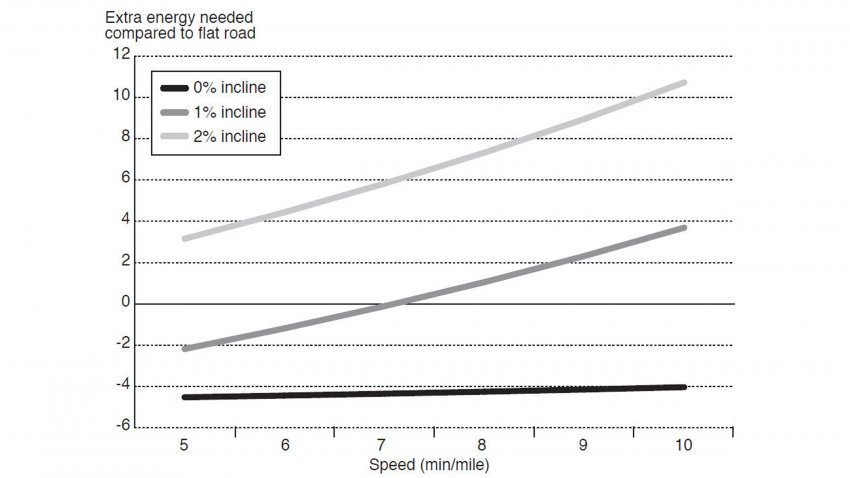
The most obvious difference between treadmill and outdoor running is the lack of air resistance. Back in 1996, Andy Jones and Jonathan Doust published a paper that compared the oxygen (i.e. energy) consumption of running outdoors or on a treadmill at various inclines. Running on a flat treadmill burned about 4 percent less energy, but that difference could be eliminated by setting the treadmill incline to 1 percent. Since then, many treadmill studies have used a 1 percent grade by default: that study has been cited more than 600 times. 

One problem with this approach is that air resistance depends on how fast you’re going. If you’re running really fast, air resistance takes a bigger toll—which means that really fast treadmill running is artificially easy by a larger amount. Conversely, when you’re running really slowly, air resistance is almost irrelevant. The 1 percent correction is best for speeds around 7:00 per mile; if you’re running at 9:00 per mile, you’d be better off with 0.5 percent. 

Here’s a graph from my 2011 book, Which Comes First, Cardio or Weights?, that shows the energy advantage (or disadvantage), in percent, of treadmill running at different speeds and inclines, based on Jones and Doust’s data:
treadmill_h.jpg
Credit: Trish McAlaster.
For the most part, the new data on energy consumption lines up with this picture: the faster you go, the bigger the advantage the treadmill gives you. But surprisingly, the picture changes when you look at heart rate and perceived effort. Both of those were higher on the treadmill at faster (but not all-out) speeds, compared to running overground.

On the surface, that makes no sense: less air resistance means you burn less energy at fast treadmill speeds, so why should heart rate and effort be higher? The answer to this riddle may once again come down to comfort, the authors suggest. It can be a little scary to really hammer at fast speeds on a treadmill: despite lower energy consumption, “the lack of comfort with higher-speed treadmill running might cause greater increases in [heart rate] and perceived effort due to feelings of anxiety about falling,” they write. It’s also possible that the lack of air resistance becomes a liability when you’re really working hard, because you don’t have moving air to cool you down.

There’s a similar disconnect when you look at maximal and near-maximal treadmill running. In this case, the max values of energy consumption (i.e. VO2max) and heart rate are pretty much the same on a treadmill or overground. But actual performance—how fast you go in a time trial or how long you last in a time-to-exhaustion test—is worse on a treadmill. Again, it probably comes down to familiarity and comfort rather than subtle differences in physiological variables.

When you put all this together, the sense I’m left with is that the biggest differences between treadmill and outdoor running aren’t in how you run, but rather in how you respond to the experience. It’s probably true that people run slightly differently on treadmills: when you look in detail at the biomechanics, you find subtle differences in things like knee angles and peak ground forces, but the overall pattern (as one such study concluded) is that the two movements are close enough that you don’t have to worry about the differences—as long as the belt is properly calibrated and not too soft.
So if you want to run on the treadmill, be my guest. It’s not my cup of tea, but there are plenty of great runners who’ve sworn by it. My favorite example is probably Christine Clark, the treadmill-trained Alaskan who emerged from the boreal winter to win the 2000 Olympic Marathon Trials in South Carolina. If you do, don’t worry too much about whether a 7:00 treadmill mile equates to a 6:55 or a 7:05 outside. Just run, get suitably tired, and repeat. The pace, when you get back outside, will take care of itself.

Alex Hutchinson is the author of Endure: Mind, Body, and the Curiously Elastic Limits of Human Performance, with a foreword by Malcolm Gladwell. Find him on Twitter and Facebook.

Tuesday, 18 August 2020

12 Fitness Experts Share How They’re Keeping up With Exercise While Staying at Home

Exercise


So it’s been about five or six months spent at home (wow, 2020 has flown by! #not) and there’s no end in sight. Back in March, I literally had no idea how to keep up with exercise when my trendy yoga studios and beloved barre classes closed. I could no longer depend on $20 cancellation fees and the promise of lavender towels to entice myself to work out, so I had to become much more intuitive about exercise and movement. For some much-needed inspo, we asked our favorite trainers, yogis, and workout gurus how they’re staying active while staying at home. 


1. Ariel Belgrave, Health & Fitness Coach and Creator of The L.E.A.N. Method

Source: Gym Hooky
“At the start of the week, I take a look at my calendar and determine the best day and times that I can get in a 30-minute workout. I then block it on the calendar and treat it like a business meeting with myself! Having it penciled in on the calendar helps hold me accountable.”
Check out her workout guides and follow her on Instagram here.

2. Katrina Scott, Co-Founder of Tone It Up

Source: @katrinascott
“I squeeze in my workouts either before my daughter wakes up or during her nap time. I actually never work out more than 30-40 minutes. Most days it’s about 20 minutes through the Tone It Up App because there are so many quick and amazing routines. I also like to work out live on Instagram because I feel like it keeps me accountable, connected, and motivated.”
heck out her Instagram LIVE workouts on Tuesdays at 8:30am PST on @SI_swimsuit, download the Tone It Up App, and follow her on Instagram here. 

3. Tie Simpson, Founder and CEO of Sisters of Yoga

“As a mindful yoga coach, keeping up with my physical health has been just as important to me as my spiritual wellbeing during this time. I’ve incorporated a fun balance of yoga, dancing, and setting up a mini gym to do circuit stations around the house. Investing in a dumbbell set, a few free-weights, yoga ball, and resistance bands was a game changer for my stay-at-home regime. This has also been a great way to get my children involved because it’s such a fun way to work out.”

4. Nicole Winhoffer, Fitness Artist, Trainer on Revenge Body, and Founder of the NWMethod 

“Love yourself where you are. If you can’t love yourself where you are today, no external changes will bring you love. Also, schedule your workout at the same time every day to instill better habits of movement on a regular basis.” 

Melissa Wood-Tepperberg, Founder of The MWH Method
“Prioritizing my practice of meditation and mindful movement is what keeps me sane through anything that comes my way. Even taking just two minutes to yourself makes such a massive impact toward shifting your mood. I do this through my method of movement to sculpt beautiful, long lean lines throughout the entire body through precise, low-impact movements.”
Try a seven-day free trial of the MWH Method and follow her on Instagram here. 

6. Jessica Rihal, Yoga & Meditation Instructor

“I like to alternate my movement and mix it up. I might go for a hike one day and do a virtual dance class the next. I like the idea of movement as nutrition for the body, so when I look at it that way, there are so many different things I can do that don’t feel like a punishment or a chore, and most importantly, keeps it from feeling routine or boring.”  

7. Chevy Laurent, Fitness Instructor and Founder of RydeFYR

Source: @chevylaurent
“In the beginning, it was really challenging for me personally to prioritize my workouts while at home. As a group fitness instructor, I love the feeling of being a part of a community when I work out. The key for me has been to find creative ways to stay connected with other people, whether it’s on Instagram, Zoom, or wherever! It’s just so important to recognize that you are not alone. So long as you keep moving forward on your journey, you can’t go wrong.” 
T

8. Carly Bustin, Personal Trainer and Fitness Blogger

Source: Carly Rowena
“Goals are created for a reason: to keep you motivated and inspired on days when you might feel like pushing the snooze button. At-home workouts were never something I did prior to lockdown, so I had to adjust not only my workouts, but my mindset. First, I changed my goals. I wanted to become stronger with bodyweight movements and do a walking handstand (both goals that are achievable from home). Next, I became a morning person. I set my alarm and put it as far away from my bed as possible, so I was forced to get out of bed. Getting your workout done first thing will make you more likely to get it done.”

9. Ramona Braganza, Fitness Expert and Celebrity Trainer

“I’ve been keeping my physical fitness up at home with my inspiring mother, Lucy, who (at age 85!) motivates me to continue to challenge myself. Together, we do a workout twice a week for our Instagram and Facebook audience. For my own mental health, I go on an hour-long walk every day with my dog, and anytime I feel like I’ve been sitting for too long, I play frisbee with him. I also swim, jog, do online Tae Bo classes, stretch, and weight train.”
Check out her programs and follow her on Instagram here.

10. Les Alfred, Personal Trainer and Host of the Balanced Black Girl Podcast

Source: @balancedles
“I’ve been far more consistent with exercise when I schedule mini movement breaks throughout the day instead of committing to one long workout. Usually this includes doing 10 minutes of yoga in the morning, a short strength training or HIIT circuit in the afternoon (to get through the post-lunch slump), and occasionally, I’ll also take an evening walk for fresh air and to get some steps in. As a former gym junkie, I’ve learned to make working out at home more enjoyable by seeing exercise as a ‘vitamin’ I can take throughout the day for increased energy.” 


11. Sophie Jaff, Yoga Teacher, Raw Food Chef, and Founder of Philosophie

Source: @sophie.jaffe
“As a mama of three, finding activities that my kiddos love while also getting what I need is a win-win. I’ll do workouts with my boys in our backyard and we all have fun! Take off the pressure and tap into your inner knowing to what you truly need.” 


12. Traci Copeland, Nike Master Trainer

Source: @traceo4
“Consistency is key and staying connected to routine is great. But also, don’t be afraid to try other workout modalities. For example, if you’re heavy in strength training, maybe try yoga. Look for ways to have a holistic approach to training.”

Friday, 28 July 2017

Short Bursts Of Physical Exercise Might Help Women's Bones

A short Run Might Help a Woman's Bones

 This article is good news for those of us who like fast exercise but not too much!


By Mary Elizabeth Dallas
HealthDay Reporter
 
MONDAY, July 24, 2017 (HealthDay News) -- Just a minute or two of running every day could strengthen your bones, new research suggests.

British scientists found that women who engage in "brief bursts" of any high-intensity, weight-bearing physical activity had 4 percent better bone health than their less active peers.


Tuesday, 2 February 2016

Let’s Continue Running as We Age

Let’s Continue Running as We Age

Running has to be the cheapest way to stay fit.  Forget expensive gym memberships and get out into the fresh air.

The key is to start slowly and run and walk in intervals.  This way you build up a good pattern until you are able to run without interruption.  Running can be done if you have just half an hour to spare and being in the fresh air has the added benefit of getting clean air into your lungs.  Select parks or the countryside if at all possible.

Wednesday, 26 November 2014

Jogging Keeps You Young

 As someone who is seriously thinking of starting to jog, this article is just coming at the right time.  Jogging is the cheapest, most effective exercise there is so I am gearing myself up for this.  Any exercise actually has the benefit of helping to stay young.


New Study: Jogging Keeps You Young