Showing posts with label jogging. Show all posts

Thursday, 26 August 2021

The Facts About Fat Burning and Running

Fitness 


Sorry, but there’s no workout “zone” that will magically melt your fat stores.

 Runners World


Photo by Unsplash on Unsplash

If you’re reading this while sitting down, congratulations—you’re primarily burning fat. However, if you get up and start moving around your home, you won’t burn as much fat. And if you felt really active and broke into a sprint outside, you’ll be burning almost no fat.

While everything we just said is true, it doesn’t mean all you have to do is sit tight and watch your fat stores melt away. The common presentation of how to exercise to lose fat—presented in admittedly exaggerated form above—is misleading.

There’s no special “fat-burning zone” that’s key to getting lean. Here’s what you need to know about burning fat through exercise.


What Fuels Your Running?

Look at wall charts or cardio equipment in the gym, or listen to many personal trainers, and you’ll encounter the fat-burning zone. The standard advice for getting in this zone is to work out at about 60 percent of your maximum heart rate.

That level of exertion is relatively low-intensity. Runners can usually talk in complete sentences at this effort, which is an easy pace like you might run the day before a race or the day after a hard interval workout. Working in this zone, it’s said, will burn more fat, and therefore result in greater long-term weight loss, than doing the same exercise at higher intensities.

On the surface, there’s some substance to part of this claim, according to decades of research. At all times, your body fuels itself primarily by burning a mix of fat and glycogen (the stored form of carbohydrate in your muscles). The less active you are at a given moment, the greater the percentage of that fuel mix comes from fat. At rest, fat constitutes as much as 85 percent of calories burned. That figure shifts to about 70 percent at an easy walking pace. If you transition to a moderate-effort run, the mix becomes about 50 percent fat and 50 percent carbohydrate, and moves increasingly toward carbohydrate the faster you go.

One reason your body goes through this shift is because your brain runs almost entirely on carbohydrates, and it wants to preserve its limited carbohydrate stores. Although burning fat requires a lot more oxygen than does burning carbohydrate, there’s plenty of oxygen available when you’re at rest or working at a low intensity. As you start exercising harder, however, your body needs fuel more quickly, and turns more to carbohydrates.

This change in the fuel-burned ratio is why you might hit “The Wall” when trying to run a marathon as fast as possible, but you might not during an ultramarathon. A marathon run at faster than your normal training pace can use up all of the glycogen stored in your muscles. When that happens—usually in the final 10K—your muscles turn to fat to fuel your stubborn insistence on reaching the finish line. But burning fat requires a lot more oxygen than burning carbohydrate, so to meet that demand for more oxygen, you have to slow considerably, usually by a minute per mile or more.

In contrast, if you’ve ever run an ultramarathon, it was likely at a much lower intensity, probably slower than your normal easy pace. The percentage of each mile that’s fueled by fat is higher than at the faster pace of racing a marathon. So even though you might be running longer in an ultra, you’re less likely to have that sensation of having to suddenly slow significantly because of depleted glycogen stores. Even the leanest runners have enough body fat to fuel hundreds of miles at a leisurely pace.


There’s Burning Fat, and There’s Losing Weight

So, it’s true that at some workout intensities you’re burning a higher percentage of fat than at other intensities. But running a certain pace so that you burn a higher percentage of fat doesn’t magically melt fat away. And even if it did, the difference in total fat burned in running three miles slowly and doing the same distance faster is perhaps a couple dozen calories. That’s negligible in the grand scheme of things, given that burning a pound of fat entails burning about 3,500 calories.

More important, as Asker Jeukendrup, Ph.D., a leading sport nutrition researcher, puts it, fat burning and weight loss aren’t synonymous. Weight control is a matter of calories in and calories out. Burn more calories than you consume, and you’ll eventually lose weight. Do the opposite, and you’ll eventually gain weight. “If you burn more fat, but you eat more calories than the calories you burn in total, you will not lose weight,” Jeukendrup has written.

Because total calories burned is what matters, perhaps you can see another flaw with the “fat-burning zone” line of thinking: You could spend an hour walking three miles; of the roughly 300 calories you’d burn, a higher percentage would be from fat than if you ran three miles. But in that hour, you might run six miles, burning about twice as many calories.

Photo by Staff

If you want to get all geeky, the math in the following example (and in the graphic) argues against the fat-burning zone.

Walk three miles in an hour, and of the roughly 300 calories you’ll burn, about 210 of them (70 percent) will be fueled by fat. Run 10-minute miles for that hour, and of the roughly 600 calories you’ll burn, about 300 (50 percent) of them will be fueled by fat. Also, your metabolism stays revved up longer after vigorous workouts than it does after low-intensity exercise. While this postrun burn is likely only a few dozen additional calories, or less than the amount in a banana, every bit helps if weight loss is one of your goals.


The Real Reason to Consider Fat Burning as a Runner

Running at the gentle effort of around 60 percent of your maximum heart rate isn’t the key to weight loss, but there are still many reasons to regularly run at this pace.

Easy runs help you recover before and after harder workouts, they provide great cardiovascular and mental health benefits, and they’re simply enjoyable. Easy running also allows you to accumulate lots of mileage, and thereby burn more calories, if doing so is one of your motivations to run.

As for fat burning and running, perhaps the most important reason to care about the topic has to do with training performance, not weight loss. As we noted above, at sustained higher-effort levels, such as half marathon to marathon pace, your running is fueled by a higher percentage of carbohydrates than at slower paces. Run far enough at these paces, and you’ll start to deplete your muscle’s glycogen stores, and you’ll have to slow.

One of the main goals of marathon training is to become more efficient at burning fat when running these faster paces. If you can train your muscles to burn a little more fat per mile when running at marathon pace, then your glycogen stores will last longer, and your chances of holding a strong pace to the finish will increase.

The best way to accomplish that is by running not at a gentle jog, but at close to your marathon pace, with wiggle room of about 5 percent per mile faster or slower. For example, if your marathon race pace is 8:00 per mile, then run between roughly 7:36 and 8:24 per mile.

You can do these runs as stand-alone workouts, such as 6 to 10 miles at marathon pace after a 1- or 2-mile warm-up. You can also incorporate them into the latter part of your long runs, such as running easy for an hour and then running another hour at around marathon pace. When done a few times a month, sustained runs at these effort levels will improve your muscle’s fat-burning efficiency.

Starting some medium-length to long runs on an empty stomach, such as soon after waking up, and taking in no fuel during those runs, can also train your body to burn more fat at a given pace. It’s best to save these “fasted” runs for easy to medium-effort sessions. (Learn more about the good and bad of fasted cardio workouts here.)

All of this might seem like a lot to remember about fat burning. The key takeaway: Ignore claims you’ll lose more weight by running in a special “fat-burning zone.” Follow a good training plan, eat a well-balanced diet, and stay healthy enough to run the amount you want to, and you’ll likely settle at what for you is a good running weight.


Wednesday, 21 April 2021

How I Tricked Myself Into Liking Running

Running 


 It’s good for your mental and physical health, and doesn’t require any equipment. So why does it seem so hard to get started?


Until last week, the only time I’d finished a race was during Track and Field Day in fifth grade. By middle school, I was trying to figure out how to get out of gym class because it was too hard for me to run a mile. Sports, in general, were not my thing. Running, less so.

As an adult, I have gone to the gyms, taken exercise classes and worked with trainers. But none of it ever brought me joy, or made me want to keep doing such things. The most sustained exercise I did in the past decade was a regimen of deep knee bends with a colicky baby in my arms after my first kid was born.

Then lockdowns came along, and I surprised everyone in my house, especially myself, by signing up to join a local running group which had moved from holding local meetups to checking in with each other virtually. Because it was exercise I could do alone, the conditions were ideal.

But for a newcomer to running, the notion that you can just throw on a pair of sneakers and hit the road turns out to be a big, fat lie, I assume created by people who started running after giving up soccer or basketball.

Continue reading the main story

Every time, I have to push myself to run that horrible first minute. I get breathless. Muscles I didn’t know I had now ache like I never thought possible. I feel self-conscious when a neighbor spots me bouncing down the street. And yet, I stick with it. I can now run 20 minutes in a row, and they are not

Here were a few of the things I learned that have helped me to get out the door — and keep going even when I would much rather stop for an infusion of iced coffee.

If you are the type who smirks at inspirational quotations on Instagram, set aside that part of your brain for the entirety of a run. I now understand why fitness instructors are so often relentlessly earnest. You need positive messages to get through the hard parts of working out.

Try a simple thought exercise recommended by Coffey, a filmmaker and the founder of DeFine New York Run Club. Ask yourself, “What’s my why?” and “What’s my purpose?” Coffey’s “why” was to get in shape; his purpose was to be able to keep up with his three young children. “I want to be energized when they want to play,” he said. “I don’t want to be the parent who says ‘I can’t.’”

To invite such positivity into my own cold dark heart, I take the outdoor running classes in the Peloton app, which is less expensive than their stationary bikes or treadmills. For 20 to 60 minutes I get an instructor in my ear keeping me going, playing his or her favorite music and sharing running tips or suggesting when to walk.


Monday, 4 January 2021

What you need to know about exercising in the dark

Running  


 Image:   Josh Gordon

Wear reflective clothing and stick to weekly routines and well-lit areas, experts say 

Short days mean many of us have no choice but to exercise before dawn or after dusk. But is it safe to run or cycle in the dark? What extra kit do you need? And, most importantly, how do you pull yourself out of your warm bed or off your comfortable sofa? We asked nocturnal athletes and experts for their tips.

How do I keep warm?

Layers are vital: leggings or tights, base layers, a running or cycling jacket and waterproofs. Sam Jones, who is a keen night-time mountain biker, says: “People often forget to layer their hands and feet. You can wear inner gloves and merino socks under thicker gloves and waterproof socks – try Sealskinz or Endura.”

How will I see – and be seen?

At night, you need reflective clothing rather than fluorescent/hi-vis. Fluorescent clothing works by converting UV sunlight into light we can see, so it isn’t effective at night, whereas reflective clothes use artificial light, such as car headlights and streetlights. But Ceri Rees, who founded the Wild Night Run series of night-time trail races in the southwest of England, says you don’t have to invest in a whole new outfit. “You could focus on accessories: reflective wristbands, bumbag and hat.”

Indeed, a study by the Queensland University of Technology, published in the journal Transportation Research, found that reflective strips worn on movable joints (wrists, ankles, knees and elbows) can significantly reduce the risk of a collision with a vehicle at night. The study, based on 50 cyclists and runners in Leeds and Brisbane, found that drivers were better able to identify those with moving reflective strips as people, rather than any other bright object, and discern how far away they were.

Off-road, runners will need a head torch, and mountain bikers will need handlebar and helmet lights. Jasmin Paris, a fell runner who won the 268-mile Spine Race along the Pennine Way in 83 hours, 12 minutes and 23 seconds in 2019, expressing milk for her baby along the way, says a head torch is the most important piece of kit. “I use a rechargeable one and charge it up after every run.”

Rees recommends a reactive torch, which automatically adjusts the brightness based on how dark it is, conserving energy.

Is it all worth it?

Try to think of exercising in the dark as a unique experience, rather than a necessary evil. You are entering “a totally different world”, says Jones, one populated by owls, badgers, hedgehogs and foxes.

Paris says: “Your whole world gets narrowed down to a pool of light in front of you. It is a form of meditation and has lots of the same benefits.”

Ultimately, Rees says: “You can choose to hibernate, or you can choose to defy the winter. There’s something very emboldening about running all year round – you don’t dread the seasons any more.”

How do I stay safe?

A common worry about exercising after dark is personal safety. One option is a runner’s alarm that straps around your wrist and is activated by pulling a chain or clicking a button. Paris says she carried one on runs when she lived in Minnesota for a year, although she never had to use it. She now lives in a village outside Edinburgh and feels much safer running in the hills. “I don’t worry about a serial killer coming to stab me in the middle of nowhere!”

Other safety tips include sticking to well-lit, well-populated areas; varying your route; running without headphones; and using a safety app such as bSafe.

Some say a few nerves are all part of the experience. “Running through a forest at night is very invigorating,” says Rees. “The hair on the back of your neck stands up, and you deal with your personal ghosts and demons.”

Jones adds: “Mountain biking alone at night can feel a bit eerie – you can spook yourself and hear weird noises – but it can also be therapeutic.”

Mountain biking after dark has the potential to be more dangerous but the risks can be reduced by riding familiar trails, using a good set of lights, wearing protective biking glasses and (of course) slowing down. Photograph: iStock

If you don’t feel comfortable exercising – or exorcising – alone, however, Paris suggests going with a dog (“although mine would be useless if someone tried to attack me”) – or a friend. In non-Covid times, you can also find a local running or cycling group to train with and enter a night race or ride. The MapMyRun app has a live tracking feature so you can share your location with a friend for added peace of mind.

Will I get injured?

You may think the risk of injury would be higher in the dark but Rees says there are far fewer injuries on his night run series than the daytime races. “Running at night engages all the senses and the musculoskeletal feedback is more intuitive,” he says. “You feel the ground more and your body reacts instinctively.”

There is little evidence that road cycling is more dangerous at night. According to a 2018 UK department for transport factsheet, most serious accidents take place from 7am-10am and 4pm-7pm on weekdays, and 10am-midday on weekends – when more cyclists are on the roads.

Mountain biking after dark has the potential to be more dangerous – it is harder to see roots that could trip you up or branches that could hit you in the face – but the risks can be reduced by riding familiar trails, using a good set of lights, wearing protective biking glasses and (of course) slowing down.

It can be difficult to judge pace in the dark, though. Rees says: “Your cadence changes; you take shorter steps and it feels like you’re running faster.” This sense of speed was confirmed by a 2012 study of cyclists published in the Journal of Sports Exercise Psychology – it’s all down to “optic flow influence”. In the dark, you can only see objects when they’re close to you, so it feels as if your surroundings are passing quickly, which in turn makes you feel that you’re running faster.

It is always sensible to tell someone where you’re going and take a phone with you, just in case you do twist an ankle or cycle into a tree.

How do I plan my route?

Paris spends six months of the year running in the dark and runs the same routes in summer sunshine or winter darkness. “The only thing I wouldn’t do at night is a technically challenging run, such as along a ridge in the mountains,” she says. Novice night runners may feel more confident on easier routes they’ve recently checked out in daylight.

Rees suggests doing different kinds of sessions in the dark. “Mix your runs up a bit, make it playful,” he says. You could use lamp-posts to do intervals, or “take your shoes and socks off and go round a football field barefoot” (as long as there are responsible dog owners in your area).

He also recommends brushing up on your map-reading skills. “It adds to the satisfaction to plan a route, study it beforehand and look at where you went afterwards,” he says. “Having basic navigation skills boosts your confidence and makes you more likely to go out.” Apps, including ViewRanger or MapMyRun, will help you plan a route and follow it.

Jones says it is easy for cyclists to get lost. “Things look totally different after dark, so consider buying a GPS bike computer and make sure your phone is charged. Start small, with short rides to build your confidence.” And always carry a puncture repair kit – you don’t want to be stuck miles from home at night.

How do I motivate myself?

If possible, exercise at the same time every week, so it becomes a habit, rather than relying on willpower. Paris works full-time as a vet and has two young children, so she runs before dawn. “Once you get into a routine of getting up at 5am, your body gets used to it,” she says. She also recommends laying out your clothes the night before and making a date. “After I had my first baby, I ran with a friend. If we’d arranged to meet at 7am in the hills, I couldn’t cancel – I’d be letting them down.”

 Rees says it depends on where your motivation comes from. “If you’re intrinsically motivated, you’ll find a reason to run, whether that’s losing weight, getting fitter or just feeling better,” he says. “If you’re extrinsically motivated, you may need to track your progress on Strava, set mileage goals or train for a race.”

He also has a tip for evening runs when restrictions allow: “I often plan a run that finishes at a pub. I like to imagine having a pint and chat by an inglenook fireplace while I’m running.”

But don’t be too hard on yourself. “We don’t need to be martyrs,” says Jones. “If it’s pouring with rain and blowing a gale, don’t feel obliged to go out – there will be a better night.”

Will exercising before bed stop me sleeping?

Don’t worry about being too wired to sleep. A 2019 study published in the European Journal of Applied Physiology found that even high-intensity interval running sessions in the evening “do not disrupt and may even improve subsequent nocturnal sleep in endurance-trained runners”, while low-intensity exercise “induced positive changes in sleep behaviour”.

Paris ran around Liverpool “in the dead of night” to cure her insomnia as a student, while Jones says he is always relaxed and ready for bed after a night ride.

Okay, a pre-dawn session is going to interfere with your sleep – but you can always compensate with an early night. – Guardian 


Tuesday, 1 September 2020

How Treadmill Running Differs from Running Outside

Running


Yes, the physiology and biomechanics of treadmill running are a little different. But how you feel about it is probably more important.

Outside

runners-in-san-fran_h.jpg

Should you run inside or outside? Photo by Scott Markewitz / Gallery Stock.
The second-biggest question about treadmills (besides whether an airplane could take off from one) is how well they approximate the experience of running outdoors. Some runners swear it’s easier to click off the miles on a moving rubber belt, for reasons including the lack of air resistance and the somewhat bizarre idea that you can just hop up and down while the belt whizzes by underneath you. Others, equally adamant, claim that treadmill miles are actually harder, perhaps because they’re stabbing themselves in the face with a fork to relieve the boredom. 

A systematic review published in 2019 in the journal Sports Medicine, from an international team of researchers led by Joel Fuller of Macquarie University in Australia, tries to resolve the debate by pooling the results of 34 different studies with a total of 468 participants in which treadmill and what researchers call “overground” running were compared. The bird’s-eye view of the results is that running is running. There’s no secret trick to treadmill running that allows you to spend half the energy you’d spend at the same pace outdoors—and if it feels like that’s the case, it probably means that your treadmill belt is miscalibrated (which is not at all uncommon). 

But when you zoom in, the picture is a little more complicated. The good news is that during typical running at a moderate effort, heart rate, oxygen uptake (which is a proxy for how much energy you’re burning), and perceived effort are all pretty similar on the treadmill and overground. (Lactate levels, in contrast, were a little lower on the treadmill, but that finding was based on a smaller number of studies and is a more error-prone measurement, so I’d treat it with caution.) 

The more interesting detail is that preferred running speed—that is, the speed that people choose when you simply tell them to run at a self-selected pace—was lower on the treadmill. This may simply reflect the fact that most people are less familiar with treadmill running and are a bit cautious about the risk of falling off or getting thrown off the back. One of the weaknesses of the studies in the review, the authors point out, is that very few assessed how much treadmill experience their subjects had. It’s possible that treadmill vets would have no difference in their natural preferred pace indoors or out. 

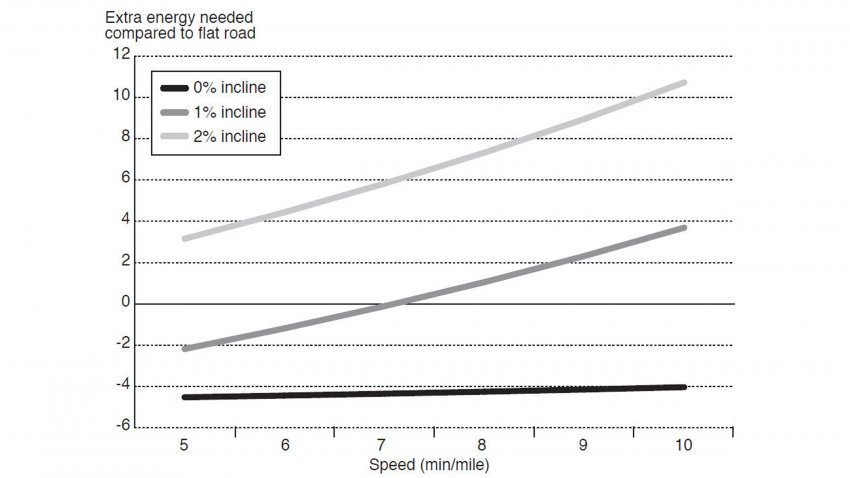
The most obvious difference between treadmill and outdoor running is the lack of air resistance. Back in 1996, Andy Jones and Jonathan Doust published a paper that compared the oxygen (i.e. energy) consumption of running outdoors or on a treadmill at various inclines. Running on a flat treadmill burned about 4 percent less energy, but that difference could be eliminated by setting the treadmill incline to 1 percent. Since then, many treadmill studies have used a 1 percent grade by default: that study has been cited more than 600 times. 

One problem with this approach is that air resistance depends on how fast you’re going. If you’re running really fast, air resistance takes a bigger toll—which means that really fast treadmill running is artificially easy by a larger amount. Conversely, when you’re running really slowly, air resistance is almost irrelevant. The 1 percent correction is best for speeds around 7:00 per mile; if you’re running at 9:00 per mile, you’d be better off with 0.5 percent. 

Here’s a graph from my 2011 book, Which Comes First, Cardio or Weights?, that shows the energy advantage (or disadvantage), in percent, of treadmill running at different speeds and inclines, based on Jones and Doust’s data:
treadmill_h.jpg
Credit: Trish McAlaster.
For the most part, the new data on energy consumption lines up with this picture: the faster you go, the bigger the advantage the treadmill gives you. But surprisingly, the picture changes when you look at heart rate and perceived effort. Both of those were higher on the treadmill at faster (but not all-out) speeds, compared to running overground.

On the surface, that makes no sense: less air resistance means you burn less energy at fast treadmill speeds, so why should heart rate and effort be higher? The answer to this riddle may once again come down to comfort, the authors suggest. It can be a little scary to really hammer at fast speeds on a treadmill: despite lower energy consumption, “the lack of comfort with higher-speed treadmill running might cause greater increases in [heart rate] and perceived effort due to feelings of anxiety about falling,” they write. It’s also possible that the lack of air resistance becomes a liability when you’re really working hard, because you don’t have moving air to cool you down.

There’s a similar disconnect when you look at maximal and near-maximal treadmill running. In this case, the max values of energy consumption (i.e. VO2max) and heart rate are pretty much the same on a treadmill or overground. But actual performance—how fast you go in a time trial or how long you last in a time-to-exhaustion test—is worse on a treadmill. Again, it probably comes down to familiarity and comfort rather than subtle differences in physiological variables.

When you put all this together, the sense I’m left with is that the biggest differences between treadmill and outdoor running aren’t in how you run, but rather in how you respond to the experience. It’s probably true that people run slightly differently on treadmills: when you look in detail at the biomechanics, you find subtle differences in things like knee angles and peak ground forces, but the overall pattern (as one such study concluded) is that the two movements are close enough that you don’t have to worry about the differences—as long as the belt is properly calibrated and not too soft.
So if you want to run on the treadmill, be my guest. It’s not my cup of tea, but there are plenty of great runners who’ve sworn by it. My favorite example is probably Christine Clark, the treadmill-trained Alaskan who emerged from the boreal winter to win the 2000 Olympic Marathon Trials in South Carolina. If you do, don’t worry too much about whether a 7:00 treadmill mile equates to a 6:55 or a 7:05 outside. Just run, get suitably tired, and repeat. The pace, when you get back outside, will take care of itself.

Alex Hutchinson is the author of Endure: Mind, Body, and the Curiously Elastic Limits of Human Performance, with a foreword by Malcolm Gladwell. Find him on Twitter and Facebook.

Tuesday, 18 August 2020

12 Fitness Experts Share How They’re Keeping up With Exercise While Staying at Home

Exercise


So it’s been about five or six months spent at home (wow, 2020 has flown by! #not) and there’s no end in sight. Back in March, I literally had no idea how to keep up with exercise when my trendy yoga studios and beloved barre classes closed. I could no longer depend on $20 cancellation fees and the promise of lavender towels to entice myself to work out, so I had to become much more intuitive about exercise and movement. For some much-needed inspo, we asked our favorite trainers, yogis, and workout gurus how they’re staying active while staying at home. 


1. Ariel Belgrave, Health & Fitness Coach and Creator of The L.E.A.N. Method

Source: Gym Hooky
“At the start of the week, I take a look at my calendar and determine the best day and times that I can get in a 30-minute workout. I then block it on the calendar and treat it like a business meeting with myself! Having it penciled in on the calendar helps hold me accountable.”
Check out her workout guides and follow her on Instagram here.

2. Katrina Scott, Co-Founder of Tone It Up

Source: @katrinascott
“I squeeze in my workouts either before my daughter wakes up or during her nap time. I actually never work out more than 30-40 minutes. Most days it’s about 20 minutes through the Tone It Up App because there are so many quick and amazing routines. I also like to work out live on Instagram because I feel like it keeps me accountable, connected, and motivated.”
heck out her Instagram LIVE workouts on Tuesdays at 8:30am PST on @SI_swimsuit, download the Tone It Up App, and follow her on Instagram here. 

3. Tie Simpson, Founder and CEO of Sisters of Yoga

“As a mindful yoga coach, keeping up with my physical health has been just as important to me as my spiritual wellbeing during this time. I’ve incorporated a fun balance of yoga, dancing, and setting up a mini gym to do circuit stations around the house. Investing in a dumbbell set, a few free-weights, yoga ball, and resistance bands was a game changer for my stay-at-home regime. This has also been a great way to get my children involved because it’s such a fun way to work out.”

4. Nicole Winhoffer, Fitness Artist, Trainer on Revenge Body, and Founder of the NWMethod 

“Love yourself where you are. If you can’t love yourself where you are today, no external changes will bring you love. Also, schedule your workout at the same time every day to instill better habits of movement on a regular basis.” 

Melissa Wood-Tepperberg, Founder of The MWH Method
“Prioritizing my practice of meditation and mindful movement is what keeps me sane through anything that comes my way. Even taking just two minutes to yourself makes such a massive impact toward shifting your mood. I do this through my method of movement to sculpt beautiful, long lean lines throughout the entire body through precise, low-impact movements.”
Try a seven-day free trial of the MWH Method and follow her on Instagram here. 

6. Jessica Rihal, Yoga & Meditation Instructor

“I like to alternate my movement and mix it up. I might go for a hike one day and do a virtual dance class the next. I like the idea of movement as nutrition for the body, so when I look at it that way, there are so many different things I can do that don’t feel like a punishment or a chore, and most importantly, keeps it from feeling routine or boring.”  

7. Chevy Laurent, Fitness Instructor and Founder of RydeFYR

Source: @chevylaurent
“In the beginning, it was really challenging for me personally to prioritize my workouts while at home. As a group fitness instructor, I love the feeling of being a part of a community when I work out. The key for me has been to find creative ways to stay connected with other people, whether it’s on Instagram, Zoom, or wherever! It’s just so important to recognize that you are not alone. So long as you keep moving forward on your journey, you can’t go wrong.” 
T

8. Carly Bustin, Personal Trainer and Fitness Blogger

Source: Carly Rowena
“Goals are created for a reason: to keep you motivated and inspired on days when you might feel like pushing the snooze button. At-home workouts were never something I did prior to lockdown, so I had to adjust not only my workouts, but my mindset. First, I changed my goals. I wanted to become stronger with bodyweight movements and do a walking handstand (both goals that are achievable from home). Next, I became a morning person. I set my alarm and put it as far away from my bed as possible, so I was forced to get out of bed. Getting your workout done first thing will make you more likely to get it done.”

9. Ramona Braganza, Fitness Expert and Celebrity Trainer

“I’ve been keeping my physical fitness up at home with my inspiring mother, Lucy, who (at age 85!) motivates me to continue to challenge myself. Together, we do a workout twice a week for our Instagram and Facebook audience. For my own mental health, I go on an hour-long walk every day with my dog, and anytime I feel like I’ve been sitting for too long, I play frisbee with him. I also swim, jog, do online Tae Bo classes, stretch, and weight train.”
Check out her programs and follow her on Instagram here.

10. Les Alfred, Personal Trainer and Host of the Balanced Black Girl Podcast

Source: @balancedles
“I’ve been far more consistent with exercise when I schedule mini movement breaks throughout the day instead of committing to one long workout. Usually this includes doing 10 minutes of yoga in the morning, a short strength training or HIIT circuit in the afternoon (to get through the post-lunch slump), and occasionally, I’ll also take an evening walk for fresh air and to get some steps in. As a former gym junkie, I’ve learned to make working out at home more enjoyable by seeing exercise as a ‘vitamin’ I can take throughout the day for increased energy.” 


11. Sophie Jaff, Yoga Teacher, Raw Food Chef, and Founder of Philosophie

Source: @sophie.jaffe
“As a mama of three, finding activities that my kiddos love while also getting what I need is a win-win. I’ll do workouts with my boys in our backyard and we all have fun! Take off the pressure and tap into your inner knowing to what you truly need.” 


12. Traci Copeland, Nike Master Trainer

Source: @traceo4
“Consistency is key and staying connected to routine is great. But also, don’t be afraid to try other workout modalities. For example, if you’re heavy in strength training, maybe try yoga. Look for ways to have a holistic approach to training.”

Wednesday, 12 September 2018

8 Surprisingly Simple Ways to Detoxify

8 Surprisingly Simple Ways to Detoxify:


 Given what we are now exposed to through our food, air, and water, detoxification has become a modern-day necessity. Without the daily activation of ancient, effective physiological pathways designed to remove environmental toxins, we are bound to get sick. So, what are some simple, effective ways we rid our body of its daily toxic burden?


8 Surprisingly Simple Ways to Detoxify
Given what we are now exposed to through our food, air, and water, detoxification has become a modern-day necessity. Without the daily activation of ancient, effective physiological pathways designed to remove naturally occurring environmental and toxins or manmade chemical toxicants, we are bound to get sick.
So, what are some simple, effective ways we rid our body of its daily toxic burden?
1) Pop a Probiotic: Of course, you don't have to 'pop a pill' to get a probiotic. In fact, it is preferred you ingest either a cultured food (e.g. kombucha, yogurt (preferably non-cow's milk based), cultured veggies, etc.) or eat more raw fruits and vegetables grown in truly healthy soil, as this is actually the root of where 'good bacteria' come from.
How will getting probiotics help? Fascinating research indicates that probiotics actually help us break down foods (e.g. gluten; casein) and chemicals  (pesticides, Bisphenol-A) which can cause great harm to our bodies, and which our own detoxification pathways do not handle effectively. Its kind of a wonder, isn't it, that 'germs' can help save us from ourselves in this way? (Learn more: 8 Ways Microbes Can Save Us From Ourselves).
1) Breaking a Sweat: Sadly, sweating has become synonymous with something gross that should be blocked with antiperspirants/deodorants – which, ironically only further exacerbates the problem of bodily odor, as it keeps one of your primary channels of detoxification from doing its job.
The reality is we were designed to move our bodies, the result of which is the release of profoundly uplifting and regenerative hormonal and neurochemical secretions. And this is just the obvious 'reward' we receive by pushing ourselves through the discomfort of sustained, intense bodily exertion to the point where we are profusely sweating.
Deeper benefits include the activation of the lymphatic system, which while being part of the circulatory system lacks a pump (like the heart) to push the lymphatic fluid through; this requires the activation of our entire skeletal musculature via exercise.
While one does not necessarily need to break a sweat to move the lymph – walking will suffice – you can 'free two birds with one hand,' by eliminating various heavy metals and chemicals via profuse sweating if you bring your physical activity towards that threshold, which incidentally also overlaps with that 'sweet spot' that activates the 'feel good' secretions we talked about.   (Learn More: Research Confirms Sweating Detoxifies Dangerous Metals, Petrochemicals).
3) Don't Break-The-Fast: In wealthier countries, where we suffer from the Orwellian paradox of being incredibly over-nourished and simultaneously dying of nutritional deficiencies, one of the best way to optimize your detoxification systems is to stop eating before sundown (which, I believe, is hard-wired into our bodily design) and skip your break-fast entirely. In other words, don't break-the-fast and continue through your day until you are truly hungry (not morbidly craving nutritionally dead gunk, or confusing the putrefaction-associated acidity of last night's poorly digested, or poorly food-combined dinner with an actual need to eat more), wherein you're eating something wholesome, organic, and preferably living to "get your fill."
If you eliminate and/or minimize the consumption of nutritionally vapid foods such as processed grain products, and beans (soybean, peanut, and other "vegetable oils"  included), and have a salad, eat an apple, or consume some organic nuts, etc., and focus on eating one really good meal later in the day, you will be surprised by how little you will be hungry; much of that craving is a byproduct of chronic, elevated insulin, which is largely caused by over-consumption of processed grain-based foods, and/or simple carbohydrates way beyond what you need to replenish your glycogen stores.
Now consider, this doesn't have to be painful. Literally, if you awake in the morning, have your cup of coffee or tea (if you imbibe), and feel that empty hunger and low energy driving you towards you French toast, or whatever you would normally eat, try taking a couple tablespoons full of coconut oil, which will provide you (and your grumpy 'morning brain') with a near immediate source of fuel (66% of coconut oil is medium chain triglycerides which your body can use for energy very quickly, and which your liver breaks down into ketone bodies for your brain, which is the brain's only other source of energy beyond glucose).[1]  Consider, of course, this is not going to work for everyone, but it certainly may fit better into a busy lifestyle than the 'heroic' fast concept of just not eating anything at all – which has its place, especially for the very sick under professional guidance, or those on a spiritual mission, but not those with kids, several jobs, and just wants a way to jump-start the internal house-cleansing, metabolism-boosting process.
4) Spice Up Your Life! Basic culinary spices can work wonders at stimulating bodily detoxification. A recent study, which we highlighted in the article "Garlic Beats Drug In Safely Detoxifying Lead from the Body," illustrates how you can use your 'food as medicine.' If you LOVE Garlic, great. You are already a step ahead of those who tolerate it. In the former case, you might just want to ratchet up your romance a bit. In the latter case, just don't ignore its potential application in foods you are already enjoying. The point is that we have plenty of help all around us, in our kitchen cupboards, on our spice racks, etc. And do you know what's cool? There is a huge list of spices, foods, and nutrients – over 75 last time we counted -- that we have indexed on GreenMedInfo.com that can stimulate detoxification pathways in the body. Here's how you navigate to it: GreenMedInfo.com > Menu Item: Research Database  > Pharmacological Action > Detoxifier.
6) An Apple A Day Isn't Going Away: One of the most amazing nutritional stories of our time is what happened to tens of thousands of so-called "Chenobyl Children," after the meltdown of that reactor. As we discussed in our article "Why Apple Is One of the World's Most Healing Superfoods" we discuss the radioisotope-detoxifying properties of this incredible healing agent:

"Post-Chernobyl, for instance, apple pectin was used to reduce Cesium-137 levels in exposed children, in some cases by over 60%.[x] From 1996 to 2007, a total of more than 160,000 "Chernobyl" children received pectin food additives. As a result, levels of Cs-137 in children's organs decreased after each course of pectin additives by an average of 30-40%.[xi] Significant reductions were noted in as short a time period as 16 days.[xii]  Apple pectin has even been found to prevent the most deadly, and entirely man-made radioisotope, Plutonium-239, from absorbing in the gastrointestinal tract of animals fed it.[xiii]"
The great thing about an apple, of course, is that it's a whole food. Rather than take mega-doses of apple pectin (assuming you don't live in Fukushima, or are exposed to its fallout in some way – then please do!), simply incorporating a 'good apple' – that is to say, 100% organic, non-irradiated, etc. – into your daily diet, should constitute an extremely pleasurable experience (especially if you incorporate this healthy snack as the "break" in our "Break-The-Fast" strategy). We can be nourished, pleasured, and detoxified all in one act; and this is, indeed, the way nature designed things in Her infinite wisdom. [insert "He" and "God" if you prefer, but don't hold the story of Adam and Eve against this sacred fruit!].
The last thing we should say on the topic, which may be the most important thing of all, is please void being poisoned in the first place. Easier said than done, I understand. But here are some really important things to remember, to make sure you aren't unintentionally throwing yourself on a chemical grenade every day....
  • Unless you need your receipts, don't take them.  Next to canned food (with those darn alphabetic soup of bisphenols in their can liners; yeah, its not just BPA, but BPS, and others the industry is now using), what is likely our primary route of exposure for this profoundly damaging class of gender-bending, heart-damaging, brain-damaging petrochemicals is going to be touching thermal printer receipts – especially if you already use lotion, which only helps to accelerate the skin's absorbance of these chemicals.
  • Stop slathering petrochemicals on your body.  If you are putting it on your skin, it's likely worse than eating it. How's that? Unlike what you put into your mouth, where your liver determines if what you eat will be allowed into your bloodstream, your skin has no such 'guardian' to keep the poisons out. If something you are using as a body care product has an ingredient that requires a degree in chemistry to understand, ditch it (that is, recycle it) or don't buy it.  If you can't eat an ingredient, don't put it on your body. Even better trying using coconut oil, or related food-cosmetic-medicines, with thousands of years of prior use backing it up for effectiveness and safety. If you want to learn more on the topic, read about how everyone now had actual crude oil derivatives in their body years of eating FDA/USDA-approved "food grade petroleum," and aforementioned exposures: ["Crude Awakening: Mineral Oil Contaminates Everyone's Bodies"]
  • Don't drink the water. What I mean by this is if you get your water through a municipal system, and it hasn't been effectively purified (ideally, distilled with minerals reintroduced), you shouldn't drink it. Keep in mind, also, you can get 'pristine' water from Iceland or Fiji, or wherever marketers like to take our imagination, but if its been sitting in plastic for a year, its not as good as it would seem. Keep in mind that the problem with municipal drinking water, isn't just the fluoride residues, but the 600+ disinfectant byproducts all of which are known to be toxic to the body,[2] to damage DNA, and probably contribute to cancer. It still boggles my imagination that anyone would willfully expose themselves to this, even in its secondary reiteration as 'cooking water,' i.e. using it to make pasta.  Water is what the majority of our bodies are composed of. Learn to savor 'biological water,' that is, water that comes from pure food, e.g. watermelon. This is 'structured' by the universe itself, and is unparalleled in what it can do for your body.
So, we've covered some problems and solutions, and certainly this is just the tip of the iceberg. Just take it all with a grain of sea salt, and take what works for you and leave the rest. If you find the time to comment on your own experience with detoxification, or how some of these strategies played out in your life, please feel free to below.


[1] GreenMedInfo.com, MCT Fats Found in Coconut Oil Boost Brain Function In Only One Dose.
[2] Susan D Richardson, Michael J Plewa, Elizabeth D Wagner, Rita Schoeny, David M Demarini.Occurrence, genotoxicity, and carcinogenicity of regulated and emerging disinfection by-products in drinking water: a review and roadmap for research. Mutat Res. 2007 Nov-Dec;636(1-3):178-242. Epub 2007 Sep 12. PMID: 17980649
Disclaimer: This article is not intended to provide medical advice, diagnosis or treatment. Views expressed here do not necessarily reflect those of GreenMedInfo or its staff.
Internal Site Commenting is limited to members.
Disqus commenting is available to everyone.

Saturday, 3 January 2015

Tips to Prevent Post-Exercise Insomnia

 Have you ever been exercising or jogging in the evening and found you could not go to sleep.  These tips can help you unwind.  Exercising in the evening can actually improve your sleep.  The trick is to unwind after the exercise suffiently to feel calm when you go to bed.

Tips to Prevent Post-Exercise Insomnia

Wednesday, 26 November 2014

Jogging Keeps You Young

 As someone who is seriously thinking of starting to jog, this article is just coming at the right time.  Jogging is the cheapest, most effective exercise there is so I am gearing myself up for this.  Any exercise actually has the benefit of helping to stay young.


New Study: Jogging Keeps You Young

Saturday, 15 November 2014

How Do I Start Running?

The New Year is just a few weeks away and you might have a plan to get fit after Christmas.  I have found a site which may be helpful for this.  Running is the best exercise and once you have bought your Trainers, it is free from then on.  After that it is motivation to keep going.  Check this out!

http://www.popsugar.com/fitness/How-Do-I-Start-Running-34864421