It’s good for your mental and physical health, and doesn’t require any equipment. So why does it seem so hard to get started?
By Farah Miller
Until
last week, the only time I’d finished a race was during Track and Field
Day in fifth grade. By middle school, I was trying to figure out how to
get out of gym class because it was too hard for me to run a mile.
Sports, in general, were not my thing. Running, less so.
As
an adult, I have gone to the gyms, taken exercise classes and worked
with trainers. But none of it ever brought me joy, or made me want to
keep doing such things. The most sustained exercise I did in the past
decade was a regimen of deep knee bends with a colicky baby in my arms
after my first kid was born.
Then
lockdowns came along, and I surprised everyone in my house, especially
myself, by signing up to join a local running group which had moved from
holding local meetups to checking in with each other virtually. Because
it was exercise I could do alone, the conditions were ideal.
But
for a newcomer to running, the notion that you can just throw on a pair
of sneakers and hit the road turns out to be a big, fat lie, I assume
created by people who started running after giving up soccer or
basketball.
Every
time, I have to push myself to run that horrible first minute. I get
breathless. Muscles I didn’t know I had now ache like I never thought
possible. I feel self-conscious when a neighbor spots me bouncing down
the street. And yet, I stick with it. I can now run 20 minutes in a row,
and they are not
Here
were a few of the things I learned that have helped me to get out the
door — and keep going even when I would much rather stop for an infusion
of iced coffee.
Let cynicism go.
If
you are the type who smirks at inspirational quotations on Instagram,
set aside that part of your brain for the entirety of a run. I now
understand why fitness instructors are so often relentlessly earnest.
You need positive messages to get through the hard parts of working out.
Try a simple thought exercise recommended by Coffey, a filmmaker and the founder of DeFine New York Run Club.
Ask yourself, “What’s my why?” and “What’s my purpose?” Coffey’s “why”
was to get in shape; his purpose was to be able to keep up with his
three young children. “I want to be energized when they want to play,”
he said. “I don’t want to be the parent who says ‘I can’t.’”
Get a voice in your head.
To invite such positivity into my own cold dark heart, I take the outdoor running classes in the Peloton app,
which is less expensive than their stationary bikes or treadmills. For
20 to 60 minutes I get an instructor in my ear keeping me going, playing
his or her favorite music and sharing running tips or suggesting when
to walk.
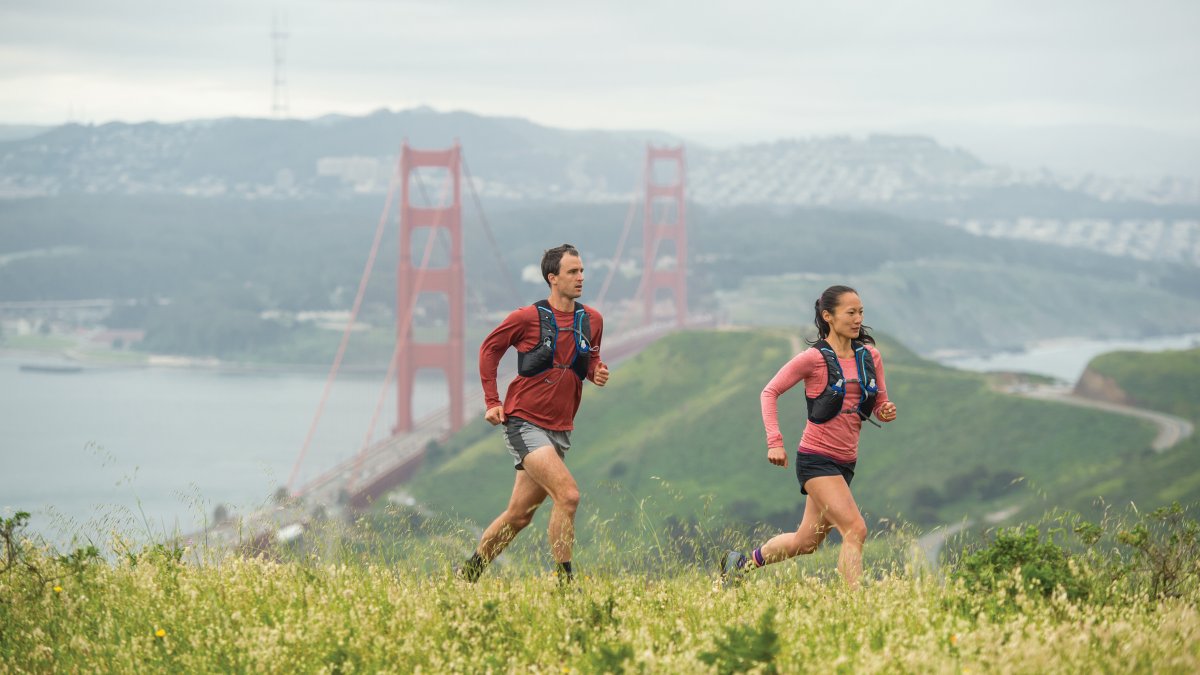
Should you run inside or outside? Photo by Scott Markewitz / Gallery Stock.
The second-biggest question about treadmills (besides whether an airplane could take off from one)
is how well they approximate the experience of running outdoors. Some
runners swear it’s easier to click off the miles on a moving rubber
belt, for reasons including the lack of air resistance and the somewhat
bizarre idea that you can just hop up and down while the belt whizzes by
underneath you. Others, equally adamant, claim that treadmill miles are
actually harder, perhaps because they’re stabbing themselves in the
face with a fork to relieve the boredom.
A systematic review published in 2019 in the journal Sports Medicine,
from an international team of researchers led by Joel Fuller of
Macquarie University in Australia, tries to resolve the debate by
pooling the results of 34 different studies with a total of 468
participants in which treadmill and what researchers call “overground”
running were compared. The bird’s-eye view of the results is that
running is running. There’s no secret trick to treadmill running that
allows you to spend half the energy you’d spend at the same pace
outdoors—and if it feels like that’s the case, it probably means that
your treadmill belt is miscalibrated (which is not at all uncommon).
But when you zoom in, the picture is a little more
complicated. The good news is that during typical running at a moderate
effort, heart rate, oxygen uptake (which is a proxy for how much energy
you’re burning), and perceived effort are all pretty similar on the
treadmill and overground. (Lactate levels, in contrast, were a little
lower on the treadmill, but that finding was based on a smaller number
of studies and is a more error-prone measurement, so I’d treat it with
caution.)
The more interesting detail is that preferred
running speed—that is, the speed that people choose when you simply tell
them to run at a self-selected pace—was lower on the treadmill. This
may simply reflect the fact that most people are less familiar with
treadmill running and are a bit cautious about the risk of falling off
or getting thrown off the back. One of the weaknesses of the studies in
the review, the authors point out, is that very few assessed how much
treadmill experience their subjects had. It’s possible that treadmill
vets would have no difference in their natural preferred pace indoors or
out.
The most obvious difference between treadmill and
outdoor running is the lack of air resistance. Back in 1996, Andy Jones
and Jonathan Doust published a paper
that compared the oxygen (i.e. energy) consumption of running outdoors
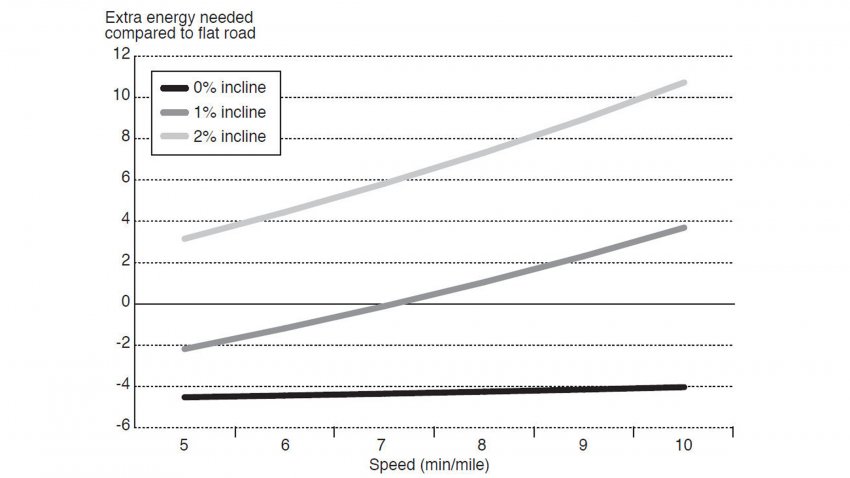
or on a treadmill at various inclines. Running on a flat treadmill
burned about 4 percent less energy, but that difference could be
eliminated by setting the treadmill incline to 1 percent. Since then,
many treadmill studies have used a 1 percent grade by default: that
study has been cited more than 600 times.
One problem with this approach is that air
resistance depends on how fast you’re going. If you’re running really
fast, air resistance takes a bigger toll—which means that really fast
treadmill running is artificially easy by a larger amount. Conversely,
when you’re running really slowly, air resistance is almost irrelevant.
The 1 percent correction is best for speeds around 7:00 per mile; if
you’re running at 9:00 per mile, you’d be better off with 0.5 percent.
Here’s a graph from my 2011 book, Which Comes First, Cardio or Weights?,
that shows the energy advantage (or disadvantage), in percent, of
treadmill running at different speeds and inclines, based on Jones and
Doust’s data:
Credit: Trish McAlaster.
For
the most part, the new data on energy consumption lines up with this
picture: the faster you go, the bigger the advantage the treadmill gives
you. But surprisingly, the picture changes when you look at heart rate
and perceived effort. Both of those were higher on the treadmill at faster (but not all-out) speeds, compared to running overground.
On
the surface, that makes no sense: less air resistance means you burn
less energy at fast treadmill speeds, so why should heart rate and
effort be higher? The answer to this riddle may once again come down to
comfort, the authors suggest. It can be a little scary to really hammer
at fast speeds on a treadmill: despite lower energy consumption, “the
lack of comfort with higher-speed treadmill running might cause greater
increases in [heart rate] and perceived effort due to feelings of
anxiety about falling,” they write. It’s also possible that the lack of
air resistance becomes a liability when you’re really working hard,
because you don’t have moving air to cool you down.
There’s
a similar disconnect when you look at maximal and near-maximal
treadmill running. In this case, the max values of energy consumption
(i.e. VO2max) and heart rate are pretty much the same on a treadmill or
overground. But actual performance—how fast you go in a time trial or
how long you last in a time-to-exhaustion test—is worse on a treadmill.
Again, it probably comes down to familiarity and comfort rather than
subtle differences in physiological variables.
When
you put all this together, the sense I’m left with is that the biggest
differences between treadmill and outdoor running aren’t in how you run,
but rather in how you respond to the experience. It’s probably true
that people run slightly differently on treadmills: when you look in
detail at the biomechanics, you find subtle differences in things like
knee angles and peak ground forces, but the overall pattern (as one such study concluded)
is that the two movements are close enough that you don’t have to worry
about the differences—as long as the belt is properly calibrated and
not too soft.
So
if you want to run on the treadmill, be my guest. It’s not my cup of
tea, but there are plenty of great runners who’ve sworn by it. My
favorite example is probably Christine Clark,
the treadmill-trained Alaskan who emerged from the boreal winter to win
the 2000 Olympic Marathon Trials in South Carolina. If you do, don’t
worry too much about whether a 7:00 treadmill mile equates to a 6:55 or a
7:05 outside. Just run, get suitably tired, and repeat. The pace, when
you get back outside, will take care of itself.
Squats look like an easy exercise that most people can achieve whatever their age. It is so important to stay supple as we get older.
Squats are a great foundational exercise that promotes balance and mobility
When
done properly, squats help improve knee stability and strengthen
connective tissue. Simple form corrections can help eliminate knee pain
caused by improper body alignment
Squats
are an ideal part of everyone’s fitness routine, as they provide
whole-body strengthening and toning. They can help induce more regular
bowel movements
The New Year is just a few weeks away and you might have a plan to get fit after Christmas. I have found a site which may be helpful for this. Running is the best exercise and once you have bought your Trainers, it is free from then on. After that it is motivation to keep going. Check this out!
The new year is well under way and how are the resolutions going. They are a test for most people and I admire those who have the willpower to carry out their plans and stick with them until and beyond the point when they have reached their target. The article below may help to see your plan through to completion.
Keeping fit and having fun at the same time is surely the ideal way to enjoy the retirement years. It enhances health and well-being and allows social interaction.
We've all been there, excuses, excuses and more excuses. Well perhaps it's time to ditch the excuses. Nothing ventured, nothing gained as the saying goes. Winter is coming and the Immune System needs to be strong to withstand the viruses that come with the cold season.