Who
wouldn’t want to live a life where they are rich, passionate, talented,
and changing the world? It sounds perfect, doesn’t it? Yet it’s
unrealistic and not the only way to live a life of meaning.
The Japanese have a beautiful concept to guide their lives called ikigai. I learned it from karate masters on the beautiful Japanese islands of Okinawa. Researchers have claimed ikigai is the reason why the islands have the highest density of 100-year-olds in the world.
Ikigai is the reason to be and reason to live.
I want to demystify ikigai for
you to help you live your version of your best life. I will clear the
confusion of the Western understanding and make you realize it’s within
your reach.
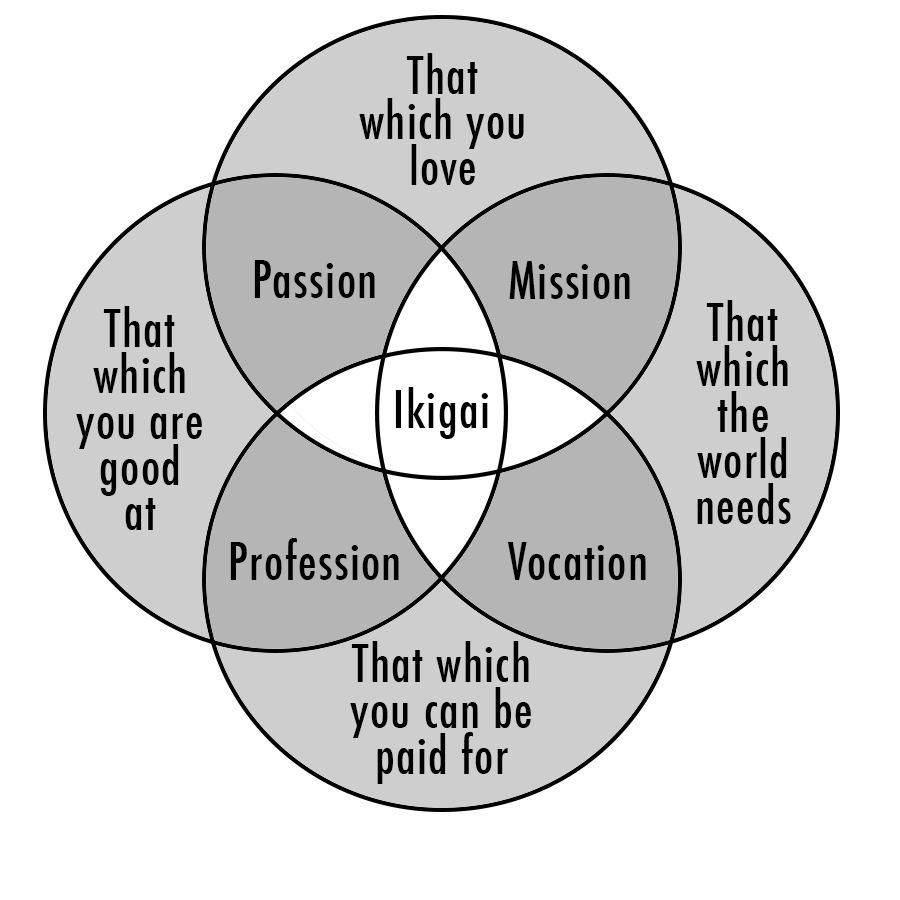
Ikigai is Not Four Circles
Now ikigai is
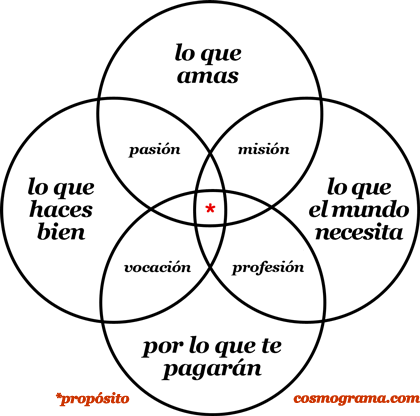
most famous in the West for a four circle Venn diagram. The internet is
full of claims it is about finding a perfect sweet spot between:
So if you’ve been following this model, thank Zuzunaga and stop calling it ikigai. Awkward right?
Now let us explore how to promote your reason for living.
Your Ikigai Doesn’t Need to Make You Rich
Your career does not need to be your ikigai. Many books have hijacked the concept and sold it as career advice. There is more to life than work!
In a large study, only 31% of Japanese people who said they had an ikigai said
it was work-related. Bear in mind Japan has one of the most extreme
workaholic cultures in the world. They even have a word for death by
overwork, karoshi! Hobbies, family, and friends all scored higher than work when asked about their ideal ikigai.
Some
of the greatest living instructors taught me karate in Okinawa. For
weeks I spent 4 hours training every day in the sweltering heat. Do you
know how much it cost? $20 to help pay for the upkeep of the dojo. The
people who taught me refused any payment except for a box of matcha
flavored treats. Sensei Kinjo explained they are here because of the joy
it brings our lives, not for money.
They
all had other normal jobs such as being teachers, policemen, and
postmen. They could choose to make a living from their skill but it
would spoil it for them. Addiction to monetizing
everything can get in the way of our ikigai. Stop to think about whether
keeping your passion as a hobby adds more value to your life.
Many elderly Okinawan women were housewives. Their ikigai was
their family and a close group of friends. Would you dare to tell them
their lives had no purpose because they didn’t make money?
If
your career is the reason you get up in the morning then awesome. Yet
if it’s not, there’s no need to despair. It is okay for work to just
allow you to make the most of what you do enjoy.
Your Ikigai Doesn’t Need to be Found
If
you take only one thing from reading this, let it be the knowledge your
purpose in life is not floating in the air waiting to be caught. Your
reason to live comes from inside and you decide what it is.
Self-doubt
plagues even some of my most successful friends. Why? Because they
haven’t found the magical purpose they read about. The idea something is out there to make our lives perfect is a lie. It’s comforting to begin with but destructive when the chase seems eternal.
I
wonder how many of the Okinawan masters knew at the age of 3 when they
started this would be their reason to live. I think you know the answer.
Our purpose can come into our lives accidentally and we grow to love it.
My
day job in the tech industry puts fire in my belly now but I was sure I
wanted to work in a bank when I was younger. It doesn’t mean I am free
from the odd mundane task. Yet I make a game out of these to create
challenges and enjoyment.
Stop seeking to do what you enjoy, instead enjoy what you do. It’s a simple mindset shift yet so powerful. What is a task you hate? How can you make it more enjoyable?
We
should be mindful that doing more of what we enjoy doesn’t always mean
we will be happier. A passion for running doesn’t mean it needs to
dominate your life. Running 5km at the weekend is not the same as the
brutal schedule of a professional runner. You may already have the
ingredients for your perfect life. You just need to allow your senses to
guide you to the right proportions.
Your Ikigai can be Multidimensional
The
idea of one pure purpose in life is enticing. Yet most of us don’t live
like this and we can find joy in many parts of our lives.
Is a happy person cheating on their ikigai if
they love their family and their work? Of course not. We want different
areas of our lives to be reasons for us to get up. This gives us
stability so our peace is not fragile. A person who finds joy in different areas of their lives will rarely fail to jump out of bed.
In
martial arts circles, there is a weird purity argument where people
want to prove their style is the best. Yet the Okinawan karate masters
themselves train in karate, kobudo, and judo. After training, I have
seen for myself they also love the company of their friends and some
cheeky karaoke!
Titans
of humanity such as Nelson Mandela may be used to argue a single life
purpose is important. When we dive a bit deeper, Nelson Mandela had many
things to give his daily life meaning. He did an exercise routine and
cranked out hundreds of push-ups even at an advanced age. He had letters
and visits from his family. He shared his prison sentence with some of
his closest friends.
There
is an obsession with making sacrifices to be happy. Often this is to
take one of our purposes to the extreme and to “grow”. You can have a family, friends, hobbies and a happy career. When making sacrifices, it is best to first pause and self-reflect.
Imagine
your daily life when you’ve reached your goals. Does this lifestyle
align with what you enjoy? I’m guilty of thinking about a single event
where I would feel happy rather than the daily routine. If you can see
your days will be full of enjoyment then steam forwards.
Your Ikigai can Change
Change
is the only constant in life. It makes sense what gets us out of bed
when we are children is different from when we are elderly.
We must allow our purpose to evolve when our situation changes. Our
body physically changes over time but so does the way we view the
world. Maybe parkour gives you a reason to wake up when you are young
but it won’t go too well for you when you aren’t. When we cling onto our
past selves, we can’t enjoy the present moment.
In Okinawa, I trained with people who were monsters in their physical prime. This was the place the most dangerous man in all of Japan learned his craft.
Their focus shifted with age from the ecstasy of their training to the
delight of students growing. Before they trained to be the best in the
world and now the best in the world come to train with them.
In Homo Deus, Yuval Noah Hariri explains our authentic self is a rationalization our brain creates from a series of events. We can change anything including our principles.
A person who hates animals, can later in life have a pet which lights
up their day. I can confess I thought I would never do yoga because I
wasn’t that type of person. Now it is a key part of my life.
Don’t limit yourself out of loyalty to a person you no longer are.
It’s ok to accept you’ve changed as isn’t this part of the whole point
of growth? Allow yourself to try new things and who knows it could be a
source of ikigai for decades to come.
Your Ikigai can be Simple
Your ikigai isn’t about impressing other people. You don’t need to shout it at everyone you meet. It’s what is important to you not who other people would like you to be. Not everyone can be an Olympic athlete or billionaire.
Ken Mogi, a neuroscientist, makes ‘the joy of little things’ one of his pillars of ikigai. Yukari Mishuhashi, a journalist, says you can uncover your ikigai by asking simple questions:
What brings happiness to my everyday life?
What puts a smile on my face just thinking about it?
What would I continue to do even if I had enough money to live happily ever after?
One
of the instructors in Okinawa was a postman. How many of you dream of
being a postman? Yet he loved his life. He was active and saw the city
every day. He would stop for a chat when he delivered to his friends’
houses or passed by someone he knew. So many of us chase career success
to make us happy but I wonder how many of us are happier than this
postman.
For
the Japanese, ikigai can be a practice in gratitude. We can tend to get
caught in what we don’t have yet rather than what we do. Many of us
won’t need to make drastic life changes to enjoy ikigai. All we need to do is give value to what is already in our lives without shame.
Don’t
compare yourselves to others when working out what wakes you up in the
morning. Enjoy the simple things in life such as a gentle walk or good
book. Be grateful for the small things and you’re less likely to lose
your head in the clouds.
All You Need to Know
If you had heard of ikigai before,
I hope I’ve changed your mind on what it is. For those new to the
concept, I hope I’ve given you the freedom to express yourself away from
the toxic rules society can impose on us.
I don’t know who you are but I know you have a reason to live. I know your life has value. You already had ikigai but now I hope you are more conscious of it and don’t let it slip.
Positive
Alacrity is the art of creating micro-experiences that have an
emotionally uplifting impact on others. But I’m getting ahead of myself …
A quick Google search for “secret to happiness” brings up over 7,500,000 results.
That’s a lot of people writing about and searching for something that, according to a groundbreaking Harvard study, has already been found.
That’s right: Thanks to Harvard’s Grant and Glueck studies — which tracked 724 participants from varying walks of life over the course of 75 years — we’ve already uncovered the key to long-term happiness and fulfillment.
The answer? Our relationships.
Here’s Robert Waldinger, director of the Harvard Study of Adult Development:
“The clearest message that we get from this 75-year study is this: Good relationships keep us happier and healthier. Period.”
In other words: The quality of our life — emotionally, physically, and mentally — is directly proportional to the quality of our relationships.
But there’s a catch. If there’s one thing most of us have learned, it’s this: Just knowing a lot of people isn’t enough.
True fulfillment in relationships is about genuine connection, and one of the most efficient ways to form that connection is bypracticing what we at Mindmaven call Positive Alacrity;a skillwe define as creating micro-experiences that cause an emotional uplifting in others.
The Uncomfortable Truth About Relationships
Did we really need a 75-year study to tell us relationships are important?
Probably
not; I bet many of you already knew that. So why do we so often
struggle to treat many of the most important relationships in our lives
with the reverence and priority we know they deserve?
For example, do any of these situations sound familiar?
When under stress, you may have a tendency to be ruder to your spouse than you’d ever dream of being to a complete stranger.
When building a business, you’re willing to work 60-hour weeks but somehow never “have time” to check in with lifelong friends.
Speaking of business: You may fail to consistently and proactively invest in deepening the professional relationships that might provide the breakthrough opportunities you need.
So why do we do this? Because …
Although many things in life are deadline and urgency driven, relationships almost never are.
As a result, they’re often one of the first parts of our lives that we neglect until we “find the time.”
The good news is, building those deep, meaningful relationships isn’t as daunting or time-consuming as it may sound. In fact, by focusing on one habit, anyone can build more fulfilling relationships every day.
The Secret Factor Controlling the Quality of Your Relationships
But what determines the level of fulfillment we find in our relationships?It isn’t simply “knowing” the other person.
What makes you feel happy or fulfilled isn’t the relationship itself, but the interactions that make that relationship up.
Here’s
what it comes down to: The only path to achieving the goal of a
fulfilling life is to have fulfilling relationships, and those
relationships can only be created by consistently connecting through
meaningful interactions.
Let me illustrate with a few examples.
#1: “I just want you to know how much I appreciate you.”
John’s
wife Sarah welled up with tears as she read the unexpected thank you
note her husband had written her before he left on a 6:00am flight for a
business trip.
John — the CEO of an aggressively
growing startup — thanked his wife for all the support and grace she’d
given him over the last three years as he worked long hours to reach his
— and his company’s — fullest potential.
The short note left Sarah feeling appreciated, loved, and truly known by her husband.
#2: “Thank you for sacrificing your time for our vision.”
Hannah,
a recent intern-turned-engineer at a public company, felt pleasantly
surprised and greatly affirmed after Erin, the CEO, walked over to her
cubicle specifically to say thank you.
Without
prompting, Hannah had recently pulled an all-nighter in order to ensure
a back-end patch was completed on time to restore server stability. And
even though Erin’s visit was shorter than 30 seconds, the fact that the
interaction was focused solely on thanking Hannah left her feeling
appreciated for stepping up and excited to work for the company.
#3: “So you never have to lose something again.”
Cole
— a die-hard Atlanta Falcons fan — laughed in amusement as he wrote
back “Thanks, but I hate you lol ;)” to Rob, a friend who had sent him a
Tile following the Falcon’s 2017 Super Bowl loss so he’d, “never have to lose something important again.”
The practical joke made Cole smile and deepened the sense of connection and friendly rivalry the two of them shared.
The Science-Backed Power of Positivity
Here’s the key takeaways from those examples: Each time, someone performed a small, lightweight gesture. For example:
John’s handwritten note to his wife,
Erin’s 30-second interaction, or
Rob’s quick email and gift.
And despite the ease of each interaction, they all delivered an uplifting sense of connection to the other person.
But perhaps the best proof of the power of interactions comes from Dr. Martin Seligman’s famous Gratitude Visits.
For those unfamiliar, Dr. Seligman — founder of the positive psychology
movement — introduced the concept of Gratitude Visits in a University of Pennsylvania study.
Here’s
how it worked: Participants were asked to write a 300+ word letter of
gratitude to someone in their life, and to then visit the recipient and
read the letter aloud to them.
Simple
though that may be, the effects were profound: Although Gratitude
Visits were one of many positivity practices recorded in the study, they
were the only practice that had participants reporting increased happiness and decreased depression for a full month after completing the action.
And
while I fully support the practice of Gratitude Visits, they come with a
challenge: Most of us don’t have time to sit down and write a 300-word
letter every time we feel positive or grateful.
So
I figured if Gratitude Visits are truly one of the most fulfilling
things we can do, there must be a way we can simplify it into a habit
that can be practiced daily.
Building Happy, Fulfilling Relationships with Ease
The solution? Positive Alacrity.
At the end of the day, this concept’s all about consistently delivering small,simple experiences that leave people feeling genuinely uplifted. So how do we do this? It all comes down to a single habit:
When you think something positive and you genuinely believe it, voice it.
As
simple as that habit may be, we believe the impact of Positive Alacrity
is as profound as Gratitude Visits, with one distinct advantage: That
same simplicity allows you to practice it anytime, anywhere, with practically anyone.
Why?
Because most of us already think positive thoughts on a daily basis.
For example, I wouldn’t be surprised if you often thought things like …
“That’s a really insightful way to look at the situation,”
“I really appreciate the way she listens to me,” or
“Wow, he handled that ordeal really well.”
Pause
a moment and test it for yourself: When was the last time you thought
something positive? I’d venture to bet it was within the last 24 hours.
The
problem is, we often let these thoughts come and go without ever
practicing Positive Alacrity. But when we forgo voicing these thoughts
to others, we cheat ourselves out of a valuable opportunity to enrich
our relationships in three key ways:
When you voice positive thoughts, you make the recipient feel emotionally uplifted.
This feeling elevates their appreciation of you and the relationship you share.
Because
you were the source of that interaction, their emotional response
creates an incredibly fulfilling sense of happiness and satisfaction in
you.
That last part’s key: By uplifting others, we inadvertently uplift ourselves.Why? Because …
The effects of Positive Alacrity go both ways.
For instance, remember the example above with Hannah the CEO and Erin the engineer?
As
a seasoned leader, Erin closely observed Hannah as she thanked her for
working so diligently on that patch; so she noticed as Hannah’s
expression slowly shifted from shocked confusion to recognition and,
finally, to realization.
Seeing
Hannah’s cheeks flush, smile spread, and eyes gleam made Erin realize
she’d just delivered something truly meaningful, and Hannah’s reaction
created a tremendous sense of satisfaction and fulfillment in Erin as the one who delivered that interaction.
If you’ve ever been in a similar situation to Erin’s, you probably understand exactly how she’s feeling, and know just how uplifting those feelings can be.
When you practice Positive Alacrity, you’re not only uplifting others. Above all, you’re uplifting yourself.
Positive Alacrity in Action: Mastering the Habit of Intentional Positivity
The action itself is simple: Think something positive? Voice it.
But until we turn that conscious action into an unconscious habit,
we won’t be able to fully leverage it to impact our relationships and
enrich our lives. And that all starts with a shift in awareness.
By
default, positive thoughts often slip through the cracks before they
ever reach conscious acknowledgement, let alone vocal affirmation. So
how do you become more aware? By becoming intentional.
Once you’ve become aware of a positive thought, consciously label it “Positive,” then ask yourself: Do I genuinely believe this?
If you believe it, voice it. Positivity works so long as it’s perceived as genuine, and as long as you truly believe what you’re saying you can usually count on a positive outcome.
Habitualizing and Compounding the Secret to Happiness
Keep
in mind: As with any new habit, practicing Positive Alacrity is
probably going to feel a little clumsy or unnatural at first. But as
long as you genuinely believe what you say, it doesn’t matter how
awkward it comes out because it’s real.
The
most important thing is that you’re voicing it. And if you’re able to
push through that initial awkwardness, I can practically guarantee the
process will become second nature in no time.
So how do you start? Thankfully, the practice is as simple as the theory. Try following this three-step process to utilize Positive Alacrity today.
Recognition:
Think of something positive that happened within the last 24 hours,
then ask yourself: “Who was the cause of (or involved in) this
experience that I could thank or compliment?”
Specificity: Ask yourself: “What specifically did I like or appreciate about this experience/situation?”
Action:
Now, voice it. Pay this person a face-to-face visit. If that doesn’t
work, call them. If you can’t call them, then text or email them;
immediately, before you finish reading this.
Keep in mind: The steps above are an example of how to leverage Positive Alacrity retroactively, but it’s even easier to perform as you move forward in your day-to-day life.
The
only thing you have to do is increase your ability to recognize these
thoughts as they occur, then voice them as you become aware of them
(rather than once a year when the holidays roll around).
John, Erin, and Rob are prime examples of these principles in action:
While getting ready to leave on his business trip, John
looked over at his sleeping wife and realized just how appreciative he
was for her continued understanding about his hectic travel schedule. So
instead of just grabbing his jacket and heading out the door, John went
over to the study, picked up some stationery, and wrote Sarah a short
note expressing those feelings.
After learning of Hannah’s all-nighter, all Erin
had to do was have a 30-second conversation genuinely thanking her. The
only risk she took? Potentially being a few seconds late to her next
meeting.
And as the Falcon’s loss made Rob
realize how long it’d been since he and Cole talked, the only actions
he had to take were writing his friend a tongue-in-cheek note and asking
his assistant to mail it off along with a package of Tiles.
John, Erin, and Rob all spent less than a minute acting on their positive thoughts, but the uplifting emotions from those simple interactions have the potential to last for months.
And
what about Sarah, Hannah, and Cole, the recipients of those
interactions? They’re probably going to walk through the rest of the day
feeling uplifted and empowered. In fact, I wouldn’t be surprised if,
later that same day, they provided a similar experience for someone
else.
That’s the Pay-it-Forward principle in practice:
A single positive interaction can have a multiplicative effect, building and spreading further than you’d ever imagine.
Ultimately, those simple interactions are the heart of Positive Alacrity and the foundation for meaningful relationships. And, as that 75-year Harvard study taught us, those very same relationships are the secret to lifelong happiness and fulfillment.
Better
Humans is a collection of the world's most trustworthy writing on human
potential and self improvement by coaches, academics, and aggressive
self-experimenters. Articles are based on deep personal experience,
science, and research. No fluff, book reports, or listicles.
Executive
coach & founder of Mindmaven, a company that teaches entrepreneurs
and leaders how to generate breakthrough opportunities from their
network.
Self-improvement and learning for life can be a lot of fun!
Working hard but not improving? You're not alone. Eduardo Briceño reveals a simple way to think about getting better at the things you do, whether that's work, parenting or creative hobbies. And he shares some useful techniques so you can keep learning and always feel like you're moving forward.
This talk was presented to a local audience at TEDxManhattanBeach, an independent event. TED's editors chose to feature it for you.
About the speaker
Eduardo Briceño · Learning expert
Eduardo Briceño is a learner, leader, speaker and writer devoted to enabling a more learning-oriented world.