Showing posts with label Mind. Show all posts

Monday, 7 June 2021

There’s A Reason Why You Procrastinate – & It Isn’t Laziness

Procrastination 


Friday, 23 April 2021

Brain fog: how trauma, uncertainty and isolation have affected our minds and memory

Our minds and memory 


After a year of lockdown, many of us are finding it hard to think clearly, or remember what happened when. Neuroscientists and behavioural experts explain why

Wed 14 Apr 2021 06.00 BST

Before the pandemic, psychoanalyst Josh Cohen’s patients might come into his consulting room, lie down on the couch and talk about the traffic or the weather, or the rude person on the tube. Now they appear on his computer screen and tell him about brain fog. They talk with urgency of feeling unable to concentrate in meetings, to read, to follow intricately plotted television programmes. “There’s this sense of debilitation, of losing ordinary facility with everyday life; a forgetfulness and a kind of deskilling,” says Cohen, author of the self-help book How to Live. What to Do. Although restrictions are now easing across the UK, with greater freedom to circulate and socialise, he says lockdown for many of us has been “a contraction of life, and an almost parallel contraction of mental capacity”.

This dulled, useless state of mind – epitomised by the act of going into a room and then forgetting why we are there – is so boring, so lifeless. But researchers believe it is far more interesting than it feels: even that this common experience can be explained by cutting-edge neuroscience theories, and that studying it could further scientific understanding of the brain and how it changes. I ask Jon Simons, professor of cognitive neuroscience at the University of Cambridge, could it really be something “sciencey”? “Yes, it’s definitely something sciencey – and it’s helpful to understand that this feeling isn’t unusual or weird,” he says. “There isn’t something wrong with us. It’s a completely normal reaction to this quite traumatic experience we’ve collectively had over the last 12 months or so.”

What we call brain fog, Catherine Loveday, professor of cognitive neuroscience at the University of Westminster, calls poor “cognitive function”. That covers “everything from our memory, our attention and our ability to problem-solve to our capacity to be creative. Essentially, it’s thinking.” And recently, she’s heard a lot of complaints about it: “Because I’m a memory scientist, so many people are telling me their memory is really poor, and reporting this cognitive fog,” she says. She knows of only two studies exploring the phenomenon as it relates to lockdown (as opposed to what some people report as a symptom of Covid-19, or long Covid): one from Italy, in which participants subjectively reported these sorts of problems with attention, time perception and organisation; another in Scotland which objectively measured participants’ cognitive function across a range of tasks at particular times during the first lockdown and into the summer. Results showed that people performed worse when lockdown started, but improved as restrictions loosened, with those who continued shielding improving more slowly than those who went out more.

Loveday and Simons are not surprised. Given the isolation and stasis we have had to endure until very recently, these complaints are exactly what they expected – and they provide the opportunity to test their theories as to why such brain fog might come about. There is no one explanation, no single source, Simons says: “There are bound to be a lot of different factors that are coming together, interacting with each other, to cause these memory impairments, attentional deficits and other processing difficulties.”

One powerful factor could be the fact that everything is so samey. Loveday explains that the brain is stimulated by the new, the different, and this is known as the orienting response: “From the minute we’re born – in fact, from before we’re born – when there is a new stimulus, a baby will turn its head towards it. And if as adults we are watching a boring lecture and someone walks into the room, it will stir our brain back into action.”

Most of us are likely to feel that nobody new has walked into our room for quite some time, which might help to explain this sluggish feeling neurologically: “We have effectively evolved to stop paying attention when nothing changes, but to pay particular attention when things do change,” she says. Loveday suggests that if we can attend a work meeting by phone while walking in a park, we might find we are more awake and better able to concentrate, thanks to the changing scenery and the exercise; she is recording some lectures as podcasts, rather than videos, so students can walk while listening. She also suggests spending time in different rooms at home – or if you only have one room, try “changing what the room looks like. I’m not saying redecorate – but you could change the pictures on the walls or move things around for variety, even in the smallest space.”

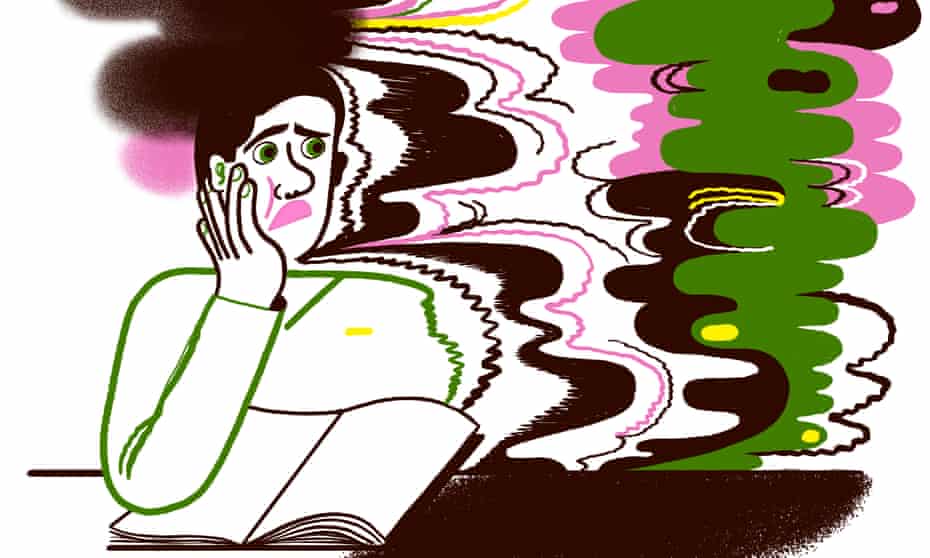
Brain fog has resulted from “degraded social interaction”
Brain fog has resulted partly from ‘degraded social interaction’. Illustration: Franz Lang/The Guardian

The blending of one day into the next with no commute, no change of scene, no change of cast, could also have an important impact on the way the brain processes memories, Simons explains. Experiences under lockdown lack “distinctiveness” – a crucial factor in “pattern separation”. This process, which takes place in the hippocampus, at the centre of the brain, allows individual memories to be successfully encoded, ensuring there are few overlapping features, so we can distinguish one memory from another and retrieve them efficiently. The fuggy, confused sensation that many of us will recognise, of not being able to remember whether something happened last week or last month, may well be with us for a while, Simons says: “Our memories are going to be so difficult to differentiate. It’s highly likely that in a year or two, we’re still going to look back on some particular event from this last year and say, when on earth did that happen?”

Perhaps one of the most important features of this period for brain fog has been what Loveday calls the “degraded social interaction” we have endured. “It’s not the same as natural social interaction that we would have,” she says. “Our brains wake up in the presence of other people – being with others is stimulating.” We each have our own optimum level of stimulation – some might feel better able to function in lockdown with less socialising; others are left feeling dozy, deadened. Loveday is investigating the science of how levels of social interaction, among other factors, have affected memory function in lockdown. She also wonders if our alternative to face-to-face communication – platforms such as Zoom – could have an impact on concentration and attention. She theorises – and is conducting a study to explore this – that the lower audio-visual quality could “create a bigger cognitive load for the brain, which has to fill in the gaps, so you have to concentrate much harder.” If this is more cognitively demanding, as she thinks, we could be left feeling foggier, with “less brain space available to actually listen to what people are saying and process it, or to concentrate on anything else.”

Carmine Pariante, professor of biological psychiatry at King’s College London, is also intrigued by brain fog. “It’s a common experience, but it’s very complex,” he says. “I think it is the cognitive equivalent of feeling emotionally distressed; it’s almost the way the brain expresses sadness, beyond the emotion.” He takes a psycho-neuro-immuno-endocrinological approach to the phenomenon – which is even more fascinating than it is difficult to say. He believes we need to think about the mind, the brain, the immune and the hormonal systems to understand the various mental and physical processes that might underlie this lockdown haze, which he sees as a consequence of stress.

We might all agree that the uncertainty of the last year has been quite stressful – more so for some than for others. When our mind appraises a situation as stressful, Pariante explains, our brain immediately transmits the message to our immune and endocrine systems. These systems respond in exactly the same way they did in early humans two million years ago on the African savannah, when stress did not relate to home schooling, but to fear of being eaten by a large animal. The heart beats faster so we can run away, inflammation is initiated by the immune system to protect against bacterial infection in case we are bitten, the hormone cortisol is released to focus our attention on the predator in front of us and nothing else. Studies have demonstrated that a dose of cortisol will lower a person’s attention, concentration and memory for their immediate environment. Pariante explains: “This fog that people feel is just one manifestation of this mechanism. We’ve lost the function of these mechanisms, but they are still there.” Useful for fighting a lion – not for remembering where we put our glasses.

When I have experienced brain fog, I have seen it as a distraction, a kind of laziness, and tried to push through, to force myself to concentrate. But listening to Loveday, Simons and Pariante, I’m starting to think about it differently; perhaps brain fog is a signal we should listen to. “Absolutely, I think it’s exactly that,” says Pariante. “It’s our body and our brain telling us that we’re pushing it too much at the moment. It’s definitely a signal – an alarm bell.” When we hear this alarm, he says, we should stop and ask ourselves, “Why is my brain fog worse today than yesterday?” – and take as much time off as we can, rather than pushing ourselves harder and risking further emotional suffering, and even burnout.

For Cohen, the phenomenon of brain fog is an experience of one of the most disturbing aspects of the unconscious. He talks of Freud’s theory of drives – the idea that we have one force inside us that propels us towards life; another that pulls us towards death. The life drive, Cohen explains, impels us to create, make connections with others, seek “the expansion of life”. The death drive, by contrast, urges “a kind of contraction. It’s a move away from life and into a kind of stasis or entropy”. Lockdown – which, paradoxically, has done so much to preserve life – is like the death drive made lifestyle. With brain fog, he says, we are seeing “an atrophy of liveliness. People are finding themselves to be more sluggish, that their physical and mental weight is somehow heavier, it’s hard to carry around – to drag.” Freud has a word for this: trägheit – translated as a “sluggishness”, but which Cohen says literally translates as “draggyness”. We could understand brain fog as an encounter with our death drive – with the part of us which, in Cohen’s words, is “going in the opposite direction of awareness and sparkiness, and in the direction of inanimacy and shutting down”.

This brings to mind another psychoanalyst: Wilfred Bion. He theorised that we have – at some moments – a will to know something about ourselves and our lives, even when that knowledge is profoundly painful. This, he called being in “K”. But there is also a powerful will not to know, a wish to defend against this awareness so that we can continue to live cosseted by lies; this is to be in “–K” (spoken as “minus K”). I wonder if the pandemic has been a reality some of us feel is too horrific to bear. The uncertainty, the deaths, the trauma, the precarity; perhaps we have unconsciously chosen to live in the misty, murky brain fog of –K rather than to face, to suffer, the true pain and horror of our situation. Perhaps we are having problems with our thinking because the truth of the experience, for many of us, is simply unthinkable.

I ask Simons if, after the pandemic, he thinks the structure of our brains will look different on a brain scan: “Probably not,” he says. For some of us, brain fog will be a temporary state, and will clear as we begin to live more varied lives. But, he says, “It’s possible for some people – and we are particularly concerned about older adults – that where there is natural neurological decline, it will be accelerated.”

Simons and a team of colleagues are running a study to investigate the impact of lockdown on memory in people aged over 65 – participants from a memory study that took place shortly before the pandemic, who have now agreed to sit the same tests a year on, and answer questions about life in the interim. One aim of this study is to test the hypothesis of cognitive reserve – the idea that having a rich and varied social life, filled with intellectual stimulation, challenging, novel experiences and fulfilling relationships, might help to keep the brain stimulated and protect against age-related cognitive decline. Simons’ advice to us all is to get out into the world, to have as rich and varied experiences and interactions as we can, to maximise our cognitive reserve within the remaining restrictions. The more we do, the more the brain fog should clear, he says: “We all experience grief, times in our lives where we feel like we can’t function at all,” he says. “These things are mercifully temporary, and we do recover.”

You've read
in the last year

… we have a small favour to ask. Through these turbulent and challenging times, millions rely on the Guardian for independent journalism that stands for truth and integrity. Readers chose to support us financially more than 1.5 million times in 2020, joining existing supporters in 180 countries.

With your help, we will continue to provide high-impact reporting that can counter misinformation and offer an authoritative, trustworthy source of news for everyone. With no shareholders or billionaire owner, we set our own agenda and provide truth-seeking journalism that’s free from commercial and political influence. When it’s never mattered more, we can investigate and challenge without fear or favour.

Unlike many others, we have maintained our choice: to keep Guardian journalism open for all readers, regardless of where they live or what they can afford to pay. We do this because we believe in information equality, where everyone deserves to read accurate news and thoughtful analysis. Greater numbers of people are staying well-informed on world events, and being inspired to take meaningful action.

We aim to offer readers a comprehensive, international perspective on critical events shaping our world – from the Black Lives Matter movement, to the new American administration, Brexit, and the world's slow emergence from a global pandemic. We are committed to upholding our reputation for urgent, powerful reporting on the climate emergency, and made the decision to reject advertising from fossil fuel companies, divest from the oil and gas industries, and set a course to achieve net zero emissions by 2030.


Friday, 9 April 2021

How to Overcome the Barriers to Self-Care

Self-Care 


Follow these expert tips to improve your relationship with your mind, body and emotions.

by Sarah John


For some, self-care might mean taking a hot bath. For others, it could be spending a night in with friends. 

Ask 100 people what self-care means to them, and you'll likely get 100 different responses. No matter the answer, we all seem to have one common theme with self-care — not doing enough of it. 

Job stress, family pressure, lack of time, limited resources and other barriers often keep us from a healthy, balanced lifestyle. For those who are low-income or are survivors of trauma, self-care might seem even more inaccessible. And with the pandemic, these stressors may be exacerbated.

We all know that self-care is important. So, why is it so hard to do? And how do we take back some control over our health and happiness — particularly if we're already in a spiral?

"I think we all want better lives for ourselves," says Jennifer Hooyman, a Minneapolis-based licensed clinical social worker and therapist. "But, (taking) the action steps is the hard part."

Rewire spoke with mental health experts about overcoming common obstacles to self-care in our lives and how we can start to improve our relationships with ourselves.

Commit to starting today

One of the first steps in taking better care of ourselves is simply committing to doing it. 

Emily Hamilton, a California-based licensed clinical social worker and therapist, insists that self-care is essential preventative work for both physical and mental health. 

The key, Hamilton says, is starting small — even if it's just setting aside a few minutes each day for yourself. "You can start today," she said.

Our mindset is also important, she adds. If we fall off the self-care horse, we shouldn't engage in self-criticism.  

Set boundaries

A critical part of carving out time for yourself is setting boundaries. Brainstorm where you can cut back on responsibilities and commitments in your daily life, and then act accordingly.

Hamilton says she encourages her clients to use a physical planner with a rough schedule of their days, including not just work, but items like hobbies and meals as well. 

The pandemic has made it difficult for some people to recognize if they are overworking themselves. But if clients realize they are, say, skipping lunch for work very often, then it might be time to reclaim a boundary for that time. 

Kathi Fanning, director of training at The Center for Trauma and Resilience, says that when it comes to setting boundaries or seeking special accommodations at work, many employers are willing to be more flexible and empathetic than you might expect. 

She recommends approaching your employer with specific details of what you want them to do, being aware of what your own boundaries are, and coming to the table with a plan and compromises ready.

Get in tune with your emotions 

Learning to understand and validate your emotions can be a daunting task. It's tempting to rely on avoidance-based coping strategies, but gaining an awareness of your emotions is important for establishing a self-care routine.  

When life feels overwhelming, sometimes it's best to go back to the basics of self-care.   |  Credit: Thruer // Adobe

Hooyman recommends starting by asking yourself if you can routinely identify what you are feeling, and trying to learn to identify others' feelings as well.

"It's even in the little things," Hooyman said. "If you are watching a show or reading something, ask yourself: 'Can I tell how this person is feeling?'"

Therapy is also an option. Hooyman says the most important thing is finding a good therapist you trust and who makes you feel safe. 

"I treat therapy as: we are re-learning how to treat ourselves using compassion and a non-judgemental lens," she said.

Ask for help

The ability to establish a self-care routine during tough times might involve leaning on your social support network.

Hamilton recommends reaching out to friends to see how they are coping. Make a list of things they do that might be helpful to self-soothe in your own life.

Although you might feel wary about reaching out for help, Hamilton insists that it's not something to feel guilty about.

"We exist in villages for a reason," she said. "We have supports so that we can use them."

Go back to basics

When life feels overwhelming, sometimes it's best to go back to the basics of self-care. 

Hamilton and Hooyman both recommend taking a few minutes to do some deep breathing, a practice they believe is highly underrated as a coping mechanism. We also often overlook dehydration as a sign of fatigue, so be sure to drink water throughout the day.

Take time to check in with your body, mind and emotions by asking the following questions: Are you aware of what you're eating and how it impacts your body? Do you have quality relationships with the people in your life? Could you establish a relaxing morning and nighttime routine? Could you cut down on caffeine? What do you like to do for movement?

Self-care may seem abstract and difficult to achieve. But it is often merely a matter of taking an inventory of your life and figuring out how to respond to your environment in sustainable, balanced ways. 

And, if all else fails, remember that self-care is anything you do to help get you through the day. You don't have to be amazing.

"If you're just treading water to not drown, then that is (still) a success," Hooyman said.

Sarah John
Sarah John is a freelance writer based in New York City. Follow her on Twitter @sarahmjohn_, or reach out via email at sarahmjohn1@gmail.com.

Monday, 3 August 2020

How To Use Boredom To Be More Productive

Boredom


Empty your cup, then fill it with what matters.

Jul 23 · 3 min read
The first step to do anything is to stop doing everything. To be still.
In a way, boredom is the most productive thing you could do.
Think about it.

There are two types of work you could be doing:

Work from fear. This is anything you do because you should. This is the full-time job you hate. The commitments you regret you’ve made. The stuff other people make you do. Work from fear is often done with the use of discipline, which, in turn, burns energy and leaves you feeling exhausted.
Work from love. This is anything you love doing and would do even if you weren’t paid for it. (In fact, the best way to know what you love doing is to notice what you do when you don’t need to be doing anything. For example, I write.)
When you do something from love, you don’t need to be motivated or compelled. You do things for the sake of doing them, and you enjoy the process.
Any work can be either ‘from love’ or ‘from fear.’
You can write from fear because you’re afraid that you won’t make enough money this month. Or you can write because you enjoy the process, respect the craft.
You can go for a run from fear because you’re afraid you’ll gain weight. Or you can go for a run from love because you enjoy running and want to breathe some fresh air.
Externally, it’s going to look the same. But your attitude, approach, and the feelings that you experience differ. At the end of the day, it doesn’t matter what you achieve, if you didn’t enjoy your life.
Fear is the opposite of love. They cancel each other out. You can’t love when you’re afraid. And vice versa, if you love — the fear ceases to exist. The difference is in the approach.

Imagine a straight line from minus infinity to plus infinity.

Everything on the left side (negative) is where you are when you work from fear. You are on the right-hand side (positive), when you work from love — meaning, you do what you want, and don’t do what you’re supposed to.
When you’re moving in a positive direction — usually, during an emotional or creative recovery, trying to do more of the stuff you love and following your dreams — you’ll inevitably end up in 0.
In mathematics, zero is not the beginning of things, but the middle. It’s what separates the negative from the positive.
In our case, that zero is boredom.
And the important question is:
What do you usually do when you get bored?
The answers will reveal what’s holding you back from doing what you love.
These are the gatekeepers that guard the entry into the world of living from love.

For example, my three ‘coping mechanisms’ with boredom are:

  1. Overworking.
  2. Binge-eating.
  3. Drinking more alcohol than I should.
This is why, whenever I get bored, I do one of the above (or everything at once) — and end up falling back into the negative, fear.
And here’s where it gets interesting.
If you resist the urge to fall back into your old habits — and sit with boredom, feel it, nurture it, embrace it — you’ll finally reconnect with yourself.
You know you’ve managed to enter the world of love when you cancel out boredom not with negative habits (‘coping mechanisms’) but with something you truly enjoy doing. Something that nourishes you.
The writer Neil Gaiman uses this principle in his work. He sits at his desk and tells himself, “Hey Neil, dude; you can either do nothing or write.” After a few minutes of staring at the wall, he starts writing, because it’s more interesting than doing nothing.
This also explains why most blocked writers drink alcohol as a way to fight off the neutral state instead of writing.
To do many great things in life, you first have to enter the state of doing-nothingness and just sit there. Enjoy it. And once you’ve had enough, fill the emptiness with doing what you love.

Written by

Sergey writes about living a meaningful creative life and content creation as a career | Join his free newsletter: https://honestcreative.substack.com/


Sunday, 13 October 2019

How to Listen to Your Anger

Anger

Anger is energy with a message, and it’s talking to you

Apr 23 · 9 min read

Credit: Malte Mueller/Getty Images
For years, I was known in my friend group as “the calm one.”
I took this label as a compliment because it meant I was stable. I could handle stress well. I could use a well-modulated voice and carefully chosen words in a conflict. I could articulate rather than emote.
I felt these were worthy accomplishments and signs of superiority — clear indications that I wasn’t a weak, emotional creature, but a strong, stable, mature, logical person.
Ha, hahaha, ha.
I carried this idea of myself for years (years!) until a small incident broke it open — and broke me down.

Illustrations: Annie Mueller
We were on the beach. My oldest daughter, 10 at the time, was coming out of the water. She was hopping and playing in the surf when a dog ran up, jumped at her, and bit her on the ankle. It wasn’t a bad bite; it didn’t even break the skin. She was physically fine but she was scared.
I was sitting a few yards away on the sand and saw it all happen. I ran to her, grabbed the dog by the collar, and looked around for the owner.
No one.
I yelled, “Whose dog is this?”
Silence.
There were plenty of people on the beach, but no one was willing to claim the dog. I gave up and shooed the dog away, then went to comfort my daughter, telling her that it’s okay and it’s not a big deal.
I was trying to convince her to forget — and also trying to convince myself.
As it turns out, being able to consistently stifle your anger is not a sign that you’re emotionally healthy.
But the feeling I had grew and grew. It was a feeling I couldn’t quite name until it burst into my face with its red and orange flares and screaming voice and insistent crackling tension: anger.
As the anger rolled and boiled, other memories clawed their way to the surface, demanding to be heard and seen for what they were: situations in which I felt helpless, unheard, ignored, diminished, and shut down.
Those situations flooding my memory broke me open. What broke me down, though, were the corresponding moments that flooded in with them: the moments when, instead of standing up for myself, making my voice heard, demanding respect, operating in power, and expressing my emotions and needs, I shut myself down.
In every one of those situations, I told myself those smooth, sinuous, debilitating words: “It’s okay. It’s not a big deal.”
Oh, but no.
Oh, but it is not okay.
Oh, but it is a big deal.

As it turns out, being able to consistently stifle your anger is not a sign that you’re emotionally healthy. It’s not a sign that you don’t have much of a temper, or that you don’t care, or that you’re super mature. It’s a sign that you’ve learned, one way or another, to exercise great restraint over how you outwardly express your anger. Sometimes this restraint is good.
It’s helpful to control your words when you’re angry, so you can communicate the cause of your distress without insulting someone. When I see grown people cursing and insulting each other over, say, a fender bender, I think, “More restraint would be good here.” When I hear a parent belittle their child over a simple mistake, same story: More restraint would be good in these situations.
Sometimes, however, this restraint is not so good. If you’re unable to express valid anger over injustice, injury, insulting treatment, or behavior that you don’t appreciate, you set yourself up for a repeat of that behavior.
No, it’s not your fault that people behave badly — but people do behave badly, or, more often, carelessly. If they carelessly step on your toes or stomp on your soul, it’s up to you to say, “Hey, don’t do that. I don’t like it. I won’t accept it.”
Anger is there to help you speak up on your own behalf. If you ignore the anger — stuff it down, stifle it, and never express it — the most likely result is that the person will continue the same type of behavior. Maybe they don’t even know it hurt you. Maybe they know but don’t really care. Either way, you keep getting stomped on.
There are a couple of ways this situation can play out.

Scenario 1: The fade

The person isn’t someone close to you, so you fade out and avoid them, and in that way, you avoid the behavior that hurt you without ever having to express your anger about it.
Sometimes this is the easiest, most logical scenario.

Scenario 2: The stuff

The person is someone close to you — someone you care about — and their repetitive bad behavior bothers you and hurts you, but you don’t know how to express your anger about it, so you just stuff it.
Stuffing it does nothing to solve or alleviate the anger, so the anger just gets packed down, smushed in, and pressurized. Soon, it becomes a supersized steel tank of super condensed anger under very high pressure, and at some point, that tank will not be able to hold anything else. It won’t boil over; it will explode. And it will not be pretty.


Anger itself is not a problem. Nope. Anger is often connected to unpleasant outbursts, yelling and screaming and cursing at people, heated arguments, fights, verbal and physical conflicts, abuse, and violence.
But anger is not the problem.
Anger is a feeling. It is not bad; it is not good. It just is. Anger is a feeling, and a feeling is a message. Physical pain is a feeling: It bears a message to you about some sort of physical damage happening to your body. It’s telling you to stop doing or allowing what’s causing the pain. It’s helping you protect yourself from harm.
Emotional pain (anger, in this case) is a message as well. It’s there to warn you about some sort of emotional, mental, psychic, or spiritual damage happening to you. Whether the damage is perceived or real doesn’t matter. The message is there, telling you, “Wake up! Pay attention! Check it out! Make it stop!”
The anger that doesn’t get to be, and act, and solve, and express, becomes something much darker than anger: It becomes a sickness, a poison.
If you check it out and determine that there’s no damage, cool. Sometimes fear provokes anger to get us to act. Sometimes a close look at anger will tell us that we’re actually feeling scared, and the best thing to do is let go of the anger and deal with the source of fear.
But sometimes there’s more going on. Fear is always the root of anger. We become angry with others because we’re afraid we won’t take care of ourselves. We don’t trust ourselves. And there’s a good reason we don’t trust ourselves to meet our own needs — so many times, we ignore them.
“It’s okay. It’s not a big deal.”
Oh, but no. Say it with me now.
“Oh, it is not okay.”
“Oh, it is a big deal.”

Unexpressed anger is a time bomb.
When anger — especially a whole lot of anger occurring over a long period of time — isn’t expressed, it doesn’t go away. It compresses.
When anger isn’t expressed, it doesn’t just disappear. It simmers.
Anger is what motivates us to take action: fix, change, stop, or fight something. Not all of our anger is well directed, of course. Sometimes it motivates us to take stupid actions. Very often we try to fix (or change, stop, or fight) the wrong thing entirely. But that’s another story.
The anger that doesn’t get to be, and act, and solve, and express, becomes something much darker than anger: It becomes a sickness, a poison. It’s bad for you, the person holding it in.
After a while, it starts to color all your emotions, your perspectives, and your assumptions. It will poison your relationship with the person who instigated the anger, but that’s not all it will do. It will poison your relationships with other people. You will become a weird mix of very sensitive and rock-hard.
That’s because of the supersized steel tank you’ve put around your pressurized anger. It’s big and impenetrable and it takes up a lot of internal space and people go clanging around in there, trying to be friends and connect, and suddenly they get this rock-hard, cold, metallic response from you.
At other times, they’ll get a completely over-the-top sensitive reaction from you. That’s because all your other emotions — joy, grief, wonder, appreciation, insecurity, disgust, and so on — are now smushed uncomfortably into tiny little spaces around your big anger tank. They get squished and pressurized, too.
Anger is energy with a message, and there’s only way to deal with it: Stop and listen to the message.
One of those emotions gets a random poke and it fizzes up and bursts out all over, and you’re just left standing at the zoo, sobbing uncontrollably because of the beauty of the pandas, and you don’t know why.
Or you’re inexplicably, deeply, horribly wounded by a friend’s comment: “Maybe we shouldn’t go to the zoo. It was a little… tricky… last time.”
And you spend days crying, hiding in your room, living on peanut butter-filled pretzels, because you can’t stop thinking about the implications of every single word and your friendship and the animals and what does “tricky” even mean and who even says that? It keeps on going until you manage to pull yourself together. Chronic overthinking is often a sign of unheard, ignored, stuffed-in anger.
You don’t know when it will happen again, and you don’t know why you respond that way, and you hate feeling out of control. You hate the deep, dark rage that pushes its way up sometimes because it scares you and you don’t know what to do with it — so you stomp it back down, back into the tank, and you twist it shut and hope it stays that way.
But it won’t. And you don’t want it to. Because that anger is there for you. It is about you. It presents as being about other people and other people’s behavior, because we’re comfortable that way. Anger will masquerade however it must to get your attention.
Anger is energy with a message, and there’s only one way to deal with it: Stop and listen to the message.
Once you listen to the message, you can decide what to do with the energy.
If the message is, “You’re allowing yourself to be mistreated,” then your energy can help you set boundaries.
If the message is, “You’re afraid of being ignored,” then you can use your energy to speak up for yourself, to make sure your voice is heard.
The message will tell you where the energy needs to go.
When you use the energy of anger without first listening to the message, you’re likely to misdirect. Have you ever yelled at your partner when you know, deep down, you’re really mad at your boss? Have you ever blown up over some tiny, uncontrollable incident — someone cuts you off in traffic — when you know, deep down, you’re a raging lava vat of fear and anger because your mom has cancer, or you didn’t get the scholarship, or your kid is in trouble, or your partner doesn’t listen?
Ignoring the message and misdirecting the energy will make you feel better for a moment, but it will not solve the problem. It will not get you to the cause. Ultimately, it will not resolve your anger.
The anger will return with its message, over and over, until you listen.
Anger is there to serve you. It is a messenger of truth. It might be painful to listen. The message might knock you over, break you open, and break you down. But it’s the way forward.
Come on. Let’s go together.

Written by

Writer, reader, growth seeker. Doing the content all day. Freelancing adventures, feelings, and gifs: ht