Showing posts with label mental health. Show all posts

Sunday, 19 September 2021

How to boost your mood using colour during autumn and winter

Colour in your life 


Posted by for Life


It’s easy to feel down when it’s dark and cold outside but there are lots of ways you can bring colour into your life. Here, an expert explains how to use colour psychology to help boost your mood.

Welcome to The Curiosity Academy, Stylist’s new learning hub where you can access workshops, how-to guides, new research and learn the most up-to-date skills from the UK’s most in-the-know people.

We think about colour all the time. It dictates the clothes we wear, how we decorate our homes and so many other small decisions we make throughout the day that we might not even realise colour is influencing. Our colour preferences are often ingrained within us, which is why it can be hard to explain why a particular colour, like blue, for example, is your favourite, but you find yellow totally unappealing.

Colours can also help us express and understand emotions, making them a powerful communication tool. This is a discovery people have made on TikTok recently. Creators have been taking to the platform to explain the meaning of each colour and how it can help them understand themselves and the people around them better, with the tag #colourpsychology reaching over 4 million views. 

As we head into the autumn and winter months and the nights get darker, many people will find this negatively impacts their mood. But although the skies might not be blue, there are plenty of ways you can bring more colour into your life and use it to help improve your mindset.

In fact, you can even use colour as a self-help method. Karen Haller, a behavioural colour psychologist, has spent years researching this and has found an array of methods to help you do so. Although it’s not necessarily as simple as TikTok would have you think.

“Colour psychology is a study of how we can use colour to positively influence how we think, feel and behave,” Karen says. “It’s one of the most underestimated resources we have to change how we act.”

“When you decide whether or not you like a colour, that’s an emotional experience,” Karen says. “It makes you feel something, even if you’re not consciously aware of it.”

Building a personal relationship with colour psychology is an ongoing process but there are a few things you can do to start to use colour to positively influence your life, and maybe even help you deal with issues like self-doubt and social anxiety

What is the meaning behind each colour?

Karen explains that each colour has a traditional psychological meaning. However this can vary depending on the shade of the colour, so it’s not necessarily important to learn them all. It can be useful to understand what the primary colours represent, though.

“Each colour has positive and adverse effects,” Karen says, explaining that both of these things need to be taken into account when you’re thinking about how to use these colours to your benefit. 

Red

“Red is a very physical colour. Red physically stimulates us – it encourages motivation and energy,” Karen explains. “Because of this, however, red can also cause overwhelm, as it represents speed, and it can sometimes make you feel like you are moving too quickly.”

Yellow

“Yellow has a direct effect on the nervous system. Yellow is an optimistic colour that encourages positivity,” Karen says. “However, the adverse effects are that yellow can be quite irritating and anxiety-inducing.” 

Blue

“Blue is the colour that aligns with the mind. Dark blue is mentally stimulating and it can help with focus; soft blue is a colour that allows your mind to dream,” Karen explains. “Often, blue can keep the mind overly-stimulated, which is something to look out for as an adverse effect.” 

How to figure out which colours work for you

Although there are traditional meanings that can be assigned to each colour, as people do on TikTok, Karen explains that colours are actually very personal, and the colours that help you feel better will be different to the colours that help a friend or family member feel good.

Karen recommends going through your wardrobe and pulling out clothes in an array of colours and then holding each of them up to your face, in order to figure out what your relationship is with each colour. “Without any make-up on, stand in front of a mirror and hold the different colours up to your face,” Karen says. “Take note of what happens to your face – does it light up or does it create shadows?”

If you know one colour suits your complexion, you can use this to compare to the other colours. This method isn’t only about your appearance, however. Consider how your facial expressions and other reactions differ with each colour, as this will help you to understand how you connect with different colours. 

How to establish an emotional connection with colour

You’re constantly coming into contact with different colours in your day-to-day life and it’s not possible to consciously understand your reaction to every single one of them. But in order to become more in touch with your relationship with colours, Karen recommends keeping a diary for a period of a week to take note of how you respond to any colours that stand out to you or that you have to make decisions about.

“Write down what you are wearing each day and how the colours in your outfit make you feel,” she explains. “You should also take note of other decisions about colour you make, like choosing a red glass instead of a yellow glass.”

You don’t have to acknowledge your decisions in this way for very long but by doing so for a short period of time, you’ll come to better understand your relationships with specific colours, which will help you make better colour decisions in the future. 

How to incorporate colour psychology into your life moving forward

Once you have established your relationship with particular colours, you can start to incorporate them into your life more, whether that’s through decorating your home with them or buying clothes in that colour. You can then also follow the same process Karen explains above to figure out which colour combinations work for you.

“The most important thing is that you think consciously about the decisions you make about colour,” Karen says, adding that by making intentional decisions, you will become more conscious of which colours you like and dislike, which will help keep you in touch with your emotions.

Want to learn more about colour psychology? You can buy Karen’s book, The Little Book of Colour: How To Use The Psychology Of Colour To Transform YourLife.

  • Karen Haller, colour psychologist

    Karen Haller, colour psychologist
    Karen has spent many years researching colour psychology.

    Karen is a leading international authority in the field of behavioural colour and design psychology. Her area of speciality is in behavioural and human centred design and how our relationship with colour, design and nature affects and influences us, as well as how businesses and designers can use it to influence positive behaviour and wellbeing. 


Thursday, 16 September 2021

3 Psychological Reasons You’re Always Anxious

Anxiety 


Let them go and peace of mind will follow


Photo by engin akyurt on Unsplash

 
Nick Wignall

Sep 8 · 7 min read

We all get anxious from time to time. But living with chronic anxiety is another thing entirely…

  • Constantly worrying about the future and imagining the worst
  • Never being fully present in conversations because you’re always worried about what the other person is thinking of you
  • Feeling tense, on-edge, and exhausted all the time
  • Dreading that your next panic attack is just around the corner
  • Constantly second-guessing yourself, seemingly unable to make even small decisions confidently

While there are obviously many things that lead us to feel anxious, here’s the key insight most people miss:

Whatever caused your anxiety in the past, it’s your habits in the present that are maintaining it.

If you can learn to identify these anxiety-producing habits in your life, you can work to undo them and eventually free yourself from constant worry and chronic anxiety.

1. Avoiding uncertainty

It’s human nature to want to avoid feeling uncertain. When you first show up to a dinner party, for example, you quickly scan the room for someone you know, then gravitate toward them.

Of course, there’s a good reason for this: Our ancestors who were better at minimizing uncertainty probably survived longer than the ones who weren’t afraid of it. In other words…

We’re wired by evolution to prefer the familiar and safe to the uncertain and potentially dangerous.

But even in modern life, it’s often good to minimize or avoid uncertainty:

  • Not sure if your upcoming presentation is going to be received well? Practice in front of a few friends and get feedback on the parts that don’t work so well.
  • Not sure if the person you’ve been dating for two months is “the one”? Maybe date a little longer and reduce some of that uncertainty.

But here’s the thing: While we are all wired to avoid uncertainty, and frequently benefit from doing so, it’s a mistake to get in the habit of alwaysavoiding it… After all, what kind of a life is it if you never take risks, never try new things, or never push yourself outside your comfort zone?

Unfortunately, it gets worse… Aside from your life becoming increasingly boring and uneventful, there’s an even bigger problem here:

Avoiding uncertainty gives relief from anxiety in the short-term, but it intensifies it in the long-term.

Here’s a simple example:

  • A good friend texts you and invites you to a dinner party she’s hosting. But after hearing that most of the other guests will be people you don’t know, you begin to feel anxious.
  • You worry about feeling awkward and uncomfortable explaining your boring job, for instance. You dread the idea of small-talk and superficial get-to-know-you chatter.
  • The more you think about it, the more anxious you feel.
  • At this point, the option to decline and make up a white lie about a previous engagement is getting pretty tempting because not only would it save you the potential anxiety of an awkward dinner party with people you don’t know (uncertainty!), but it would also immediately alleviate all the anxiety you’re feeling right now.
  • So you text your friend that you won’t be able to make it. And sure enough, you immediately feel relieved.

The problem here is that while you’ve escaped uncertainty and anxiety in the present, you’ve actually made it more likely that you’ll feel anxious in the future.

Here’s how it works…

The fear center in your brain is always on the lookout for danger. And when it spots something, it makes you a little anxious (physiologically, anxiety is just adrenaline and your fight or flight system activating).

But critically, it also watches how you respond to that initial threat and hit of anxiety:

  1. Escape. Do you confirm your fear center’s initial assessment that the uncertainty of the dinner party is a threat to your survival by trying to escape it? If so, you will feel less anxious in the moment. But you’ve taught your brain that dinner parties with unfamiliar people are a threat to your survival. Which means the next time a similar opportunity shows up, you’re going to feel even more anxious and be more tempted to avoid it. See where this vicious cycle is going…?
  2. Approach. Or, you could dis-confirm your fear center’s initial assessment that the uncertainty of the dinner party is a threat by approaching it and going anyway, which would give your brain valuable feedback that just because it feels uncomfortable doesn’t mean it literally is dangerous. And while this might make you more anxious in the short-term, your brain would be less anxious the next time a situation like this came up. See where this virtuous circle is going… ?

Here’s the take-home message:

Avoiding uncertainty leads to short-term relief and long-term anxiety. Welcoming uncertainty leads to short-term anxiety and long-term confidence.

Choose wisely.

2. Avoiding helplessness

If there’s one thing human beings tend to avoid more than uncertainty it’s helplessness.

We absolutely hate feeling helpless.

For example:

  • Feeling scared that your upcoming interview won’t go well and not being able to do anything about it now that it’s almost here.
  • Being afraid of your son’s first airplane flight alone and not being able to do anything about it.
  • Hearing your spouse talk about how depressed they’ve been feeling and knowing that you can’t make them feel better.

Of course, like uncertainty, some amount of helplessness is unavoidable in life because we just can’t control everything (and everyone). But here’s the thing: The urge to try and control the uncontrollable is surprisingly strong.

So strong, in fact, that we end up doing some surprisingly irrational and harmful things in order to maintain the illusion of control:

  • You build up excessively high expectations for people in your life because, hey, if I can’t make them do well, telling myself that they should do well feels kinda close….
  • You get overly involved in other people’s lives even though they’ve asked you not to (and it stresses you out).
  • You replay mistakes and regrets in your head over and over again because even though you know intellectually that you can’t change the past, ruminating on it at least feels like you’re doing something productive and not totally helpless.

With a little self-reflection, you can probably think of many areas in your life where you try to control something that’s actually not under your control.

But there’s one big form of unhelpful (and anxiety-producing) control that most people miss:

You worry about things you can’t control because it temporarily makes you feel in control.

By definition, worry is unhelpful negative thinking about hypothetical or future problems. And as every chronic worrier will admit to, it leads to A LOT of anxiety. In fact, as I’ve made the case before, worry is the engine of anxiety.

But what’s weird about worry is that often when you’re worrying, you probably know intellectually that it’s not actually helpful. And that it’s only making you anxious and stressed.

And yet, you keep worrying… Why?

Well, just like we tend to eat junk food despite knowing that it’s bad for us, we worry because for a few brief minutes or seconds it feels good.

Worrying gives us something to do and makes us feel in control when we would otherwise feel helpless.

And because worry is so similar to problem-solving and planning, it’s easy to rationalize it. But in the end, worry is all side-effects and no benefit: It makes you incredibly anxious and doesn’t actually fix anything.

But because it temporarily feels good, we get addicted to it. Because it temporarily alleviates that terrible feeling of helplessness, we come back to it over and over again despite all the anxiety it generates.

Which is all to say that if you want to feel less anxious, you must learn to control your worry habit.

3. Avoiding boundary-setting

One of the most subtle but powerful causes of chronic anxiety is unhealthy boundaries:

  • Always saying yes to your manager’s request to do “a little” extra work over the weekend
  • Always “going with the flow” and agreeing to what your spouse wants to do for vacation
  • Always answering your sister’s phone calls and listening to her vent and complain about her toxic relationship

I mean, think about it:

If you’re constantly taking on other people’s problems, and never have time to address your own wants and needs, how could you not be anxious!

But if it’s so obvious that unhealthy boundaries lead to anxiety, why do we struggle so much to set healthy boundaries?

While there are many, many reasons, one of the most important is this:

You struggle to set boundaries because you’re afraid to communicate assertively.

Now, a lot of people hear the term assertive and they think rude or pushy. But in reality, assertive communication is the healthy middle ground between aggressive and passive.

  • Aggressive communication is when you try to get what you want but in a way that’s rude and disrespectful to others.
  • Passive communication is when you’re disrespectful to your own wants and needs because you’re overly concerned with and accommodating of other people.
  • Assertive communication means asking for what you want and saying no to what you don’t want in a way that’s respectful to yourself and the other person.

This isn’t the time or place to get into all of the nuances of how to be more assertive. But what’s key to realize is this:

If you’re unwilling to stand up for yourself, you’ll be unable to maintain healthy boundaries. And without healthy boundaries, your anxiety will skyrocket.

If you want to start feeling less anxious all the time, practice communicating assertively.

Wednesday, 30 June 2021

Anxiety Is in Your Body, Not Your Mind

Anxiety 


Why you might want to stop talking about your anxiety and try this instead

Emma Pattee

Let’s back up 50,000 years or so. Imagine you’re a Neanderthal taking a leisurely stroll through the fields. Suddenly, in the nearby bushes, you hear a tiger. In a nanosecond, your entire body starts reacting. Your pulse quickens, your breathing gets shallow, your eyes dilate, your body starts producing adrenaline.

Everything happening in your body is good; you’re prepared to survive this tiger encounter. There’s just one small problem. It wasn’t a tiger. It was a tiny prehistoric weasel. Now your body is primed for fight-or-flight, your heart is racing, you’re totally jacked up on adrenaline… but there is no danger.

This is your body on anxiety. Replace the (nonexistent) tiger in the bushes with social media, traffic, politics, Covid-19, money, childcare, climate change, work stress, family drama, and you can quickly see why anxiety is the most common mental illness in America, affecting nearly 20% of the population. Modern-day humans are basically a bunch of freaked-out Neanderthals in fight-or-flight mode 24/7.

“Anxiety is an impulse in our body that says, ‘I’m not safe right now,’” says Elizabeth Stanley, PhD, the author of Widen The Window: Training Your Body and Brain to Thrive During Stress and Recover from Trauma. “It’s automatic, really fast and unconscious.”

Your survival brain vs. your thinking brain

In her work, Stanley makes the distinction between the thinking brain, our neocortex, responsible for decision-making, reasoning, ethics, conscious memory, learning, and the survival brain — the limbic system, brain stem, and cerebellum — which handles our basic survival, emotions, implicit memory, and stress arousal.

One of the survival brain’s most important functions, according to Stanley, is neuroception, an unconscious process of rapidly scanning the internal and external environment for safety and danger. When danger is spotted, your survival brain sends an instantaneous stress arousal message to your body by turning on the sympathetic nervous system, resulting in the release of specific hormones that lead to certain physical sensations related to our heart, breathing, and digestion. “Whatever’s happening in the survival brain has these tremendous ripple effects through our body,” Stanley says.

As Stephen Porges, PhD, a psychologist and the creator of the Polyvagal Theory, explains in an interview with PsychAlive, “These responses are not voluntary. Our nervous system is picking up information in the environment, not on a cognitive level, but on a neurobiological level.”

Importantly, when we’re caught in a defensive response, the thinking brain is the last to be aware that something is wrong.“The thinking brain isn’t what decides whether we’re stressed, whether we’re feeling threatened or challenged, whether we’re going to turn stress on, whether we’re going to turn emotions on,” Stanley says. “Stress arousal and emotions belong to the survival brain.”

So if you want to track your anxiety, your body, not your thoughts, will be your most accurate map.

The talk therapy trap

Unlike our prehistoric ancestors (who might have dealt with anxiety by running, panting, or shaking like a dog and letting the cortisol work through their system, according to Stanley), modern anxiety sufferers turn to their trustworthy friend, their thinking brain. “Most people identify anxiety by their thoughts because most people identify with their thinking brain,” she explains.

The problem is that when it comes to regulating our nervous system after a stress response (read: anxiety), our thinking brain is the absolute worst tool for the job. That’s because, according to Porges, even after becoming aware of the physical response, we often don’t know what has triggered that response. For Stanley, a veteran who was diagnosed with PTSD, this realization was a huge turning point. “Recovery from stress and anxiety is a survival brain job.”

We are a cerebral culture, which makes us very equipped to deal with problems that require reason and logic — think moral dilemmas — and less equipped to deal with problems where cognitive reasoning can just make them worse. Having a “fight or flight” response to running late to brunch may seem like an overreaction, but sitting in traffic, you are physiologically experiencing it all the same. We use our thinking brain to try and decide if the issue is “worth” being anxious about, and then we try to force our nervous system to comply. “Our consciousness gets disconnected from our body in those moments,” says Stanley. Your thinking brain decides that you have nothing to feel anxious about, so you spend your days walking around telling yourself that everything is fine while still feeling the physical symptoms of anxiety throughout your body. Even worse, your thinking brain may start to criticize and shame you for still being anxious even after it’s told you that everything is fine.

If you, like me, have spent a few decades (and the equivalent of a house down payment) in talk therapy analyzing all the reasons you’re anxious, this is probably a hard pill to swallow. Not only did all that talking not do much to alleviate anxiety, but it could also even have made it more acute. “Our survival brain wants to keep us safe, but when we disregard our body and its signals because we’re so caught up in our thinking brain’s stories and thoughts, the survival brain actually perceives that as even more threatening,” says Stanley. “Like a toddler, it’s going to tantrum louder until its message gets through. And that’s why it becomes such a vicious cycle.”

Take, for example, Cognitive Behavioral Therapy, one of the most common forms of talk therapy. According to the Mayo Clinic, “CBT helps you become aware of inaccurate or negative thinking so you can view challenging situations more clearly and respond to them in a more effective way.” Sounds great, right? While this kind of analysis could be profoundly helpful when dealing with family issues or working out an ethical question, when it comes to anxiety, which doesn’t take place in your thinking brain, it places the focus on the thought (“I thought there was a tiger!”) and not the physical response which preceded, and even caused, the thought (“my heart is racing and I’m full of adrenaline and I need tools to calm down”).

“We don’t necessarily want to be aware of and feel the discomfort in our bodies because anxiety in our bodies is uncomfortable. Instead, we want to try and fixate it and give it this external object,” explains Stanley. But if the external object didn’t cause the anxiety, then fixing it won’t alleviate the anxious feeling.

A bottom-up solution for anxiety

While talk therapy and medication are still the mainstream solutions offered for chronic anxiety, other modalities exist that offer a body-first approach. And while these modalities are still considered “alternative,” an increased interest in “brain science” and neurobiology along with continued research on mindfulness and mind-body connections are shifting our psychological understanding from focusing only on the mind to seeing the brain and body as a cohesive unit.

Part of the challenge, according to Pat Ogden, PhD, the creator of Sensorimotor Psychotherapy, is that you need to close the loop that was started when your body first went into a stress response. Ogden uses the example of a client who is Black and frequently stopped by the police without cause. When this happened, the man understandably felt himself getting angry and his body tightening up: a “fight” response. As part of their work together, Ogden helped him identify and act out the physical de-escalation his body needed in order to return to a regulated state, in this case getting to strike out and defend himself within the safety of a therapy session. “We want to complete that impulse in mindfulness so that his brain is integrated and it’s not held in his body anymore,” says Ogden.

Ogden points out that part of the limitation of talk therapy is that anxiety is often related to a dysregulated response connected to an implicit memory, which then gets incorrectly pinned on a current experience or thought. “It doesn’t have anything to do with the current content,” says Ogden.

Stanley, who offers a mind fitness training course to help people build resilience, focuses on mindfulness techniques. And while at this point it’s a cliché to tell anybody with anxiety to take 10 deep breaths, her course has helped thousands of people, including active-duty military. “The military is very experienced in stressful situations, and they’ve trained themselves to turn on the survival brain but don’t always know how to turn it off,” says Stanley. Studies funded by the Department of Defense showed that Stanley’s method significantly helped improve cognitive performance during stress, lower perceived stress levels, increase regulation, and foster a faster return to baseline after stress arousal.

When your body is having a stress response, the first thing is to become aware of objects that help the survival brain feel safe, like what you can see and hear. “One of the best ways to help the survival brain feel grounded is to bring attention to where our body is in contact with our environment,” Stanley says. She suggests focusing on the contact between your feet with the floor, or your body in your chair. As soon as the survival brain perceives groundedness and safety, it automatically starts the recovery process.

Obviously, when you’re caught in a moment of severe anxiety, trying to breathe deeply or be mindful can feel almost impossible. In those situations, what you need is to get the adrenaline and cortisol out of your system. Stanley suggests jumping rope or running up and down stairs. After 10 minutes, try a mindfulness exercise again.

Is there any role for talk therapy, or trying to think logically about your anxiety? Absolutely. But only once your body is regulated, Stanley says: “After we have helped our survival brain feel safe and stable, then we can work on our thoughts. Otherwise, our cognitive response continues to be biased by our stress and emotions.”

Writer from Portland, Ore. Words in The New York Times, The Washington Post, The Cut, Glamour, Marie Claire, Elle, and others. emmapattee.com


Wednesday, 9 June 2021

‘Don’t freak out!’ Why keeping calm and carrying on exercising can help back pain

Back Pain 


When it hurts to walk, bend or even sit, it’s tempting to lie down until your spine sorts itself out. But moving can be the key to getting better


Turns out pandemics can be atrocious for our backs. By last October, more than a third of people in the UK had reported increased back pain, according to one study – and that was before an intense winter lockdown, followed by a month-long storm. We’ve been doing online yoga without an instructor’s watchful eye and lunging with Joe Wicks without warming up, but mostly slouching over laptops feeling tense or depressed.

While the onset of back, shoulder or neck pain can feel like the last straw, the good news is that it probably isn’t as bad as you think. “It’s not likely to be serious,” says Chris Mercer, an NHS consultant physiotherapist in Sussex who specialises in back pain. It was not uncommon to keep an old door under the bed, upon which to lie when your back “went”. But the latest evidence indicates that being active is essential for both avoidance and recovery. “Keep moving, keep active and things will settle,” he says.

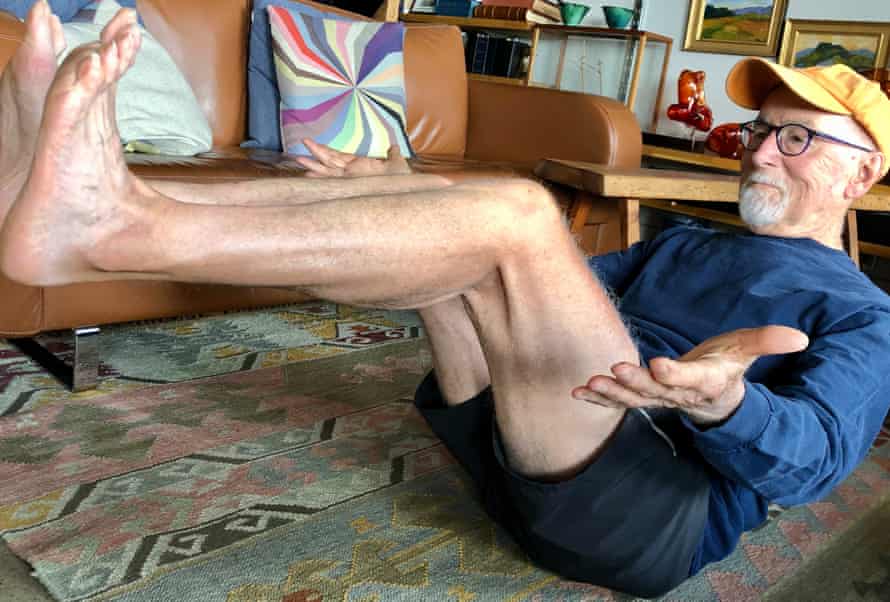
Embracing activity when you’re hurting can be scary, but Jack Noonan, an 80-year-old retired English professor who lives in Philadelphia, has learned the benefits first-hand. He did, in fact, have something serious – sciatica, intense pain, usually in the back of one leg, caused by the compression or irritation of the sciatic nerve – but is now as fit as a fiddle and believes the exercise regime he developed for himself not only cured his back pain, but helped him avoid surgery.

‘I worked really, really hard, and it worked’ ... Jack Noonan, exercising at home.
‘I worked really, really hard, and it worked’ ... Jack Noonan, exercising at home. Photograph: Provided by Jack Noonan

When he first developed sciatica he says he was “hit over the head with the pain”, adding that it was so bad at one point that he couldn’t even go for a walk. An orthopaedic surgeon told Noonan that he had a hardened perineural cyst in his spine, and the only lasting solution was surgery. But to Noonan, it felt “intuitive that if you can, by stretching, raise those collapsed vertebrae a little better, that might solve the problem. So I worked really, really hard. And it worked.”

A physiotherapist taught him how to do pelvic tilts – lying flat on your back and lifting the pelvis up off the floor. “It felt really good to learn how to move my pelvis,” he says, “and I became kind of driven about that.” He devised a series of 15 exercises – some from physiotherapists, some from yoga, some he has tweaked himself. He does them when he gets up, and again later in the day, each repeated 15 times, breathing through each one. “I’ve learned from experience that it’s easier to fake your way through 10,” he says. “But you want to be thoughtful and deliberate about every one of them.”

Noonan’s regime will not suit everyone but, crucially, he found what worked for him. Mercer’s good news continues, however, because it doesn’t matter what type of exercise you do, as long as you like it and you are sensible. “There is loads of evidence that exercise is good for back pain,” he says. “But none of the research points to one form of exercise being better than another. So the advice is to do something you enjoy because you’ll keep doing it. For me, that would be surfing or a bike ride, but for somebody else that could be doing Zumba, yoga or pilates. The evidence just says you’re better to move and do stuff than not. It’s a lot simpler than people think.”

Caroline Atkinson is living proof of such a philosophy. She is 55, 6ft 1in and has always been an athletic, mountain-climbing, sports-playing, distance-swimming kind of woman. In 1999, she had back surgery for disc degeneration, and is an advocate for exercising to manage ongoing back and shoulder problems, as well as an active member of the National Back Pain Association community.

“Within six months of the operation,” she says, “I was back in a pool. I’ve continued to have a gym membership. I started doing long-distance bike rides and hikes of 25 to 50 miles in one day.” She wanted to get back into tennis, too, but realised, “You don’t play tennis to get fit. You get fit so you can play the sport you love.” To do that, she started pilates, and continues a “regimental” daily routine. “Whether I’m in a hotel room or a tent or working in an office, I get my mat out and do pilates every morning to remobilise myself. If I didn’t do my stretching in the morning and I didn’t get up throughout the day, I would really suffer.”

While an entire industry has sprung up around the notion of special exercises for individual conditions, says Mercer, “the evidence doesn’t stack up behind them”. There has, for example, been great emphasis on improving core strength to support good posture, but even this can be a red herring. “Sometimes it causes people to focus on tightening their abdominals, so everything’s really tight instead of moving normally. You can end up teaching people unhelpful ways of moving,” he says.

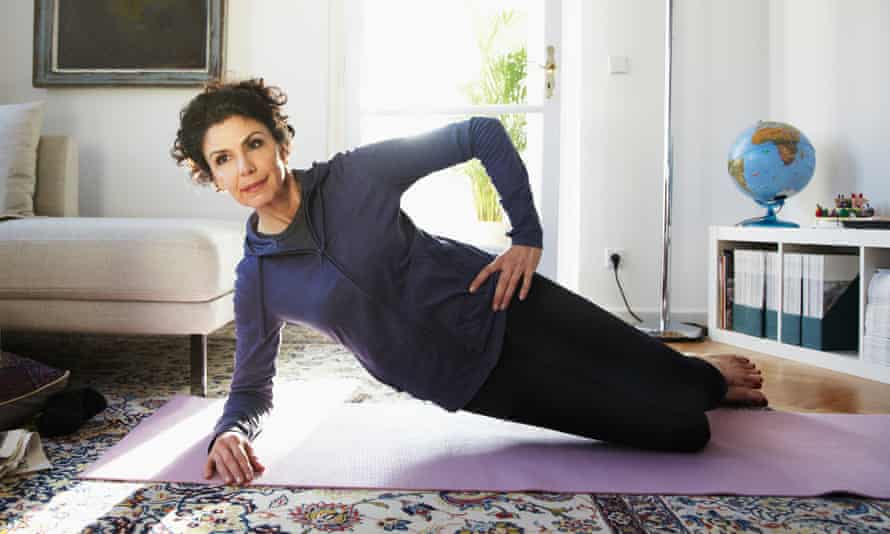
woman doing yoga at home
‘It doesn’t matter what type of exercise you do, as long as you like it and you are sensible.’ Photograph: Posed by model/Silke Woweries/Getty

To put it in perspective, he suggests you think of back pain like a sprained ankle. “The tissues in your back that can cause irritation with the discs and nerves and joints are like tissues in the rest of the body and they react in the same way,” he says. “A sprained ankle might be a bit sore to walk on but you can hobble around a little, while it gets better slowly.” So the message is, essentially, don’t freak out? “That should be the headline of your article. Perfect advice,” he says.

If it hurts too much to carry out your usual tasks and activities, the NHS recommends taking over-the-counter painkillers and remaining “active within the limits of your pain”, says Mercer. If pottering around and changing sitting position regularly is all that is possible for a while, then at least do that. “What can happen if people have had a severe episode of pain is that they stop walking, gardening, going for a bike ride and doing all the things that they like to do. They become less and less active, and more and more disabled by their worries.”

If, after a few weeks, there’s no improvement, he suggests talking to your GP about some stronger anti-inflammatory tablets. Then, if it still hasn’t settled down after a few more weeks of being as active as possible, this is when, he says, “seeing a healthcare professional is probably helpful. They can see how you are doing the exercise and might be able to advise you on how to pace it, and how to adapt so that you can still do it without causing pain.”

Victoria Tzortziou Brown, the joint honorary secretary of the Royal College of General Practitioners, agrees that exercise, “perhaps counterintuitively”, is the best treatment, such as “walking, swimming or safe stretching exercises. Back pain episodes can be disabling and worrying but they are common and usually people recover reasonably quickly. If, however, the pain persists or is severe, patients are advised to discuss their symptoms with their GP.” More serious conditions, such as a slipped disc or sciatica, usually cause extra symptoms such as numbness, weakness or a tingling sensation, and would need to be investigated by your doctor. “If you are developing clear weakness in your legs you should also seek advice,” says Mercer. Very rarely, he adds, the nerves in the spine that connect the bladder, bowels and sexual organs, and provide sensation around the genitals and back passage can be compressed. “If you develop any changes in these functions, you should seek immediate advice.”

Exercise is about more than physical fitness. “Back pain is heavily linked to depression and mental health problems,” says Mercer. And exercise is, of course, brilliant for helping to maintain mental health. So while Noonan’s exercises have improved his strength and balance, they have also boosted his confidence. “I think I’ve become more open to the world around me,” he says. “And I’ve certainly become more open to how my body works.”

Yoga has long been associated with improved mental health as well as improving back pain symptoms. In 2011, Alison Trewhela, a yoga teacher who specialises in classes for people with back pain, was approached by researchers at the University of York to collaborate on a study, funded by Arthritis Research UK, to test yoga’s efficacy in relieving symptoms. They found that on average, yoga was more effective than the “usual care”, and similar research has continued to show promising results ever since.

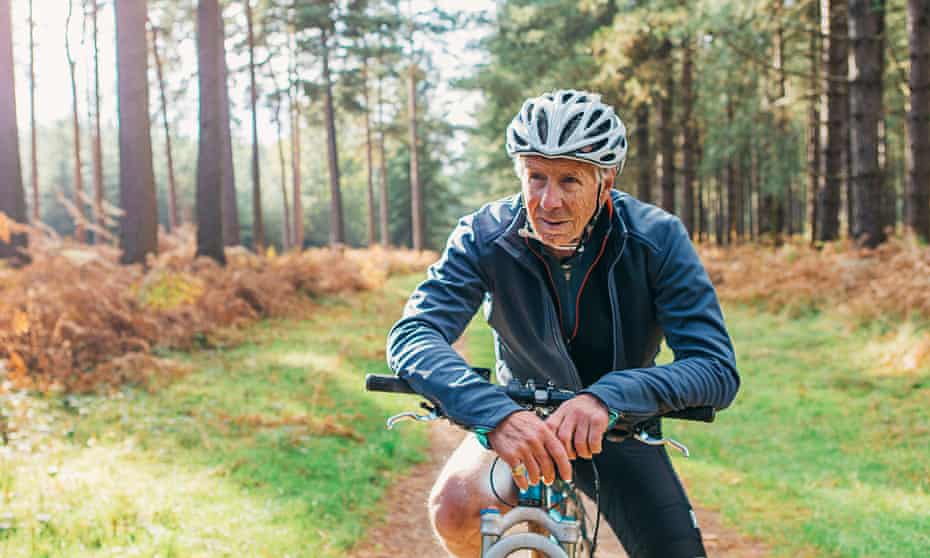
senior man on a bike in a forest
‘It’s estimated that 80% of adults in the UK will experience back pain at some point, but almost everyone can do something about it.’ Photograph: Posed by model/Justin Paget/Getty

Trewhela was asked to double the duration of the course for the study because the researchers told her, she says, “If you want to see behavioural change, get muscles to understand how to fit differently, expand differently – and you want to breathe differently and be aware of when you get tension – you need 12 weeks to integrate those changes into your daily life.”

She wouldn’t recommend suddenly launching into a dynamic yoga class to alleviate back pain, or to force your body into uncomfortable poses. “If you try something too intense,” she says, “you’ll avoid using your weaker muscles and they will carry on getting weaker.” Find a gentle class (Trewhela’s social enterprise, Yoga for Healthy Lower Backs, now has 500 practitioners nationwide) and, she says, “A good adage I like is: try to find the optimum position, not the maximum.”

Her top three poses for back pain start with standing near a wall, feet hip distance apart and toes turned in slightly. “Reach arms up high to the top of a door frame or up a wall for 10-20 seconds.” The second is a standing shoulder stretch. “Interlock hands behind the back,” she says. “Open the chest by taking the elbows back, then slowly and gently straighten the arms behind you for 10-20 seconds.”

Relaxation is integral to yoga and is perhaps a key element of back care that is often overlooked. “All these layers of stress and tension build up,” says Trewhela. The following modified version of savasana (or “corpse pose”) – which ends all yoga classes – she says “works like magic to take off the top layers of pain, discomfort and stress. Lie down on your back with your calves up on a chair seat and your head and neck supported on a folded towel or blanket for about 10 minutes.”

It is estimated that 80% of adults in the UK will experience back pain at some point, but almost everyone can do “something” about it, says Trewhela. Noonan’s sciatica disappeared a few years ago. “Maybe once a year I wince,” he says, “but nothing that debilitates me.”

… we have a small favour to ask. Tens of millions have placed their trust in the Guardian’s high-impact journalism since we started publishing 200 years ago, turning to us in moments of crisis, uncertainty, solidarity and hope. More than 1.5 million readers, from 180 countries, have recently taken the step to support us financially – keeping us open to all, and fiercely independent.

With no shareholders or billionaire owner, we can set our own agenda and provide trustworthy journalism that’s free from commercial and political influence, offering a counterweight to the spread of misinformation. When it’s never mattered more, we can investigate and challenge without fear or favour.

Unlike many others, Guardian journalism is available for everyone to read, regardless of what they can afford to pay. We do this because we believe in information equality. Greater numbers of people can keep track of global events, understand their impact on people and communities, and become inspired to take meaningful action.

We aim to offer readers a comprehensive, international perspective on critical events shaping our world – from the Black Lives Matter movement, to the new American administration, Brexit, and the world's slow emergence from a global pandemic. We are committed to upholding our reputation for urgent, powerful reporting on the climate emergency, and made the decision to reject advertising from fossil fuel companies, divest from the oil and gas industries, and set a course to achieve net zero emissions by 2030.

If there were ever a time to join us, it is now. Every contribution, however big or small, powers our journalism and sustains our future. Support the Guardian from as little as £1 – it only takes a minute. If you can, please consider supporting us with a regular amount each month. Thank you.


Sunday, 30 May 2021

How to be resilient: This practical guide to dealing with setbacks is essential reading

Resilience 


 Ensure you're making practical self-care steps to avoid becoming overwhelmed by the 'new normal'.


Photo by David Wirzba on Unsplash


Life might be getting back to normal but many of us are still feeling the effect of the pandemic on our mental health. In fact, you might not even realise the full impact the past year has had on your mental health until you're back in 'the real world'. Indeed, recent ONS figures show cases of depression are on the rise despite lockdown lifting. From the period of 27th January to 7th March 2021, around 1 in 5 (21%) adults in the UK experienced some form of depression, an increase since November 2020 (when the figure stood at 19%) and more than double that observed before the Coronavirus pandemic (10%).

That's why it's so important to take heed of your own mental health and ensure you're making practical self-care steps to avoid becoming overwhelmed by the 'new normal'.

"Mental health is a huge part of all of our lives and for too many of us it’s a mystery, but if we understand our minds we can put ourselves in control so we can really live," says Daniel Howell, a mental health activist and author of You Will Get Through This Night

Inspired by Dan’s own mental health journey shared with millions of his fans on stage and screen, along with his work as an ambassador for mental health charity Young Minds, his new book promises to be a practical guide to understanding and taking control of your mental health, written in an entertaining and personal way from someone who has been through it all.

Written in consultation with psychologist Dr. Heather Bolton and spilt over three sections; This Night, Tomorrow and The Day After, the book provides a refreshing, realistic approach to looking after your mental wellbeing the way we all experience it - whether you are in a crisis, just looking to make a change or want to know how to look after yourself every day.

One key aspect of his book is how to be resilient and deal with setbacks, which we are adamant will prove extremely useful for anyone struggling as we come out of lockdown....

"We all know that life can throw a curveball when we least expect it, so it’s important to know how to cope with these surprises, and not let them throw you off your positive momentum.

Life is a rollercoaster, or more like the graph shape of a llama rolling down a hill and climbing up again. We can’t predict the chaos. Despite our best efforts and intentions, it’s normal to have ups and downs. Remember that mental health is not a straight line, we can do what we can to raise the floor level, but it will always wave with the happenings of the world.

It doesn’t have to be a sudden shocking event, such as a… lightning strike! (sorry?) Life is naturally full of moments of change that we need to be able to handle. Breakups, moving, changing jobs – things that are very common can throw us off our track and we should all know how to keep ourselves on the rails.

Resilience

Training your resilience can help you to keep going in the face of adversity. It’s more than just bouncing back, it’s the act of moving forward as we grow from our experiences. Being resilient can look like:

  • Viewing challenges as opportunities
  • Focusing on the things you can control
  • Adapting your response to challenging situations
  • Maintaining a sense of purpose and drive
  • Asking for support when needed

Training your resilience can help you to keep going in the face of adversity.

Resilience is about being realistically optimistic. It’s not wishful thinking, it’s just being aware of what you can actually achieve and allowing yourself to be hopeful that you will succeed. Don’t be cynical about your own abilities, planting a seed of doubt that can self-sabotage. If you second guess yourself, it could be a self- fulfilling prophecy. Be realistic, but be fair to yourself and go into situations wanting to win!

It’s not something that’s fixed, it fluctuates through life and is something we can develop. It’s partly about our mindset, but also about how we respond in the face of stressful situations.

Most importantly, it’s not about pushing through the pain, telling yourself you’re being brave (don’t hide the pain, Harold), it’s about honestly accepting what you can handle and being practical.

Don’t overwork or exhaust yourself; it’s unrealistic to expect to cope with literally everything all the time!

Think about the attitude you have when you approach situations. Let’s imagine two different people being rejected after a particularly awkward first date:

They both have similar first thoughts: ‘Well that’s disappointing’ and ‘will I ever love again?’

But then how they make sense of that situation is different:
– Akachi starts to accept that not everyone will love her, their date wasn’t right for her anyway, and decides to take control by getting back out there and finding another fish in the sea.

– Fernando doesn’t accept it, but gets stuck on the idea that they’ll always be rejected, they’ll never meet anyone and be lonely forever to live as a spectre haunting the local lighthouse.

Both people are in the same situation but approach it with very different attitudes, which affects how they respond. To build up your own resilience to setbacks, it’s important to understand ‘adaptive coping’ (see opposite).

Self-care service station

During stressful and challenging times, self-care is essential to maintain your overall resilience, so don’t forget the basics – eating, sleep and hygiene, and staying hydrated.

It may sound simple, but if you let these slip it can chip away at your hard work and your mindset.

Try to keep your positive routine and stay on top of necessary stuff – having routine and structure gives you a strong foundation for coping.
Take time for yourself – literally remember to breathe, be mindful if you need a moment and take time to do things you enjoy to recover.


Reading the signals right

Psychological theory says we tend to see stressful situations in one of three broad ways: a challenge, a threat, or a loss.

Seeing it as a challenge → having hope, a fighting spirit and putting energy into finding a solution.

Seeing it as a threat → assuming the worst, feeling anxious and deflated.

Seeing it as a loss → acting like the damage has already been done, there’s nothing you can do, and feeling helpless. 

 Try to look for aspects of your situation that you can see as a challenge to overcome – this will help you adopt a positive approach and channel your energy into solving the problem, known as adaptive coping. Of course, this might not always be possible and you can’t keep fighting forever, but there will always be an opportunity for learning from the situation.
Feeling threatened is absolutely normal, but try to notice whether you’re getting caught up with catastrophic thinking. Break the problem down and focus on what you can control, even if it’s a small piece of the 10,000 piece 1-colour jigsaw.

If you’re feeling helpless because of things you’ve lost, allow yourself to feel that – resilience involves connecting honestly with feelings, not shutting them off. It’s a healthy part of processing what’s going on for you. The key is balance.

  • Channel your energy into what you can change.
  • Evaluate any aspects bringing up anxiety.
  • Allow time to deal with your feelings.
  • Being flexible between these three approaches will help you deal with the fun of life’s many suddenly surprising challenges."

You Will Get Through This Night by Daniel Howell is available now in hardback, eBook and audio download (HQ)