Showing posts with label tired all the time. Show all posts

Saturday, 26 June 2021

Fight Fatigue by Harnessing the Power of Your Internal Clock

Fatigue 


Sluggish? Tired? Seven tips for getting your body into better alignment.


relates to Fight Fatigue by Harnessing the Power of Your Internal Clock
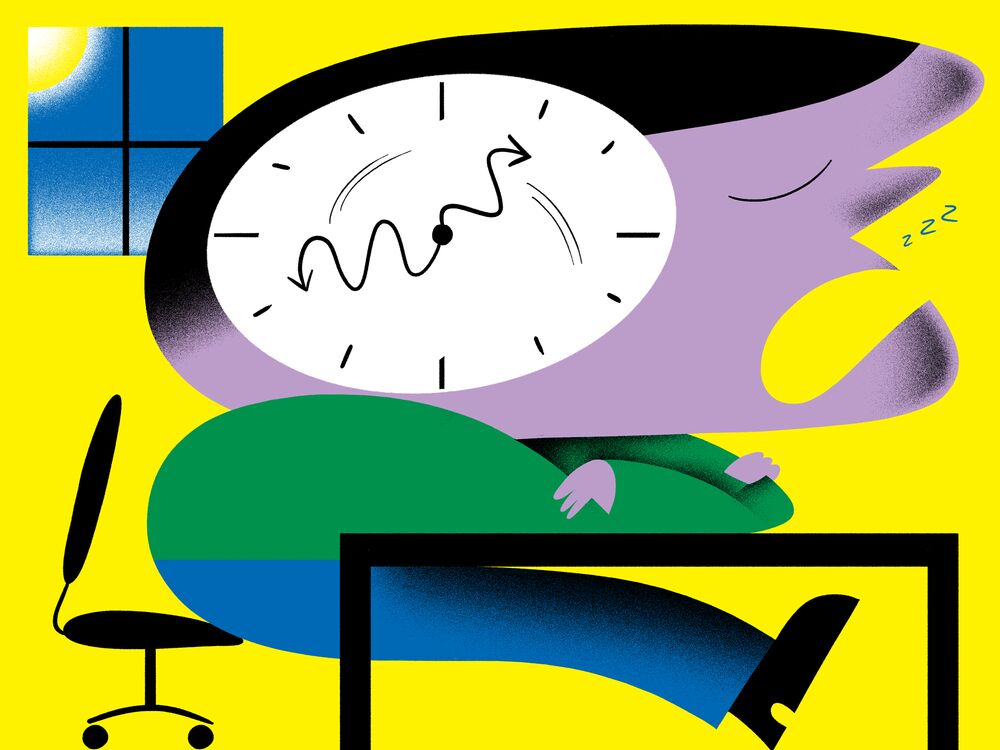
Illustration by Yann Bastard

I’m typing these words at 1 a.m., which is suboptimal for a morning person like me, according to Christopher Barnes. “If you slam some caffeine and keep the body awake long enough, you can probably do an after-hours task,” says Barnes, a professor of management at the University of Washington who studies performance and fatigue. “But when you’re consuming caffeine to fight your own sleep-regulation processes, ultimately you’re going to pay for that with your health.”

You’re likely attempting to be active when the circadian rhythm that regulates your sleep-wake cycle is calling for rest, says Kevin Koronowski, a post-doctoral fellow at the University of California at Irvine who studies metabolism and the circadian clocks that govern everything from hormone levels and cellular processes to body temperature and brain waves.

Chronically misaligned rhythms are associated with cancer and metabolic syndrome (conditions including high blood pressure and cholesterol and excess waistline fat that can spike the risk for heart disease and stroke). There’s also the brain fog that comes with fighting against what the body wants.

Here’s how you can harness the power of your internal clock to help you be more productive.

Identify when you’re most alert. What time do you wake up naturally (without an alarm)? Many people are most alert shortly after that time. Do your most important work then, and don’t waste peak-focus hours on exercise or commuting. Office dwellers are typically most productive around 11 a.m., but you might fire on all cylinders earlier or later.

Set work hours accordingly. If possible, early birds and night owls should shift their schedules to accommodate when they’re most focused. Barnes recommends core office hours from, say, 11 a.m. to 3 p.m., but otherwise schedules should be flexible.

Eat to trigger your clock. “When you eat can have a big impact on your rhythm,” Koronowski says. Shift your calories toward breakfast and lunch, with a lighter dinner three to five hours before bedtime. This ramps up your metabolism earlier in the day and dials it down at night when bursts of energy typically aren’t needed.

Ditch the bad diet. “It’s thought that the clock itself responds differently to different dietary nutrients,” Koronowski says. One late-night doughnut won’t reschedule your cellular processes, but chronic munching could.

Talk to your boss. Explain that you’re more effective at certain times. Night owls, beware: Barnes co-authored a paper showing that managers perceive them to be less effective and less conscientious. “It’s unfortunate that this stereotype is so pervasive,” he says.

Think about timing. “A boss giving a rah-rah speech to a night owl at 7:30 a.m. will kind of fall on deaf ears, and not be nearly effective as the same speech later in the day,” Barnes says. Managers should keep an eye on how perceptions can shift throughout the day.  

Sleep when you’re tired. Temperature, noise, light—all of this can affect our ability to doze off. Know what your needs are to fall asleep, and make sure they’re met. Koronowski, for instance, says he likes to remain cool while he sleeps while his wife looks for warmth, so they started using separate blankets.


Wednesday, 18 November 2020

Why You're Tired All the Time

Constant Tiredness 


Fatigue, writes our columnist, comes in two very different flavors, and fixing each requires a completely different approach

Athletic Young Women Relaxing Next To City Park Lake

Jenny’s situation is not uncommon. It illustrates what I’ve come to think of as the difference between two types of fatigue:

  1. When your mind-body system is truly tired, or what I’ll call real fatigue.
  2. When your mind-body system is tricking you into feeling tired because you’re in a rut, or what I’ll call fake fatigue. 

It’s important to differentiate between these two sensations, because the response each requires couldn’t be more different. The former calls for shutting things down and resting. The latter calls for nudging yourself in the direction of action, not taking the sensation of exhaustion too seriously but, rather, working your way out.

When it comes to physical fatigue, it may be easier of the two to discern. This is because feedback tends to be more objective—your muscles become sore, your heart rate increases, or the speed at which you run (or the weight you lift) declines. For more generalized and predominantly psychological fatigue, however, such clear metrics are lacking. This means that you’ve got to feel your way into the right response.

Generally speaking, the cost of pushing through real fatigue is greater than the cost of acquiescing to fake fatigue. Going too hard for too long, and pushing over the edge, can result in burnout, which research shows can take many months—and in severe cases, years—to reverse. The safest bet, then, is to treat the onset of exhaustion as if it were real fatigue. Take a day off, or a few. Sleep a little extra. Disconnect from digital devices. If you can, spend time in nature. Reexamine your regular routine, and if something seems haywire, make adjustments. If you do all this and yet still feel malaise, then it’s worth seeing what happens if you firmly nudge yourself into action.

An extreme example of “fake” fatigue is the exhaustion that accompanies depression. Your brain is doing everything it can to trick you into staying in bed all day, when the best thing to break out of the cycle would be to get up and go, or what psychologists call “behavioral activation,” which is a gold-standard treatment for depression. This isn’t to say the sensations of lethargy, dullness, and torpor are not real—they are, and they can be quite paralzying. But those sensations, as far as we know, are not organic, not caused by a lack of sleep, an expenditure of physiological resources, or something wrong in the body, for example. If they were, taking action would make the situation worse. But, as research shows, with depression, taking action—particularly when supported by therapy—tends to make the situation better.

This kind of fake fatigue happens on a smaller scale all the time. For instance, about eight months ago, I kept putting off starting my next big writing project. I felt tired! So I rested. And rested some more. After about three weeks of this, with the help of my own coach, I decided to force myself to just get started. Three days later, I was in a great writing groove that lasted for over a month. More rest would have only deepened the rut. I needed to work my way out of it. 

There is one more layer of nuance here, and it’s an important one. Sometimes breaking the cycle of fatigue requires combining both of the above strategies. You may be experiencing real fatigue and thus need rest. But after a week of rest, your mind-body system may be recovered yet still latched onto the inertia of doing nothing. At this point, the strategy shifts. In sports, this is why so many tapers end with a few short, intense efforts. Studies show that these efforts wake the body up and snap it back into action.

Your best bet is to think of managing exhaustion as an ongoing practice. Over time, if you pay close attention to how you feel, what you do in response, and what you get out of it, you’ll become better at differentiating between real and fake fatigue. The first step is learning that not all sensations of fatigue mean the same thing. For those accustomed to always pushing through exhaustion, perhaps you need a bit more rest. For those accustomed to always resting, perhaps you’d benefit from more of a just get-going, “mood follows action” mentality. Think of these approaches as two tools in the kit. There’s a time and place for each.

Brad Stulberg (@Bstulberg) is a performance coach and writes Outside’s Do It Better column. He is also bestselling author of the books The Passion Paradox and Peak Performance. Subscribe to his newsletter here. 

Support Outside Online

Our mission to inspire readers to get outside has never been more critical. In recent years, Outside Online has reported on groundbreaking research linking time in nature to improved mental and physical health, and we’ve kept you informed about the unprecedented threats to America’s public lands. Our rigorous coverage helps spark important debates about wellness and travel and adventure, and it provides readers an accessible gateway to new outdoor passions. Time outside is essential—and we can help you make the most of it. Making a financial contribution to Outside Online only takes a few minutes and will ensure we can continue supplying the trailblazing, informative journalism that readers like you depend on. We hope you’ll support us. Thank you.

Contribute to Outside→
Filed To: SleepSportsScienceNatureRecovery
Lead Photo: Alina Hvostikova/Stocksy