Showing posts with label exhaustion. Show all posts

Monday, 9 August 2021

Our burnout moment is a good thing

Burnout 


 Thanks to Thought Catalogue on Unsplash


As lockdowns start to lift, we have a rare opportunity to address burnout on a systemic level – and make sure everyone’s included


IT STARTS WITH a lack of energy, which gradually builds into a sense of exhaustion. You feel an apathy towards your job, when you previously took pride in it. Cynicism sets in. Your productivity drops, or at least it feels that way. You put in more time and effort to try to compensate, but you don’t feel the sense of accomplishment you used to – you just feel even more tired. You’re burned out.

More than a year-and-a-half into the Covid-19 pandemic, burnout is having a moment. Having initially scrambled to adjust to the sudden upheaval of the workplace – made to switch to remote work with little or no preparation, or deemed an essential worker and asked to continue business-as-usual in highly unusual circumstances – we’re perhaps only now really starting to feel the repercussions. 

When the pandemic first hit, says Torsten Voigt, a sociologist at RWTH Aachen University in Germany who has researched burnout, everyone was so busy trying to adjust and keep things moving that we didn’t have time to worry about longer-term consequences. But more than a year on, and with lockdowns starting to lift in some regions, this initial expenditure of energy may be catching up with us. “Now, when we take a deep breath, some will realise that they potentially have given too much at that point and that they need a break,” he says.

But while it may be little comfort to those suffering, there could be an upside to our current burnout reckoning. It presents an opportunity to reconsider our relationship with work – not just on an individual level, but on a societal one.

Because while burnout may be gaining greater recognition, it’s not applied equally. We tend to think of burnout as affecting doctors, teachers, office workers. “I'm not sure if, say, a hairdresser or a car mechanic would say they are burned out,” Voigt says. It’s not that people in these roles don’t experience burnout, he says – but discussions of burnout often seem to be centred on occupations associated with a certain educational or socioeconomic level. You don’t often hear of cleaners, or supermarket workers, or people balancing three jobs as being “burned out”, even though most of us would say their work is objectively harder. “They basically don't even have the luxury to talk about burnout,” Voigt says.

The world in which burnout as a concept was initially conceived likely looked quite different to the one we live and work in today. The gig economy, zero-hours contracts, automation, even smartphones, have transformed the way many of us work. Our understanding of burnout – and how to address it – may need to evolve too.

BURNOUT IS AN intuitive term that’s both easy and difficult to define. On the one hand, it’s a clear metaphor that describes how a lot of people feel when they lose energy and motivation at work. But it is not a medical diagnosis, and lacks the kind of tightly-defined symptom list you might expect for a physical or mental health condition. The World Health Organisation includes burnout in its International Classification of Diseases (ICD) only as an “occupational phenomenon”, and defines it as “a syndrome conceptualized as resulting from chronic workplace stress that has not been successfully managed.” Some researchers question whether burnout is even a distinct phenomenon, or if it might overlap with depression.

Originally, burnout was researched and discussed largely in the context of healthcare workers. The origin of the idea is usually credited to Herbert Freudenberger, an American psychologist who used the term to describe what he saw among employees in the “free clinic” he worked at, which offered medical services to underserved communities, such as people with substance abuse issues. In 1974, Freudenberger wrote about “staff burn-out”, describing physical symptoms including fatigue, frequent headaches and not being able to shake off a cold, as well as behavioural signs such as crying or angering easily, paranoia and drug abuse.

Saturday, 26 June 2021

Fight Fatigue by Harnessing the Power of Your Internal Clock

Fatigue 


Sluggish? Tired? Seven tips for getting your body into better alignment.


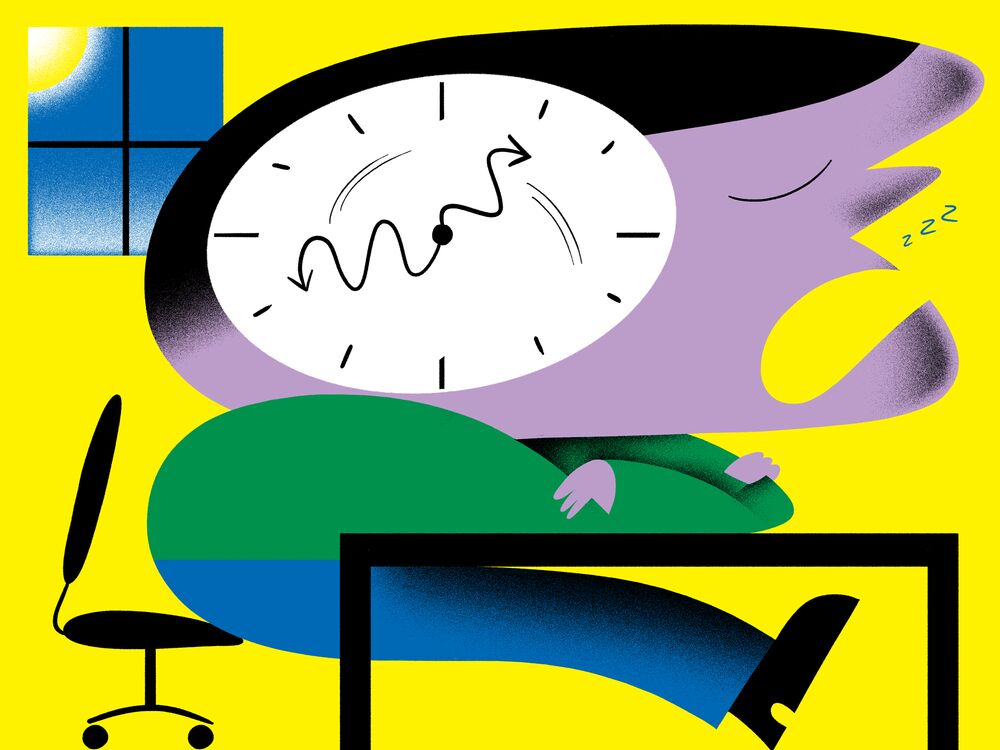
relates to Fight Fatigue by Harnessing the Power of Your Internal Clock
Illustration by Yann Bastard

I’m typing these words at 1 a.m., which is suboptimal for a morning person like me, according to Christopher Barnes. “If you slam some caffeine and keep the body awake long enough, you can probably do an after-hours task,” says Barnes, a professor of management at the University of Washington who studies performance and fatigue. “But when you’re consuming caffeine to fight your own sleep-regulation processes, ultimately you’re going to pay for that with your health.”

You’re likely attempting to be active when the circadian rhythm that regulates your sleep-wake cycle is calling for rest, says Kevin Koronowski, a post-doctoral fellow at the University of California at Irvine who studies metabolism and the circadian clocks that govern everything from hormone levels and cellular processes to body temperature and brain waves.

Chronically misaligned rhythms are associated with cancer and metabolic syndrome (conditions including high blood pressure and cholesterol and excess waistline fat that can spike the risk for heart disease and stroke). There’s also the brain fog that comes with fighting against what the body wants.

Here’s how you can harness the power of your internal clock to help you be more productive.

Identify when you’re most alert. What time do you wake up naturally (without an alarm)? Many people are most alert shortly after that time. Do your most important work then, and don’t waste peak-focus hours on exercise or commuting. Office dwellers are typically most productive around 11 a.m., but you might fire on all cylinders earlier or later.

Set work hours accordingly. If possible, early birds and night owls should shift their schedules to accommodate when they’re most focused. Barnes recommends core office hours from, say, 11 a.m. to 3 p.m., but otherwise schedules should be flexible.

Eat to trigger your clock. “When you eat can have a big impact on your rhythm,” Koronowski says. Shift your calories toward breakfast and lunch, with a lighter dinner three to five hours before bedtime. This ramps up your metabolism earlier in the day and dials it down at night when bursts of energy typically aren’t needed.

Ditch the bad diet. “It’s thought that the clock itself responds differently to different dietary nutrients,” Koronowski says. One late-night doughnut won’t reschedule your cellular processes, but chronic munching could.

Talk to your boss. Explain that you’re more effective at certain times. Night owls, beware: Barnes co-authored a paper showing that managers perceive them to be less effective and less conscientious. “It’s unfortunate that this stereotype is so pervasive,” he says.

Think about timing. “A boss giving a rah-rah speech to a night owl at 7:30 a.m. will kind of fall on deaf ears, and not be nearly effective as the same speech later in the day,” Barnes says. Managers should keep an eye on how perceptions can shift throughout the day.  

Sleep when you’re tired. Temperature, noise, light—all of this can affect our ability to doze off. Know what your needs are to fall asleep, and make sure they’re met. Koronowski, for instance, says he likes to remain cool while he sleeps while his wife looks for warmth, so they started using separate blankets.


Friday, 21 May 2021

Burnout: Modern Affliction or Human Condition?

Burnout 


As a diagnosis, it’s too vague to be helpful—but its rise tells us a lot about the way we work.


Photo by Aiony Haust on Unsplash


very age has its signature afflictions,” the Korean-born, Berlin-based philosopher Byung-Chul Han writes in “The Burnout Society,” first published in German in 2010. Burnout, for Han, is depression and exhaustion, “the sickness of a society that suffers from excessive positivity,” an “achievement society,” a yes-we-can world in which nothing is impossible, a world that requires people to strive to the point of self-destruction. “It reflects a humanity waging war on itself.”

Lost in the misty history of burnout is a truth about the patients treated at free clinics in the early seventies: many of them were Vietnam War veterans, addicted to heroin. The Haight-Ashbury clinic managed to stay open partly because it treated so many veterans that it received funding from the federal government. Those veterans were burned out on heroin. But they also suffered from what, for decades, had been called “combat fatigue” or “battle fatigue.” In 1980, when Freudenberger first reached a popular audience with his claims about “burnout syndrome,” the battle fatigue of Vietnam veterans was recognized by the DSM-III as post-traumatic stress disorder. Meanwhile, some groups, particularly feminists and other advocates for battered women and sexually abused children, were extending this understanding to people who had never seen combat.

Burnout, like P.T.S.D., moved from military to civilian life, as if everyone were, suddenly, suffering from battle fatigue. Since the late nineteen-seventies, the empirical study of burnout has been led by Christina Maslach, a social psychologist at the University of California, Berkeley. In 1981, she developed the field’s principal diagnostic tool, the Maslach Burnout Inventory, and the following year published “Burnout: The Cost of Caring,” which brought her research to a popular readership. “Burnout is a syndrome of emotional exhaustion, depersonalization, and reduced personal accomplishment that can occur among individuals who do ‘people work’ of some kind,” Maslach wrote then. She emphasized burnout in the “helping professions”: teaching, nursing, and social work—professions dominated by women who are almost always very poorly paid (people who, extending the military metaphor, are lately classed as frontline workers, alongside police, firefighters, and E.M.T.s). Taking care of vulnerable people and witnessing their anguish exacts an enormous toll and produces its own suffering. Naming that pain was meant to be a step toward alleviating it. But it hasn’t worked out that way, because the conditions of doing care work—the emotional drain, the hours, the thanklessness—have not gotten better.

Burnout continued to climb the occupational ladder. “Burnout cuts across executive and managerial levels,” Harvard Business Review reported in 1981, in an article that told the tale of a knackered executive: “Not only did the long hours and the unremitting pressure of walking a tightrope among conflicting interests exhaust him; they also made it impossible for him to get at the control problems that needed attention. . . . In short, he had ‘burned out.’ ” Burnout kept spreading. “College Presidents, Coaches, Working Mothers Say They’re Exhausted,” according to a Newsweek cover in 1995. With the emergence of the Web, people started talking about “digital burnout.” “Is the Internet Killing Us?” Elle asked in 2014, in an article on “how to deal with burnout.” (“Don’t answer/write emails in the middle of the night. . . . Watch your breath come in and out of your nostrils or your stomach contracting and expanding as you breathe.”) “Work hard and go home” is the motto at Slack, a company whose product, launched in 2014, made it even harder to stop working. Slack burns you out. Social media burns you out. Gig work burns you out. In “Can’t Even,” a book that started out as a viral BuzzFeed piece, Petersen argues, “Increasingly—and increasingly among millennials—burnout isn’t just a temporary affliction. It’s our contemporary condition.” And it’s a condition of the pandemic.

In March, Maslach and a colleague published a careful article in Harvard Business Review, in which they warned against using burnout as an umbrella term and expressed regret that its measurement has been put to uses for which it was never intended. “We never designed the MBI as a tool to diagnose an individual health problem,” they explained; instead, assessing burnout was meant to encourage employers to “establish healthier workplaces.”

The louder the talk about burnout, it appears, the greater the number of people who say they’re burned out: harried, depleted, and disconsolate. What can explain the astonishing rise and spread of this affliction? Declining church membership comes to mind. In 1985, seventy-one per cent of Americans belonged to a house of worship, which is about what that percentage had been since the nineteen-forties; in 2020, only forty-seven per cent of Americans belonged to an institution of faith. Many of the recommended ways to address burnout—wellness, mindfulness, and meditation (“Take time each day, even five minutes, to sit still,” Elle advised)—are secularized versions of prayer, Sabbath-keeping, and worship. If burnout has been around since the Trojan War, prayer, worship, and the Sabbath are what humans invented to alleviate it. But this explanation goes only so far, not least because the emergence of the prosperity gospel made American Christianity a religion of achievement. Much the same appears to apply to other faiths. A Web site called productivemuslim.com offers advice on “How to Counter Workplace Burnout” (“There is barakah in earning a halal income”). Also, actually praying, honoring the Sabbath, and attending worship services don’t seem to prevent people who are religious from burning out, since religious Web sites and magazines, too, are full of warnings about burnout, including for the clergy. (“The life of a church leader involves a high level of contact with other people. Often when the church leader is suffering high stress or burnout he or she will withdraw from relationships and fear public appearances.”)

You can suffer from marriage burnout and parent burnout and pandemic burnout partly because, although burnout is supposed to be mainly about working too much, people now talk about all sorts of things that aren’t work as if they were: you have to work on your marriage, work in your garden, work out, work harder on raising your kids, work on your relationship with God. (“Are You at Risk for Christian Burnout?” one Web site asks. You’ll know you are if you’re driving yourself too hard to become “an excellent Christian.”) Even getting a massage is “bodywork.”

Burnout may be our contemporary condition, but it has very particular historical origins. In the nineteen-seventies, when Freudenberger first started looking for burnout across occupations, real wages stagnated and union membership declined. Manufacturing jobs disappeared; service jobs grew. Some of these trends have lately begun to reverse, but all the talk about burnout, beginning in the past few decades, did nothing to solve these problems; instead, it turned responsibility for enormous economic and social upheaval and changes in the labor market back onto the individual worker. Petersen argues that this burden falls especially heavily on millennials, and she offers support for this claim, but a lesson of the history of burnout is that every generation of Americans who have come of age since the nineteen-seventies have made the same claim, and they were right, too, because overwork keeps getting worse. It’s this giant mess that Joe Biden is trying to fix. In earlier eras, when companies demanded long hours for low wages, workers engaged in collective bargaining and got better contracts. Starting in the nineteen-eighties, when companies demanded long hours for low wages, workers put newspaper clippings on the doors of their fridges, burnout checklists. Do you suffer from burnout? Here’s how to tell!

Burnout is a combat metaphor. In the conditions of late capitalism, from the Reagan era forward, work, for many people, has come to feel like a battlefield, and daily life, including politics and life online, like yet more slaughter. People across all walks of life—rich and poor, young and old, caretakers and the cared for, the faithful and the faithless—really are worn down, wiped out, threadbare, on edge, battered, and battle-scarred. Lockdowns, too, are features of war, as if each one of us, amid not only the pandemic but also acts of terrorism and mass shootings and armed insurrections, were now engaged in a Hobbesian battle for existence, civil life having become a war zone. May there one day come again more peaceful metaphors for anguish, bone-aching weariness, bitter regret, and haunting loss. “You will tear your heart out, desperate, raging,” Achilles warned Agamemnon. Meanwhile, a wellness site tells me that there are “11 ways to alleviate burnout and the ‘Pandemic Wall.’ ” First, “Make a list of coping strategies.” Yeah, no. ♦

Published in the print edition of the May 24, 2021, issue, with the headline “It’s Just Too Much.”
Jill Lepore, a staff writer at The New Yorker, is a professor of history at Harvard and the author of fourteen books, including “If Then: How the Simulmatics Corporation Invented the Future.” She is also the host of the podcast “The Last Archive.”
More:HealthPsychologyWorkSociologyTired

Monday, 17 May 2021

If Your Brain Feels Foggy And You're Tired All The Time, You're Not Alone

Brain Fog 


In recent weeks, Dr. Kali Cyrus has struggled with periods of exhaustion.

"I am taking a nap in between patients," says Cyrus, a psychiatrist at Johns Hopkins University. "I'm going to bed earlier. It's hard to even just get out of bed. I don't feel like being active again."

Exhaustion is also one of the top complaints she hears from her patients these days. They say things like, "It's just so hard to get out of bed" or "I've been misplacing things more often," she says.

Some patients tell Cyrus they've been making mistakes at work. Some tell her they can "barely turn on the TV. 'All I want to do is stare at the ceiling.' " Others say they are more irritable.

While some people who have had COVID-19 report brain fog and fatigue as lingering symptoms of their infection — what's known as long COVID — mental health care providers around the U.S. are hearing similar complaints from people who weren't infected by the virus. And many providers, like Cyrus, are feeling it themselves.

Article continues after sponsor message

This kind of mental fog is real and can have a few different causes. But at the root of it are the stress and trauma of the past year, say Cyrus and other mental health experts. It's a normal reaction to a very abnormal year.

And while many people will likely continue to struggle with mental health symptoms in the long run, research on past mass traumas suggests that most people will recover once the coronavirus pandemic ends.

"We know that the majority of people tend to be resilient," says Lynn Bufka, a psychologist with the American Psychological Association. "They may have struggled during the time of the challenges but generally come out OK on the other end."

In the meantime, Bufka and other experts say that there are things we can do now to fight the mental fog and exhaustion.

How stress and sleep are linked

"Exhaustion can be a symptom of many things," says Cyrus.

For one, it can be a symptom of stress.

"We know from other research that people will talk about fatigue as something that they experience when they're feeling overstressed," says Bufka.

A recent survey by the American Psychological Association found that 3 in 4 Americans said that the pandemic is a significant source of stress.

Millions of people have lost loved ones, have become ill themselves and/or have lost income as a result of the pandemic. The threat of COVID-19 alone has been stressful for most people, as has all of the upheaval that the pandemic has brought, says Bufka.

Stress "keeps our mind vigilant and our nervous system vigilant, and that uses more energy," says Elissa Epel, a psychologist at the University of California, San Francisco. That's one reason that prolonged stress can leave us feeling drained.

Another way that chronic stress makes us feel exhausted is by interfering with sleep, says Bufka. "When we're feeling stressed, our sleep can get disrupted, which naturally leads to feelings of tiredness and exhaustion," she says.

"We really rely on sleep to recover each day," explains Epel. "And so for many of us, even though we might think we're sleeping the same number of hours, it's not the same quality. It doesn't have the same restorative ability, because we're getting less deep sleep, and we think that is tied to this chronic, subtle uncertainty, stress."

Chronic stress also triggers low-grade inflammation, she adds.

"We have this inflammatory response when we're feeling severe states of stress that can last. It's subtle, it's low grade and it can absolutely cause fatigue and a worse mood."

A year of anxiety, grief and trauma

The fatigue and fog so many are feeling now also could be symptoms of other mental health issues that flared over the last year, says Dr. Jessica Gold, a psychiatrist at Washington University in St. Louis. "After this long, most people have had some degree of anxiety, depression, trauma, something," she says.

As studies have shown, rates of anxiety and depression in the population have gone up during the course of the pandemic.

Long-term anxiety can also exhaust the body, says Gold.

"We evolved as creatures, people that run from predators in the animal kingdom, right? To have anxiety as a way to predict and run from threat," she says.

When we're anxious, our hearts race and our muscles tense up as we prepare to fight a predator or run from it. But "you can only run a 100-yard dash for a short amount of time. Not a year, and not a year where they keep moving the finish line," says Gold. "We can't do that. Eventually our muscles and our body say, 'No, I'm tired.' "