
Photo by: Tom Parsons
Newspapers started writing about Betty Lowe when she was 96 years old. Despite being long past retirement age, she was still volunteering at a cafe at Salford Royal Hospital in Greater Manchester, UK, serving coffee, washing dishes and chatting to patients. Then Lowe turned 100. “Still volunteers at hospital”, the headlines ran. Then she reached 102 and the headlines declared: “Still volunteering”. The same again when she turned 104. Even at 106, Lowe would work at the cafe once a week, despite her failing eyesight.
Lowe told the reporters who interviewed her that the reason she kept working at the cafe long after most people would have chosen to put their feet up was because she believed volunteering kept her healthy. And she was probably right. Science reveals that altruistic behaviours, from formal volunteering and monetary donations to random acts of everyday kindness, promote wellbeing and longevity.
Studies show, for instance, that volunteering correlates with a 24% lower risk of early death – about the same as eating six or more servings of fruits and vegetables each day, according to some studies. What’s more, volunteers have a lower risk of high blood glucose, and a lower risk of the inflammation levels connected to heart disease. They also spend 38% fewer nights in hospitals than people who shy from involvement in charities.
And these health-boosting impacts of volunteering appear to be found in all corners of the world, from Spain and Egypt to Uganda and Jamaica, according to one study based on the data from the Gallup World Poll.
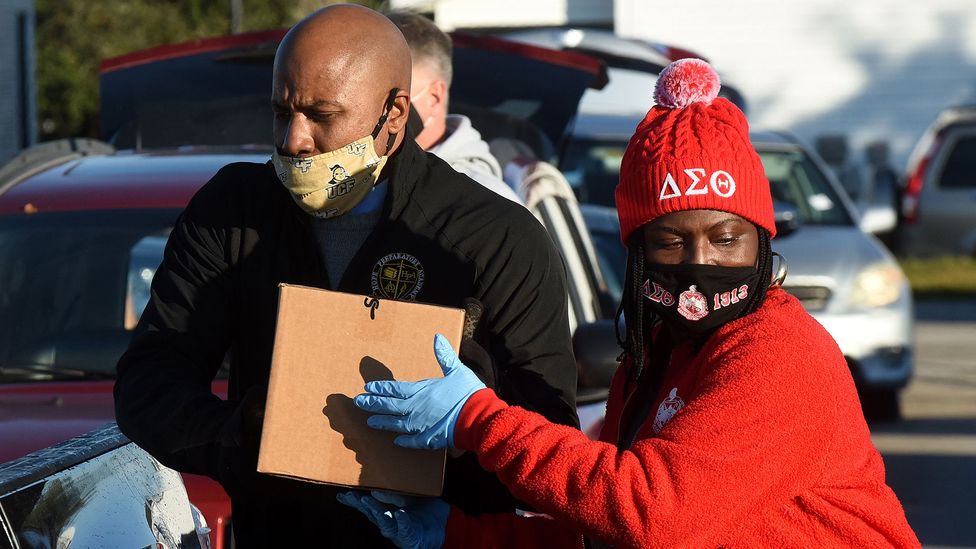
During the pandemic, many people have volunteered to help those who have been worst hit by lockdowns (Credit: Paul Hennessy/Getty Images)
Of course, it could be that people who are in better health to begin with are simply more likely to be in a position to pick up volunteering. If you are suffering from severe arthritis, for example, the chances are you won’t be keen to sign up to work at a soup kitchen.
“There is research suggesting that people who are in better health are more likely to volunteer, but because scientists are very well aware of that, in our studies we statistically control for that,” says Sara Konrath, a psychologist and philanthropy researcher at Indiana University.
Even when scientists remove the effects of pre-existing health, the impacts of volunteering on wellbeing still remain strong. What’s more, several randomised lab experiments shed light on the biological mechanisms through which helping others can boost our health.
In one such experiment, high school students in Canada were either assigned to tutor elementary school children for two months, or put on a waitlist. Four months later, after the tutoring was well over, the differences between the two groups of teenagers were clearly visible in their blood. Compared to those on the waitlist, high-schoolers who were actively tutoring the younger children had lower levels of cholesterol, as well as lower inflammatory markers such as interleukin 6 in their blood – which apart of being a powerful predictor of cardiovascular health, also plays an important role in viral infections.
Participants assigned to conduct simple acts of kindness, such as buying coffee for a stranger, had lower activity of leukocyte genes that are related to inflammation
Of course, in pandemic times, volunteering may be more of a challenge. However, Konrath believes that doing so online could also bring health benefits, if our motivation is to really help other people. She also recommends virtual volunteering with friends, since research shows that the social component of volunteering is important for wellbeing.
But it’s not just the effects of formal volunteering that show up in the blood either – random acts of kindness do as well. In one study in California, participants who were assigned to conduct simple acts of kindness, such as buying coffee for a stranger, had lower activity of leukocyte genes that are related to inflammation. That’s a good thing, since chronic inflammation has been linked to conditions such as rheumatoid arthritis, cancer, heart disease, and diabetes.
You might also like:
- Why we are suspicious of those who are kind
- The surprising downsides to empathy
- The people solving mysteries during lockdown
And if you put people into a functional magnetic resonance imaging (fMRI) scanner, and tell them to act altruistically, you may see changes in how their brains react to pain. In one recent experiment, volunteers had to make various decisions, including whether to donate money, while their hands were subjected to mild electric shocks. The results were clear – the brains of those who made a donation lit up less in response to pain. And the more they considered their actions as helpful, the more pain-resistant they became. Similarly, donating blood appears to hurt less than having your blood drawn for a test, even though in the first scenario the needle may be twice as thick.
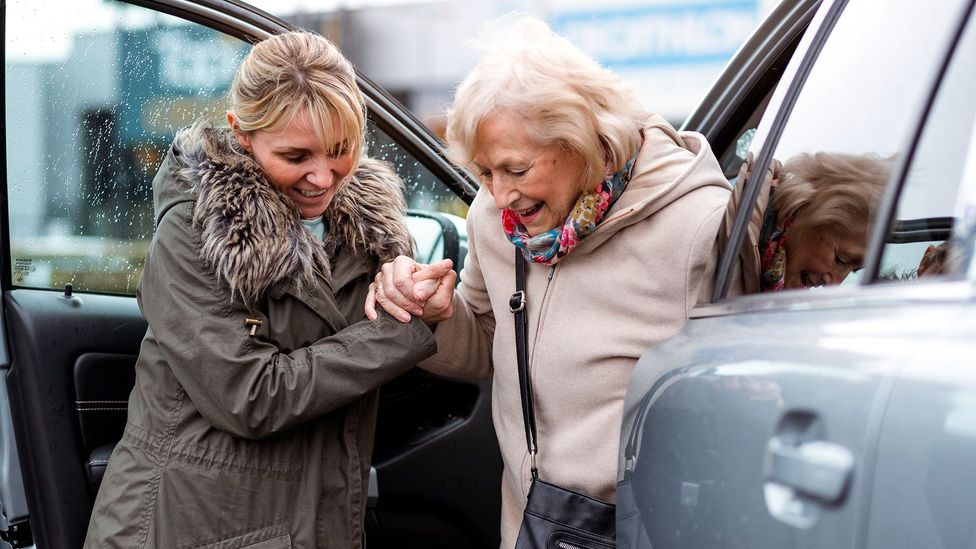
Random acts of kindness can do a lot more than simply bring a smile to someone's face (Credit: Getty Images)
There are countless other examples of the positive health effects of both kindness and monetary donations. For instance, grandparents who regularly babysit their grandchildren have a mortality risk that is up to 37% lower than those who don’t provide such childcare. That’s a larger effect than may be achieved from regular exercise, according one meta-analysis of studies. This assumes the grandparents are not stepping into the parents’ shoes completely (although, admittedly, caring for grandkids often does involve a lot of physical activity, especially when we are talking about toddlers).
On the other hand, spending money on others rather than for your own pleasure can lead to better hearing, improved sleep and lower blood pressure, with the effects as large as those of starting new hypertension medication.
Meanwhile, writing a cheque for a charity can be a good strategy for boosting your muscle power. In one experiment that tested handgrip strength, participants who made a donation to Unicef could squeeze a hand exerciser for 20 seconds longer than those who had not given away their money. So, the next time you want to try yourself at arm wrestling, for example, reach for your chequebook first.
Humans are extremely social, we have better health when we are interconnected, and part of being interconnected is giving – Tristen Inagaki
For Tristen Inagaki, neuroscientist at San Diego State University, there is nothing surprising in the fact that kindness and altruism should impact our physical wellbeing. “Humans are extremely social, we have better health when we are interconnected, and part of being interconnected is giving,” she says.
Inagaki studies our caregiving system – a network of brain regions tied to both helping behaviours and health. This system likely evolved to facilitate parenting of our infants, unusually helpless by mammalian standards, and later probably got co-opted to helping other people, too. Part of the system is made up from the reward regions of the brain, such as the septal area and ventral striatum – the very same ones that light up when you get three cherries in a row on a slot machine. By wiring parenting to the reward system, nature has tried to assure we don’t run away from our screaming, needy babies. Neuroimagining studies by Inagaki and her colleagues show that these brain areas also light up when we give support to other loved ones.
Besides making caregiving rewarding, evolution also linked it with reduced stress. When we act kindly, or even simply reflect on our past kindness, the activity of our brain’s fear centre, the amygdala, goes down. Again this could be linked to raising children.
It may seem counterintuitive that childcare might be stress-reducing – ask any new parent and they’ll likely tell you that caring for babies isn’t exactly a trip to the spa. But research shows that when animals hear the whimpers of infants of the same species, the activity of their amygdalae tempers down, and the same thing happens to parents when they are shown the photo of their own child. Inagaki explains that the activity of the brain’s fear centre has to go down if we are to be truly useful to others. “If you were completely overwhelmed by their stress, you probably couldn’t even approach them to help them in the first place,” she says.
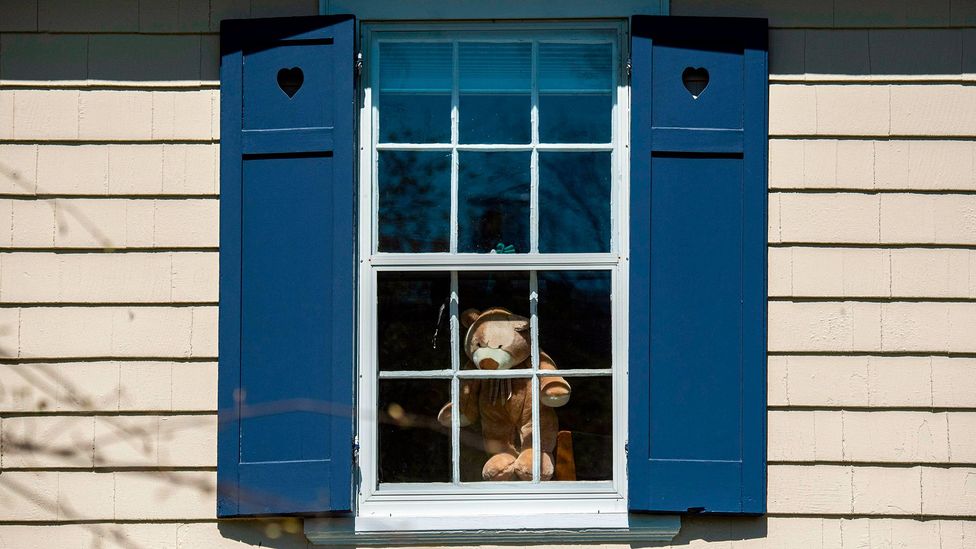
In the US and Australia many people put stuffed toys in their windows to give children a fun activity during the pandemic (Credit: Eric Baradat/Getty Images)
All this has direct consequences for health. The caregiving system – the amygdala and the reward areas – are networked with our sympathetic nervous system, which is involved in regulating our blood pressure and inflammatory responding, Inagaki explains. This is why turning your caregiving on can improve your cardiovascular health, and help you live longer.
Adolescents who volunteer their time have been found to have lower levels of two markers of inflammation – interleukin 6 and C-reactive protein. Both of these have also been implicated in severe outcomes in patients infected with Covid-19. It raises the tantalising prospect that during the pandemic, helping others in need could be particularly powerful, not simply as a way of lifting our moods through lockdown gloom. Research actually testing whether volunteering could have a protective effect against Covid-19 has yet to be conducted, and anything that increases your contact with others who might carry the virus would potentially increase your risk.
What if, however, giving doesn’t come naturally to you?
Empathy, a quality that is strongly linked to volunteering and giving behaviours, is highly heritable – about a third of how empathetic we are is down to our genes. Yet, Konrath says it does not mean people born with low empathy are doomed.
“We are also born with different athletic potential, it’s easier for some of us to build muscles than for others, but all of us have muscles, and all of us if we do some exercises we will build our muscles," she says. "No matter where we start, and research shows this, all of us can improve in empathy.”
The research suggests such kindness not only warms our hearts, it can help them stay healthy for longer
Some interventions take no more than a few seconds at a time. For example, you can try looking at the world from another person’s perspective, really getting under their skin, for a moment or two each day. Or you can practice mindfulness and loving-kindness meditation. Taking care of pets and reading emotionally-charged books, a perfect lockdown past-time, also works well to boost empathy.
During the first six months of 2020, Britons donated £800m ($1.05bn) more to charity than for the same period in 2019, and similar stats pour in from other countries. Almost half of Americans have recently checked on their elderly or sick neighbours. In Germany, the coronavirus crisis has pulled people closer together – while in February 2020 as many as 41% said that people did not care about others, this figure was down to just 19% by early summer. And then, there are the stories of pandemic kindness – Americans and Australians leaving teddy bears in their windows to cheer up children. A French florist, Murielle Marcenac, placed 400 bouquets on cars of hospital staff in Perpignan.
The research suggests such kindness not only warms our hearts, it can help them stay healthy for longer, too. “There is really something about just focusing on others sometimes that’s really good for you,” Inagaki says.
With that in mind, surely we could all spare a little time for a moment's kindness in the months ahead.
* Marta Zaraska is the author of Growing Young: How Friendship, Optimism and Kindness Can Help You Live to 100. She can be found @mzaraska.
--
Join one million Future fans by liking us on Facebook, or follow us on Twitter or Instagram.
If you liked this story, sign up for the weekly bbc.com features newsletter, called “The Essential List”. A handpicked selection of stories from BBC Future, Culture, Worklife, and Travel, delivered to your inbox every Friday.


