Showing posts with label Chronic pain. Show all posts

Friday, 20 August 2021

Chronic Pain Has 9 Distinct Types, According to a Large New Body Mapping Study

Identifying Chronic Pain 


6 AUGUST 2021

The relentlessness of chronic pain wears you down. Beyond being a physical distraction in and of itself, it disrupts sleep, interferes with work and relationships, and can even alter the way we process emotions by causing physiological changes in our brains.

But the experience of long-term pain is complicated and varies between individuals, making it difficult to explain and quantify, let alone diagnose and manage.

Now, in a large study of over 21,500 people who visited the University of Pittsburgh's severe pain management clinics, perioperative specialist Benedict Alter and colleagues have developed a new method to try to help work this out.

"We found that how a patient reports the bodily distribution of their chronic pain affects nearly all aspects of the pain experience, including what happens three months later," the team wrote in their paper.

Using a computer clustering analysis of patient body pain maps and pain assessments, the researchers discovered that patients fit into nine groups of chronic pain, as defined in the image below.

What's more, these patterns of pain distribution could predict pain intensity, pain quality, pain impact, physical function, mood, sleep and indicate likely patient outcomes.
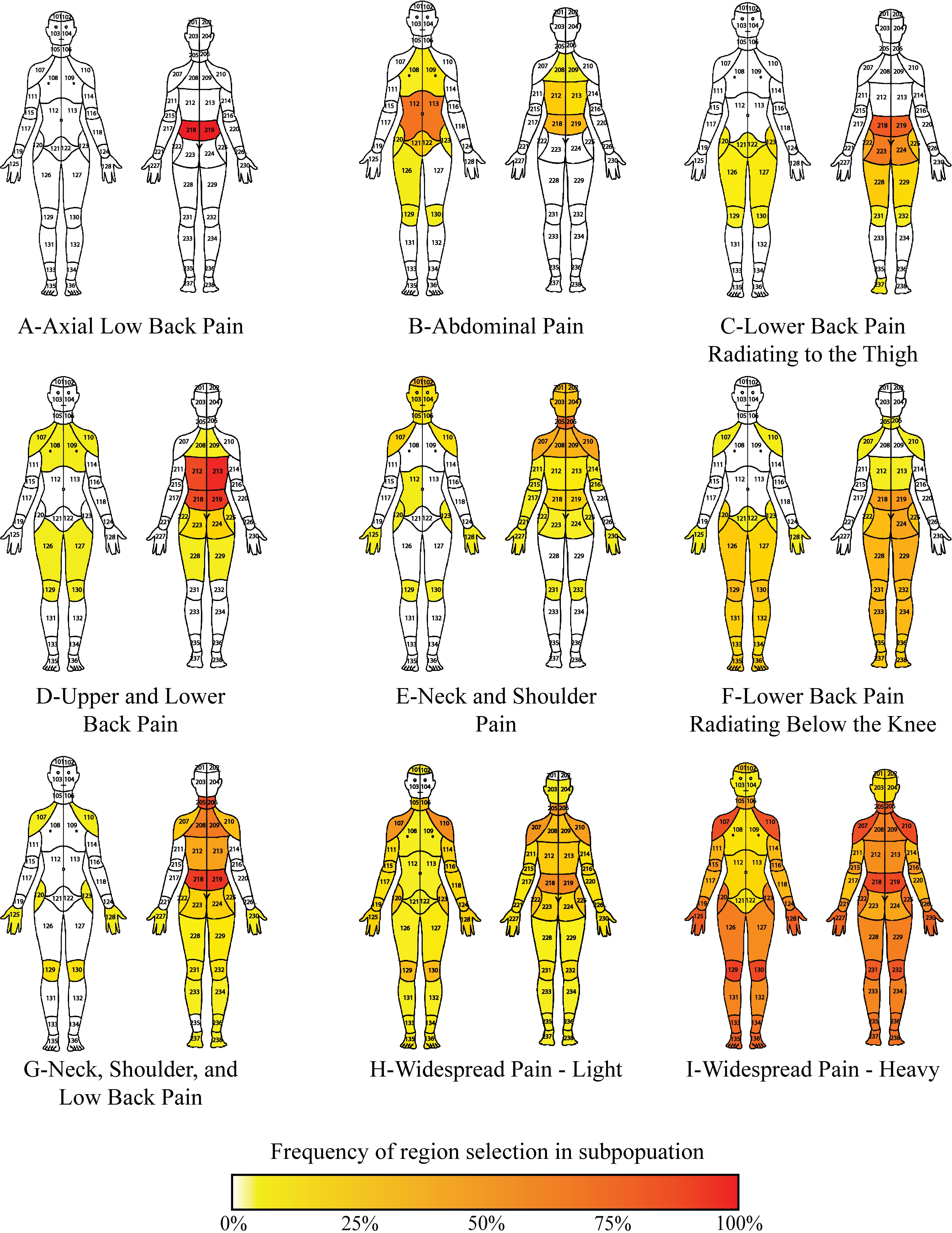
Body pain maps for each of the nine chronic pain clusters. with colored heat map indicating intensity of pain. ((Alter et al., PLOS One, 2021)

Above: Body pain maps for each of the nine identified chronic pain clusters, with colored heat scale indicating frequency of pain.

For example, while the group of patients experiencing lower back pain radiating below the knee (group F) had worse physical function difficulties than those experiencing neck and shoulder pain (E) or neck, shoulder and lower back pain (G), these patients reported less anxiety, depression, and sleep disturbance than the other two groups. 

A subset of over 7,000 patients completed a follow-up questionnaire, three months after filling out the initial body pain map and questionnaire. Patients experiencing abdominal pain (group B) showed the most progress, with almost half reporting significant improvement.

Those with neck, shoulder and lower back pain (group G), however, demonstrated the worst outcomes on follow-up, with only 37 percent reporting improvements. This group shared characteristics with the two widespread pain groups, causing the team to ponder if this subgroup may be an early stage in developing generalized, widespread chronic pain. The researchers recommend a long term study to monitor pain duration and stability over time within this group.

What's more, their findings that the more widespread the pain, the more persistent it is, are consistent with a recent MRI study in fibromyalgia patients that found the more widespread reported pain is on body maps, the more changes observed in brain connectivity around the pain-processing parts of the brain.

"A case can be made that reports of widespread pain collected with digital pain body maps are diagnostic of pathophysiological changes in pain processing," Alter and team suggest.

This ability for body pain maps to indicate likely patient outcomes could help identify patients at risk of poor outcomes even from their first pain clinic visit.
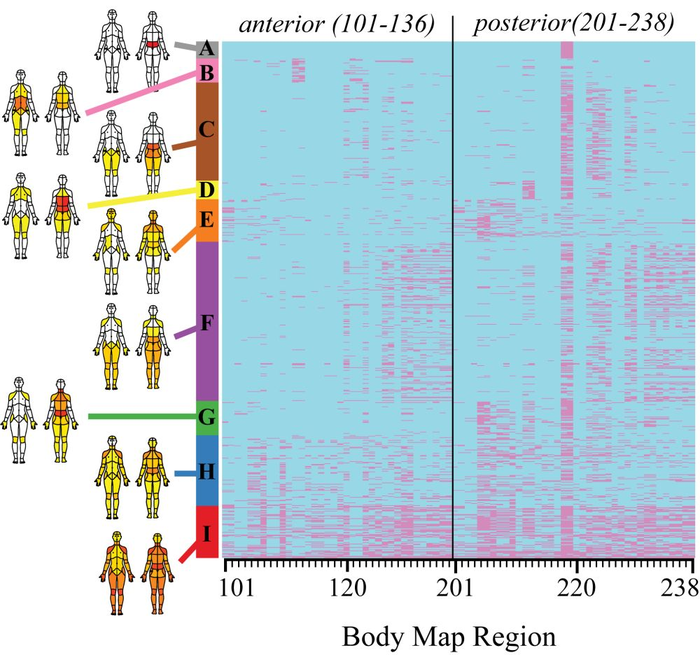
(Alter et al, Plos ONE, 2021)(Alter et al., PLOS One, 2021)

Above: each row on the vertical axis represents an individual patient out of the entire cohort (N = 21,658 unique patients) organized by pain body map cluster membership.

With up to 40 percent of adults in the US currently experiencing chronic pain - which is likely to increase with the potential impacts of long term COVID-19 - diagnostic tools such as this could make a massive difference in many people's lives.

There's still a lot of work to do to untangle all these relationships, and the researchers caution that this is an observational study so they cannot establish causation.

"Outcome data do not address specific therapies, and therefore, it remains unclear which specific treatment may be helpful for a particular body map cluster," they wrote.

However, Alter and team believe their study supports the idea that chronic pain is a disease process and these aspects of how its physical distribution manifests will be "important for future developments in diagnosis and personalized pain management".

This research was published in PLOS One.


Sunday, 13 May 2018

Virtual Reality has Benefits

Virtual Reality Can Bring Relief


Newswise — ITHACA, N.Y. – We’ve all enjoyed losing ourselves in a good book, but what if the story could change our lived experience? It may sound like science fiction, yet Andrea Stevenson Won uses a similar concept to study how virtual reality can treat real-life pain.

Virtual reality offers tantalizing hope as a way to relieve the anguish of physical and mental stress. For those dealing with acute pain, it can form a distraction for the mind. And for those suffering from trauma, it helps relive triggering situations in a supported way.

Won, assistant professor of communication at Cornell University, directs the Virtual Embodiment Lab, exploring how physical and social interactions in mediated environments affect people’s perceptions. “I’m interested in the idea that you can transform your movements – see yourself doing something other than what you’re actually doing in real life – and this could help relieve chronic and acute pain,” says Won.

Won’s research on chronic pain has examined two types of afflictions: complex regional pain syndrome, an uncommon form of chronic pain that typically develops after an injury, surgery, stroke or heart attack but that is out of proportion with the severity of the initial injury; and persistent idiopathic facial pain, a similar condition that occurs in the face.

Both of these maladies could be addressed by giving patients what they would receive under normal conditions: visual feedback on their actions. Using virtual reality, patients can see themselves moving in ways they can’t in real life, and their brains use that feedback to recreate their body image. According to Won, this “bogus” visual feedback can effectively change the way people with chronic conditions move. By tricking the brain with virtual experiences, the results could prompt lasting relief in the real world.

Virtual reality treatments for pain intervention,trauma and post-traumatic stress disorder have proven to be successful. Together with increasingly accessible technology and lower price tags, that success has inspired more researchers to explore ways to treat myriad conditions.
“For better or worse, our experiences change us,” says Won. “As virtual reality becomes a more common experience, there are more opportunities to use the technology to benefit our health.”
Cornell University has television, ISDN and dedicated Skype/Google+ Hangout studios available for media interviews. For additional information, see this Cornell Chronicle story.

Tuesday, 3 November 2015

Help for Chronic Pain Sufferers To Get a Good Night’s Sleep

Forget Counting Sheep - Therapy Could Help Chronic Pain Sufferers Get a Good Night’s Sleep

The above article caught my eye and promises a new therapy for Chronic Pain Sufferers.  It is always helpful to explore every avenue and every new method and each person must take from these findings what benefits them.

Sunday, 27 September 2015

Tinnitus and Chronic Pain - Secrets Revealed

 This article is interesting as several people I know suffer from Tinnitus. It highlights the issues surrounding Tinnitus.  Awareness is always the first step to understanding the problem and can lead to, in some cases, a cure.  None has so far been found for Tinnitus, sadly.


Neuroscientists Uncover Brain Abnormalities Responsible for Tinnitus and Chronic Pain

Friday, 24 April 2015

A Healthy Drink To Banish Aches And Pains

 As I am always looking for ways to give valuable information, this film caught my interest.  Juicing is one of the healthiest ways to look after your body and get all the nutrients of 5 a day.
  • The film chronicles eight people who collectively suffered from 22 different chronic diseases who were placed on a 28-day juice fast, with amazing results
  • All eight experienced weight loss, felt energized, and had a massive reduction in symptoms; one’s diabetes and another’s chronic pain completely resolved
  • Vegetable juicing is a powerful tool for enhancing your health, whether done daily or as part of a regular detoxification plan

 Healthy Drink

Tuesday, 14 January 2014

New Route for Better Brain Disorder Treatments

 Interesting new study conducted to find a new route for better Brain Disorder Treatments.  We are so fortunate that our Scientists are working to find solutions to all sorts of conditions so that illnesses and conditions can be treated much better and more effectively.

Solving a 40-Year-Old Mystery, Researchers Find New Route for Better Brain Disorder Treatments

I hope you enjoy the article.

Best wishes,
Adele Bantle
International Style Coach