Showing posts with label Insomnia. Show all posts

Saturday, 28 August 2021

5 Things You Should Never Do in the Evening

Good Sleep 


And what you can do instead.

Sinem Günel
 

Did you ever ask yourself why some people always seem to be well-rested and energized while you need a big cup of coffee to feel awake?

Or did you tell yourself that you’ll go to bed earlier but ended up glued to your phone to realize it’s past midnight and you’re still wide awake?

Well, you’re not alone. Surveys show that less than 50% of American adults get enough sleep and more than half of the sample said their sleep quality is poor or fair.

That’s partly because we spend our evenings on the wrong activities. We watch tv, order unhealthy foods, end up in arguments with our loved ones, and spend the last 30 minutes in bed scrolling through TikTok or Instagram feeds.

With all these routines being ordinary, it’s no surprise that most people feel drained instead of energized.

But the good news is that you can change the game. You can be one of those people who sleep with ease, wake up feeling refreshed, and spend their days happily and productively.

And most importantly, you don’t need to build dozens of new habits, take supplements, work out seven times per week, and be a super-human to take your life to the next level.

Changing the way you sleep and live often comes down to eliminating the subtle habits that might’ve been manipulating you for years or even decades.

Don’t try to get more done.

I never had a real “job.” I started my journey as an entrepreneur besides my studies and a full-time internship when I was 19 years old. Working late at night was normal as it was the only way to make progress despite my busy schedule.

And just until a few weeks ago, my office was my living room, which made it hard to set boundaries between private life and work.

As a result, I often ended up working late at night, even if I didn’t have to. It was just tempting to check emails or get a few more things done when I was sitting on the couch after a long workday.

This mostly happened because I measured my productivity by the hours I worked and items I crossed off my to-do list.

What happened is that I ended up being unproductive, ineffective, and unhappy.

The truth is, you can’t work productively when on the couch or in your bed anyway.

On top of that, taking your work-related problems to bed means you’re never fully able to detach and recover, but that’s exactly what we need.

According to Ruchir Patel, medical director of the Insomnia and Sleep Institute of Arizona, doing mentally stimulating activities in bed makes us believe that the bed is a place to stay awake and work.

This mental association makes it harder to fall asleep and rest well.

What to do instead:

The best thing you can do after a day of work is shutting down your devices and getting some rest.

Go outside and move your body. Cook yourself a nice, healthy meal. Read great books. Spend time with your loved ones, slow down, and take care of yourself.

Focus on resting well, so you can be more effective and efficient tomorrow, no matter how much you got done today.

The truth is, you’ll never be “done” with work, so you can also take some time to enjoy what matters most: life.

If you’re struggling to let go of your to-do list, try creating an end-of-work ritual.

After finishing the last task on your to-do list, follow a routine that tells your body and brain that you’re done.

For me, this includes preparing my to-do list for the next day, closing all applications and browsers, and cleaning up my desk.

That’s my “mental reset” at the end of a workday, no matter if I worked for 30 minutes or 8 hours.

Additionally, I often go on a walk or do some grocery shopping. Sometimes, I end up scrolling my Instagram news feed for an hour. You don’t need to be perfect to live a good life. Just give your best and take small steps to help you get closer to your desired lifestyle and results every day.

But make sure your laptop stays away from your bed.

Don’t let decision fatigue mess up with your life

If you ever tried to make a decision late at night and struggled, you experienced decision fatigue.

At the end of the day, our willpower is used up, and we’re mentally exhausted, even if we didn’t do any hard tasks. Rest is a natural part of life, and it’s not just about recovering our bodies but also our minds.

Think of your willpower as a battery. The more you use it, the more often you need to recharge it. But what most people don’t know is that we’re using our willpower all the time by making hundreds, sometimes even thousands, of decisions every day.

What to do instead:

If you want decision-making to be easy, don’t do it late at night. Instead, make important decisions throughout the day after taking a break, eating some healthy snacks, and feeling energized.

Don’t expect your mind to operate at 100 % after a full day of coping with this crazy thing called life.

Don’t order that pizza (but also don’t do that workout)

After a long day of work, it can be tempting to skip the cooking and order an XXL pizza, but the problem is that your body isn’t made for that late-night sin.

When you’re sleeping, your digestive tract is meant to rest as well.

You shouldn’t go to bed feeling hungry, but whenever possible, choose light and healthy meals for dinner. This will help you fall asleep easier and get uninterrupted sleep.

Similarly, start avoiding caffeinated drinks in the afternoon, and early evenings, so your body can digest the caffeine until bedtime.

Most people struggling with sleep problems aren’t aware of the fact that their afternoon coffees might be messing up with their sleep.

They consume too much caffeine, can’t sleep well at night, wake up feeling exhausted, drink a cup of coffee as soon as they get up, and end up in a doom loop of coffee and bad sleep.

Another common mistake is exercising late at night. Of course, you should move your body, but late evenings aren’t the best choice for a sweaty workout.

Getting your heart rate up late at night can cause struggles when trying to fall asleep, so it’s better to work out at least three hours before going to bed. This is particularly true for vigorous workouts such as HIIT, running, or heavy lifting.

Moderate intense activities such as yoga, swimming, or stretching, however, are fine up to an hour before bedtime.

What to do instead:

To sleep better and wake up more energized, avoid carb-heavy and fatty meals late at night. Instead, consume light and nourishing food. Whenever possible, eat dinner earlier instead of later, so your body has enough time to digest the food.

Make sure to avoid caffeine in the afternoon or evening. For better sleep, you could try herbal teas such as camomille, lavender, or mint.

Moving your body is important and good, but avoid excessive workouts close to bedtime.

If it’s late and you couldn’t work out yet, choose moderate-intensity activities such as a walk, swimming, or yoga and give your body enough time to calm down after the exercise.

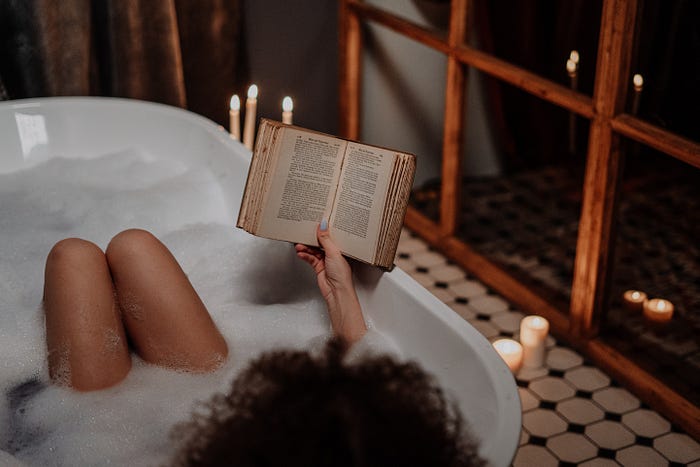
Photo by cottonbro from Pexels

Your brain is not a trash dump.

Growing up, the TV was always the center of our home. It was always on, whether we were eating, having guests over, or having arguments.

I even remember moments when Turkish series were running in the background while I was blowing out the candles of my birthday cake.

Back then, I thought this was normal. Looking back, it was horrible because our brains were constantly being bombarded with news (which are mostly negative) and nonsense information or entertainment.

If you want to live a good life, you need to be careful about the content and information you consume.

Staying up to date on world news is nice, but the truth is that watching the news before going to bed will likely make you feel anxious and worried, not well-informed.

Negative emotions before going to bed can strongly influence the quality of your sleep and rest. Whenever possible, stay away from watching the news or arguing with your partner late at night. And be careful about the information you consume in general. Life’s too short to be worried all the time.

“Your calm mind is the ultimate weapon against your challenges.”

— Bryant McGill

What to do instead:

Instead of bombarding your brain with negativity and fear, surround yourself with positive, uplifting content and people.

Spend your evenings doing something good for yourself and those around you.

Read books that make you feel good instead of bad. Do some stretching exercises. Take a relaxing bath. Listen to calming music or a guided meditation.

Life is busy anyway, so make some space for relaxation and good vibes when ending your days.

Repetition isn’t boring; it’s effective.

Strong routines are the backbone of a happy, productive, and successful life.

Without routines, you’ll waste vast amounts of your time wondering if you should do this or that.

Repetition doesn’t make your life boring. It makes everything easier. If you know exactly what you want to do in the evening, you’ll have more time and energy to think about all the other things in your life.

What to do instead:

Build an evening routine and stick to it on as many days of the year as possible. Don’t expect yourself to be perfect, but give your best to stay consistent.

Go to bed at the same time, follow the same end-of-work ritual, and do the same activities to calm down before going to bed.

View your habits as your superpower instead of treating them as a challenge.

Final thoughts

Doing the right things in the evening can influence all areas of your life.

A proper evening routine will help you feel more relaxed, be well-rested, take time for yourself, and enjoy the beauty and stillness of life, even when everything seems to be hectic.

A good life results from good habits, but most importantly, it’s about avoiding the harmful practices we’re often used to. As Mike Murdock once said:

“The secret of your future is hidden in your daily routine.”

If you’re serious about making a change in your life, start by avoiding the five sins each evening and watch your wellbeing, health, productivity, and happiness rise.


Monday, 25 November 2019

Valerian

For those of us with difficulty to have a good night's sleep.


Insomnia: Everything You Knew
Valerian is the herbal superstar for insomnia. Several studies prove that valerian safely helps you fall asleep faster and enjoy a better sleep. Double-blind research shows that valerian improves sleep in 89% of people and that 44% of them report perfect sleep.
How good is valerian? Valerian is better than the best drugs for insomnia. In one double-blind study, 600mg of valerian extract equalled the benzodiazepine oxazepam while being safer, and in another it beat it: while both treatments significantly improved sleep quality, the valerian was safer, and 82.2% of people with insomnia felt they had very good results with valerian while only 73.4% felt they did with oxazepam. A review of controlled studies of insomniacs found that nine out of twelve studies of valerian found improvement in at least one measure of sleep. According to the authors, there were severe design flaws in the three studies that didn't find a benefit.
Another reason valerian is the treatment of choice over drugs is that valerian doesn't cause the morning hangover that is so common with pharmaceutical sleeping pills.
The usual dose for valerian pills is 1.5-2g as a dried root or 150-300mg of valerian extract standardized for .8% valeric acid.
Valerian Combinations
Valerian combines really well with other relaxing herbs. One great herbal partner is hops. This potent combination will help you to fall asleep significantly faster, to wake up in the night last often and to feel more refreshed in the morning. The valerian/hops combination has not only proven itself against a placebo: it is as effective as benzodiazepines without leading to their withdrawal symptoms. Other studies have also shown the benefit of this herbal combo.
Valerian and hops can also be combined with passionflower. A double-blind study compared the three herb combo to the drug zolpidem in 78 adults with insomnia. The herbal dose was 300mg valerian extract standardized to .8% valerenic acid, 80 mg passionflower extract standardized to 4% isovitexin and 30 mg hops extract standardized to 0.35% rutin. Each person took one dose at bedtime. In both groups, time to fall asleep improved significantly and comparably. The two treatments both also significantly and comparably improved the amount of time they slept: the drug group improved from 3.5 to 5.7 hours, and the herb group had a slightly better improvement from 3.4 to 5.9 hours. The two treatments were also equally effective for significantly improving night time awakenings and quality of life.
Another good herb to combine with valerian is lemon balm. Double-blind studies prove that this combination works (1). It works as well as the drug Halcion without the daytime drowsiness and trouble concentrating that the drug causes (2).
More than Insomnia: Everything You Didn't Know
Insomnia & Menopause
Women going through menopause often struggle with insomnia: about 50% of menopausal women experience sleep disturbances. But a four week triple-blind study of 100 postmenopausal women with insomnia found that quality of sleep improved significantly more with valerian than with placebo. 30% of women in the valerian group had improved sleep versus only 4% in the placebo group. The dose was 530mg concentrated valerian extract twice a day.
When 100 menopausal women with sleep disturbances were given a placebo or a combination of valerian and lemon balm, there was significantly better improvement in sleep in the herbal group.
It may not come as much of a surprise that the greatest herb for insomnia can help menopausal women with insomnia. What is much more surprising is that valerian doesn't just help the insomnia of menopause, it helps the menopause.
A new triple-blind study gave a placebo or 530mg of valerian twice a day for two months to sixty postmenopausal women. Both the frequency and severity of hot flashes improved significantly more in the valerian group.
This is not the first study to show that valerian helps hot flashes. An earlier study of 68 women found that, when compared to placebo, 225mg of valerian given three times a day significantly reduces the frequency and severity of hot flashes. Hot flash severity dropped from 9.82 to 5.23 after eight weeks on valerian, while the placebo group only changed from 9.96 to 9.86. As for frequency, the valerian group improved from 7.91 hot flashes a day to only 4.83 while the women on the placebo went from 7.73 to 7.75.
PMS
And menopause is not the only problem that valerian can solve for women. A recent double-blind study gave women with PMS valerian extract or placebo. There was significant improvement on valerian but no improvement on placebo. Valerian was significantly better at improving PMS symptom severity. It significantly improved both emotional and physical symptoms.
Painful Periods
And that's not all. A double-blind study gave either a placebo or 255mg of valerian three times a day to 100 students. The valerian was given for three days beginning at the start of menstruation for two consecutive cycles. The valerian was significantly more effective at reducing menstrual pain.
Anxiety
The great sleep herb valerian is also as good as drugs for anxiety. When researchers compared valerian to benzodiazepines for insomnia, they found an unexpected result: it not only equalled the drug for insomnia, it also equalled it for anxiety and with fewer side effects. Combining valerian and passionflower is also effective (3).
Social Stress
Anxiety down, stress to go. Valerian, passionflower and lemon balm are all great herbs for relaxing. This double-blind study gave seventy men either a placebo or a combination of 90mg valerian, 90mg of passionflower, 60mg of lemon balm and 90mg of butterbur or no treatment for four days. The men were then subjected to a social stress test, consisting of a five minute oral presentation and a five minute mental subtraction activity while being taped in front of a live audience. Tests for self reported levels of stress revealed that the group on the herbs suffered significantly less stress than the other two groups.
OCD
Valerian may even be able to help people struggling with OCD. An eight week double-blind pilot study of 31 adults with OCD found that 765mg a day of valerian was significantly better than placebo at treating OCD (J Complement Integr Med 2011;8).
If you found this article interesting, join Linda and Ted's newsletter and get The Natural Path delivered to your in-box every month. The Natural Path is Your Guide to Good Health & Vitality: Cutting Edge Research Made Easy. Subscribe today, and get the latest research to keep you and your family healthy.
To learn more about ways Valerian may benefit your health, visit the GreenMedInfo database on the subject. 

Friday, 9 August 2019

Sleep Interrupted: What’s Keeping Us Up at Night?

Sleep Interrupted: What’s Keeping Us Up at Night?:

 Click the link above to see the full article!

 One of the largest longitudinal studies to date examined evening consumption of alcohol, caffeine and nicotine among an African-American cohort and objectively measured sleep outcomes in their natural environments instead of laboratory or observatory settings. The study involved 785 participants and totaled 5,164 days of concurrent actigraphy and daily sleep diaries that recorded how much alcohol, caffeine or nicotine they consumed within four hours of bedtime. Results may be good news for coffee lovers, bad news for smokers.

Monday, 2 October 2017

10 Ways To Fight Insomnia Naturally

10 Ways To Fight Insomnia Naturally

 Everybody suffers from insomnia at some time in their life.  This article can help get back to healthy sound sleep.


Sleep is a subject we talk about constantly in the office, yet we’ve never really addressed it here on the blog. This odd phenomenon is mirrored by our society at large: while sleep is obviously one of the foremost pillars of wellness, we tend to brush past the subject entirely. 

That’s why Dr. Preeti Devnani MD has dedicated her career to understanding and managing sleep disorders, as well as raising what she calls “Sleep Awareness” among the medical community and general public. “The science of sleep is extremely fascinating, and it’s clearly evident that we are still in the nascent phase of learning much about the various physiological aspects and the impact of sleep disorders on general health,” says Dr. Devnani. “Ideally a person must sleep from sunset to sunrise, optimizing the cumulative effect on the homeostatic and circadian drive for ideal physiology.

 In the modern era, we’re burning the candle at both ends. We’ve become a 24-hour society due to social and work stressors. We need to make a consistent effort to sleep at the same time and maintain a sleep and wake schedule. Recent studies have shown that dysregulation of this sleep cycle (or delayed sleep circadian phase) can have an adverse effect on the metabolic functions of the body.” You heard that right. Not getting proper sleep can even make you gain weight. Read on for Dr. Devnani’s 10 Commandments for Getting a Good Night’s Sleep, and fight your insomnia naturally.

Wednesday, 26 April 2017

The Effects Of Sleep Deprivation

The Effects Of Sleep Deprivation 

 Sleep deprivation can be dangerous to health.  Over a long period it undermines the Immune System and causes all sorts of health problems.


  • Even one night of too little sleep may lead to unwanted behavior at work the next day, such as acting rude toward co-workers, theft or going home early without notifying the boss
  • Poor sleep may make it harder for people to stop engaging in such behaviors, as well as to overcome feelings of failure when displaying the undesirable behaviors
  • Employees’ “misbehaving” at work adds up, to the tune of $200 billion a year in the U.S. alone

Tuesday, 3 November 2015

Help for Chronic Pain Sufferers To Get a Good Night’s Sleep

Forget Counting Sheep - Therapy Could Help Chronic Pain Sufferers Get a Good Night’s Sleep

The above article caught my eye and promises a new therapy for Chronic Pain Sufferers.  It is always helpful to explore every avenue and every new method and each person must take from these findings what benefits them.

Wednesday, 25 March 2015

Magnesium Deficiency

 Here is a helpful article about Magnesium deficiency.  This could help identify some symptoms you may bee having like cramp or sleeplessness.  Yesterday I posted an article about Food Cravings, well you may find some answers here:

Magnesium Deficiency

Friday, 11 April 2014

A Good Night's Sleep

 Sleep is as vital as food if not more so.  This article goes into a lot of details about sleeping patterns and how we can get a good night's sleep.  There are so many factors that prevent a healthy sleep.  It is also worth listening to your body in this.

 Among the findings, the review found that disruption of the body's natural sleep cycle—as experienced by shift workers—has a pronounced link with suffering metabolic health, as well as rates of chronic illness and early death."


Enough Sleep Can Help PreveSnt and Treat Metabolic Disorder

Thursday, 27 March 2014

Sleep Deprivation

 Sleep deprivation causes a dangerous state of being.  It can lead ot all sorts of complications as has been proved time and again.  In the article these complications are explained and hopefully can be rlemedied if this is what you or someone else suffers from.  It is said that sleep deprivation is more dangerous than lack of food.


How Dangerous Is Sleep Deprivation? | Lack of Sleep