Which sounds more urgent: "global warming" or "pollution blanket overheating planet"? In this actionable talk, communications strategist John Marshall explains why we need to rethink how we talk about climate change -- and offers small but mighty language adjustments to get people to more intuitively understand and care about this existential threat.
About the speaker
John Marshall · Environmental advocate, communications strategist
John Marshall is changing the way people talk about climate change so that we can better understand and act against it.
Showing posts with label carbon footprint. Show all posts
Showing posts with label carbon footprint. Show all posts
Saturday, 24 April 2021

Wednesday, 7 April 2021
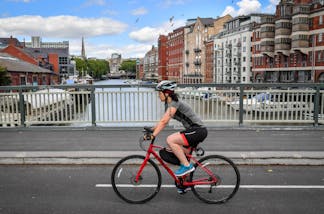
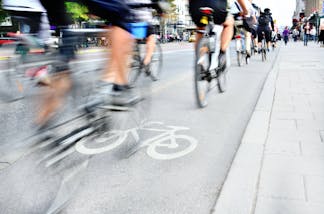
Cycling is ten times more important than electric cars for reaching net-zero cities

Globally, only one in 50 new cars were fully electric in 2020, and one in 14 in the UK. Sounds impressive, but even if all new cars were electric now, it would still take 15-20 years to replace the world’s fossil fuel car fleet.
The emission savings from replacing all those internal combustion engines with zero-carbon alternatives will not feed in fast enough to make the necessary difference in the time we can spare: the next five years. Tackling the climate and air pollution crises requires curbing all motorised transport, particularly private cars, as quickly as possible. Focusing solely on electric vehicles is slowing down the race to zero emissions.
This is partly because electric cars aren’t truly zero-carbon – mining the raw materials for their batteries, manufacturing them and generating the electricity they run on produces emissions.
Transport is one of the most challenging sectors to decarbonise due to its heavy fossil fuel use and reliance on carbon-intensive infrastructure – such as roads, airports and the vehicles themselves - and the way it embeds car-dependent lifestyles. One way to reduce transport emissions relatively quickly, and potentially globally, is to swap cars for cycling, e-biking and walking – active travel, as it’s called.
Fight back against disinformation. Get your news here, direct from experts
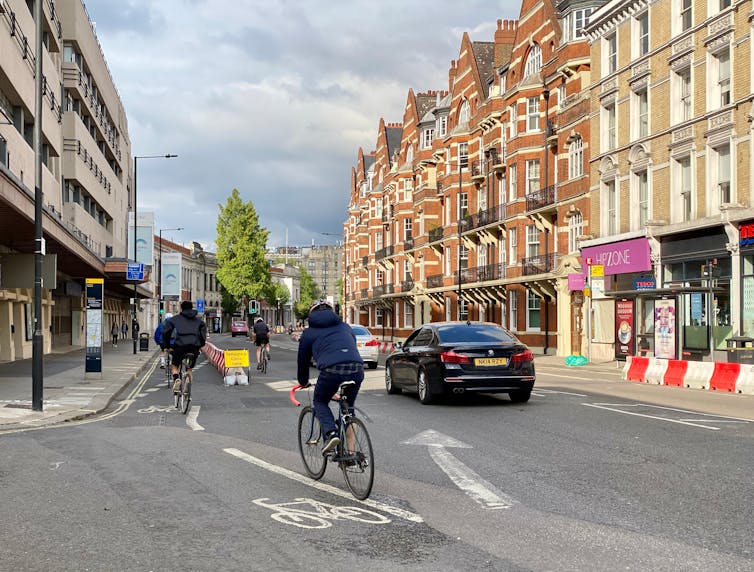
Active travel is cheaper, healthier, better for the environment, and no slower on congested urban streets. So how much carbon can it save on a daily basis? And what is its role in reducing emissions from transport overall?
In new research, colleagues and I reveal that people who walk or cycle have lower carbon footprints from daily travel, including in cities where lots of people are already doing this. Despite the fact that some walking and cycling happens on top of motorised journeys instead of replacing them, more people switching to active travel would equate to lower carbon emissions from transport on a daily and trip-by-trip basis.
What a difference a trip makes
We observed around 4,000 people living in London, Antwerp, Barcelona, Vienna, Orebro, Rome and Zurich. Over a two-year period, our participants completed 10,000 travel diary entries which served as records of all the trips they made each day, whether going to work by train, taking the kids to school by car or riding the bus into town. For each trip, we calculated the carbon footprint.
Strikingly, people who cycled on a daily basis had 84% lower carbon emissions from all their daily travel than those who didn’t.
We also found that the average person who shifted from car to bike for just one day a week cut their carbon footprint by 3.2kg of CO₂ – equivalent to the emissions from driving a car for 10km, eating a serving of lamb or chocolate, or sending 800 emails.
When we compared the life cycle of each travel mode, taking into account the carbon generated by making the vehicle, fuelling it and disposing of it, we found that emissions from cycling can be more than 30 times lower for each trip than driving a fossil fuel car, and about ten times lower than driving an electric one.
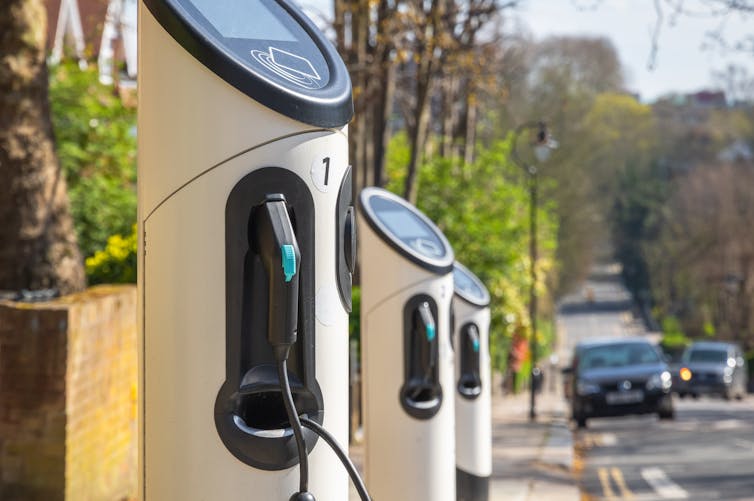
We also estimate that urban residents who switched from driving to cycling for just one trip per day reduced their carbon footprint by about half a tonne of CO₂ over the course of a year, and save the equivalent emissions of a one-way flight from London to New York. If just one in five urban residents permanently changed their travel behaviour in this way over the next few years, we estimate it would cut emissions from all car travel in Europe by about 8%.
Nearly half of the fall in daily carbon emissions during global lockdowns in 2020 came from reductions in transport emissions. The pandemic forced countries around the world to adapt to reduce the spread of the virus. In the UK, walking and cycling have been the big winners, with a 20% rise in people walking regularly, and cycling levels increasing by 9% on weekdays and 58% on weekends compared to pre-pandemic levels. This is despite cycle commuters being very likely to work from home.
Active travel has offered an alternative to cars that keeps social distancing intact. It has helped people to stay safe during the pandemic and it could help reduce emissions as confinement is eased, particularly as the high prices of some electric vehicles are likely to put many potential buyers off for now.
So the race is on. Active travel can contribute to tackling the climate emergency earlier than electric vehicles while also providing affordable, reliable, clean, healthy and congestion-busting transportation.
Democratic norms are being stress-tested all over the world, and the past few years have thrown up all kinds of questions we didn't know needed clarifying – how far should politicians be allowed to intervene in court cases? To monitor these issues as closely as we have in the past we need your support.
Laura Hood
Politics Editor
Saturday, 9 March 2019
Living the Change Documentary
Help Save The Planet
A documentary to shake up the way we live!
A documentary to shake up the way we live!
Story at-a-glance
- The Earth is in the midst of crises — social, environmental and economic
- At the heart is the overconsumption of resources, which is fueled by economics; the money system demands and compels endless growth, which necessitates the conversion of nature into property and products
- The documentary, “Living the Change: Inspiring Stories for a Sustainable Future,” makes clear that unsustainable growth is accelerating in a way that can’t be met by the natural resources available on the planet
- While it may seem hopeless, there are people pioneering change in their own lives and communities to further a more sustainable and regenerative way of life
- Everyone can participate in “Living the Change,” creating a healthier planet and stopping the inevitable destruction of ecosystems and loss of species that we’re currently seeing
- Most people would agree that we’re living in an age when the Earth is in the midst of crises — social, environmental and economic. At the heart is the overconsumption of resources, which is fueled by economics. The money system demands and compels endless growth, which necessitates the conversion of nature into property and products.
With growth, the economy keeps growing, but in order to grow, it needs more natural resources to support it. Plus, increasing interest causes people to work longer and harder to maintain the same standard of life, all the while overconsuming and contributing to the overexploitation of precious resources. It’s a vicious cycle that’s explored in-depth in “Living the Change: Inspiring Stories for a Sustainable Future.1
This documentary, directed by Jordan Osmond and Antoinette Wilson, makes clear that unsustainable growth is accelerating in a way that can’t be met by the natural resources available on the planet, but while it may seem hopeless, there are people pioneering change in their own lives and communities to further a more sustainable and regenerative way of life. As the film states, “The issues are global but many of the solutions are local.”
The Not-so-Green Revolution
At one time, all food was grown organically in concert with nature and surrounding ecosystems. This all changed with the Green Revolution, which sounds beneficial but actually describes the conversion of natural farming to one dependent on chemicals, fossil fuels and industry. “The Green Revolution led to oil revolution,” Living the Change added.
The Rockefeller Foundation funded the Green Revolution that led to the introduction of petroleum-based agricultural chemicals, which quickly transformed agriculture, both in the U.S. and abroad. Monoculture was the outcome, with a focus on monocrops, i.e., growing acre upon acre of only one crop at a time. The very definition of monoculture is a system of agriculture with very little diversity.
It defines the wide swatches of corn and soy being grown across the U.S. and worldwide. A whopping 35 percent of cereal and soy harvested globally is actually fed to animals being raised on CAFOs (concentrated animal feeding operations).2 Where you could once find locally grown food nearby, we’re now very much dependent on the industrial agriculture complex for our very sustenance.
As the film explains, our food production system is meant to save the world but is based on something that’s temporary and leading to a loss of biodiversity, like the collapse of insects. Diversity is crucial to survival. In the industrial system, farmers go to great lengths to protect food production systems, adding in fertilizers, pesticides, herbicides and other chemicals. But the system is actually very fragile and vulnerable.
For instance, we’re now hearing discussions of “peak phosphorus and potassium” in the way we discuss “peak oil,” and, according to some, we may soon be facing looming shortages of these two critical fertilizer ingredients.
As the film states, if supermarkets stop selling food for three days — how would you survive? What would you do? Many people would have nowhere to find food, which makes you begin to realize that the very food on your plate is dependent on many system that need to be in place for the entire chain to run smoothly.
But with the environmental issues and economic pressures at hand, “it’s easy to see how a bad situation could develop quickly … we need to quickly change our food system or there will be huge impacts on humans and the other animals on the planet.”
Technology Is Not the Answer
Many people are waiting for a new technological advancement to bail out the planet. But if technology could solve all of our problems, the film suggests, wouldn’t it have done so already?
Even green technology like solar panels, wind turbines and electric cars require fossil fuels at every stage of their production. “For these technologies to be part of the solution, those of us in the developed world need to drastically reduce our energy consumption.”
Leaving coal, oil and other natural resources in the ground and replanting forests that have been lost to deforestation is the path we should be on, but instead humanity is still clearing grasslands to plant monocrops like corn to make ethanol — a perfect example of the dichotomy of many “green” products and fuels.
There’s now so much corn grown in the U.S. that the Corn Belt (typically said to include corn grown across Indiana, Illinois, Iowa, Missouri and parts of Nebraska and Kansas) can be seen from space, courtesy of satellite chlorophyll-sensors.3
Unbeknownst to many, biofuels such as corn ethanol are not carbon neutral. In fact, they're associated with a net increase in carbon dioxide emissions; they're even worse than gasoline when the water need to grow corn is taken into account.
Research shows, instead, that ethanol-producing (i.e., corn) crops only offset 37 percent of carbon dioxide emissions produced by burning biofuels.4 Meanwhile, according to the Environmental Working Group (EWG), more than 8 million acres of grassland and wetlands have been converted to corn from 2008 to 2011, which released at least 80 million tons of carbon a year.5
Every time an acre of grassland is plowed, 60 tons of carbon dioxide are released into the environment.6 On the other hand, leaving grasslands as-is and adding in compost has the potential to significantly increase carbon sequestration.
But as it is, the planet is largely dependent on a system that requires fossil fuel inputs and will collapse without them. Globally, the world uses 95 million barrels of oil every day.7 Fossil fuels are used to produce clothing, plastics, food, electronics and everything in between. We’re at a point now where being sustainable isn’t just something that’s a nice idea — “being unsustainable is a threat to our species.”
Organic, Regenerative Agriculture to the Rescue
The filmmakers traveled to New Zealand, where they spoke to the owners of Wairarapa Eco Farms — an example of agriculture done right. They explain, as most regenerative farmers do, that they’re in the business of creating healthy soils — basically creating a habitat for the microorganisms therein, which then lead to healthy plants that support healthy animals.
A key difference at their Eco Farm and other regenerative farms is the move away from growing annual crops like grains and moving toward perennial agriculture, which incorporates annuals along with trees and animals like pigs, sheep, cows, ducks and geese.
The system operates on a closed-loop, such that external inputs like chemical fertilizers and pesticides are not needed. They also operate a community-supported agriculture program, or CSA, in which a group of people support the farmer. The farmer knows he has somewhere for his crops to go — they’re sold before they’re even grown as each member purchases a share.
In return, the people know they’re going to get a fresh box of produce each week, and there’s no food waste on the farm — they give out everything they produce to their members. We often hear that a plant-based diet or cutting out meat from the diet is the solution to feeding the world, but the film suggests that while eating less meat is important, cutting it out isn’t necessary.
In fact, you can’t have a healthy ecosystem without animals, and there’s a complex interplay between animals and plants that provides for the closed loop, for things like natural fertilization and pest control, to take place. The best solution is not to eliminate meat entirely but to seek out meat from farmers raising animals on pasture, according to the laws of nature — not against them, as in CAFOs.
Holistic Grazing to Rebuild the Planet
The documentary takes a close look at holistic grazing, a method popularized by Allan Savory, Zimbabwean ecologist and livestock farmer. Desertification has long been thought to be caused by livestock, such as sheep and cattle overgrazing and giving off methane. But, according to Savory, we have completely misunderstood the causes of desertification.
We've failed to realize that in seasonal humidity environments, the soil and vegetation developed with very large numbers of grazing animals meandering through. The constant movement of large herds naturally prevented overgrazing of plants, while periodic trampling ensured protective covering of the soil, helping to sequester carbon in the soil.
Similarly, Mark Shepard, founder of New Forest Farm, a 106-acre perennial “agricultural savanna,” stated that civilizations that depend on annual grain crops eventually collapse.
Instead, he follows a perennial agricultural ecosystem, the design of which combines brushland, woodlands and oak savannah, a type of grassland that also includes oak trees, to create the type of environment that might naturally occur.
Shepard describes it as a three-dimensional system that includes “a tree canopy layer, a smaller tree subdominant tree layer, shrubs, vines, canes, shade tolerant plants, ephemeral plants, fungi forage and livestock”8 all of which work together to naturally increase biodiversity and soil fertility.
Grazing animals, including cows, pigs, sheep, turkeys and chickens, are also part of the system, helping with grass, pest and brush control. These systems, whether you call them regenerative agriculture, holistic management, permaculture or something else, aren’t “magical,” the documentary points out, but rather are based on sound science:
“With regenerative agriculture, we can not only produce food, and produce an abundance of food, but we can do it in a way that regenerates the land, that replenishes the aquifers, that sequesters carbon, that nurtures and supports biodiversity.
[It’s based on] … having a point of view that is looking at your ecosystem in its entirety, not just individual aspects of it. So really what this breaks down to is that anyone who’s looking after land, whether you’re a farmer or a gardener, you’re an ecosystem manager.”
Breaking Free From Consumerism
The film follows the stories of people who broke free from the daily grind of consumerism, giving up high-pressure lifestyles and the constant drive to amass more things for lives more connected to nature, growing their own food and living sustainably.
While some have made drastic changes — giving up corporate jobs to live off the land — others take part on a smaller scale, by supporting small, local businesses. Some take part in “timebanking,” trading skills with one another at no cost and creating spaces to repair clothing, furniture, bikes and other products instead of throwing them away — and building a sense of community at the same time.
Others have focused on minimizing waste in their homes, cutting down on garbage, composting food scraps and paying attention to the way they shop, especially purchasing products with minimal or no packaging and avoiding throwaway or single-use items.
And therein lies the key, that everyone can participate in “Living the Change,” creating a healthier planet and stopping the inevitable destruction of ecosystems and loss of species that we’re currently seeing.
By choosing to buy locally crafted goods, food from small grass fed farmers and also growing some of your own, you’re making a difference for the better. By avoiding foods that come from CAFOs and cutting down on or eliminating excessive consumerism in your life, you stop some of the destruction from occurring while breaking free from an unsustainable system.
What’s more, the more people who choose to live this way, the less expensive and more attainable local goods and food will become. We all have a chance to help revive and recover our ecosystems before it’s too late. Start small if you need to — little by little, we can all make better, healthier choices that add up to major positive change.
Thursday, 19 April 2018
A Printable, Flexible, Organic Solar Cell
Saving Our Planet!
Unlike the solar cells you're used to seeing, organic photovoltaics are made of compounds that are dissolved in ink and can be printed and molded using simple techniques. The result is a low-weight, flexible, semi-transparent film that turns the energy of the sun into electricity. Hannah Bürckstümmer shows us how they're made -- and how they could change the way we power the world.
Sunday, 6 March 2016
Car Sharing For A Cleaner Environment
Car Sharing To Cut Emissions
I believe there are schemes for car sharing already in place but it could become even more widespread and is very important. We are not talking about short journeys once in a while. It is about people travelling to the same workplace from the same town each day, this is where car sharing would make so much sense.
The good news is that this scheme has had success and will surely be the way forward to cut emissions and create a better, healthier environment. Of course the other benefit is cost.
Subscribe to:
Posts (Atom)